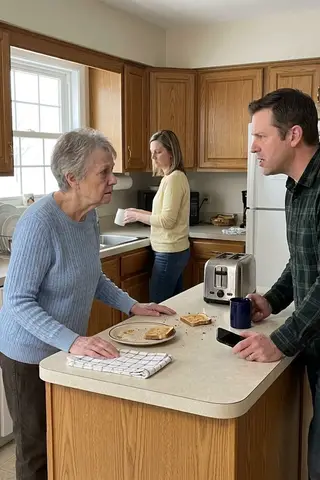
 Son Calls His Grieving Mother a Burden and Kicks Her Out
Chapter 4
The Third-Floor Suite
The third-floor guest suite was larger than the entire master bedroom in Bradley’s split-level house. It featured high vaulted ceilings with exposed oak beams, a massive brass-framed bed draped in hunter-green velvet quilts, and a private bay window that overlooked the sprawling, walled-in back garden.
For the first time in three weeks, I locked a door from the inside and didn't feel like an intruder.
I unpacked my meager belongings—the two sweaters, my church shoes, Charles’s worn gray cardigan, and the framed photograph from our trip to Lake Erie. I placed Charles’s photo carefully on the mahogany nightstand, right beside a reading lamp that didn't buzz or flicker. I hung his cardigan in the spacious walk-in closet, burying my face in the soft fabric for a long moment, breathing in the faint, comforting scent of cedar and old pipe tobacco that still clung to the wool.
You would love this place, Charles, I whispered into the quiet, vaulted room. They think they exiled me. But they just handed me the keys to the kingdom.
My duties began immediately that evening. Arthur Sterling turned out to be a creature of strict habits, yet surprisingly easy to care for. He didn't demand coddling or endless conversation; he respected quiet, appreciated competence, and possessed a dry, razor-sharp wit that kept me on my toes.
As we sat in his book-lined study after a simple dinner of roasted chicken and vegetable soup, Arthur thumbed through a worn leather-bound ledger while I knitted a scarf by the hearth.
“You move around this house as though you’ve lived here before, Eleanor,” Arthur observed suddenly, not looking up from his ledger.
My knitting needles paused mid-stitch. My heart skipped a single, betraying beat. I had been careful, or so I thought, keeping my movements deliberate and my expressions neutral.
“It’s a traditional layout, Mr. Sterling,” I replied carefully, forcing my voice to remain even. “Victorian architecture follows a very predictable blueprint.”
Arthur closed the ledger with a soft thud, placing it on the mahogany desk. He leaned back in his leather chair, steepling his fingers together as he fixed those piercing blue eyes on me once more.
“Victorian blueprints don't explain why you instinctively turned left toward the old solarium instead of right toward the kitchen when I mentioned tea this morning,” he said smoothly, a knowing smile playing at the corners of his mouth. “Nor do they explain why you didn't even flinch when I told you about the east wing’s structural quirk.”
I set my knitting down in my lap, looking back at him. There was no use hiding it anymore. The walls I had tried to build were crumbling under the weight of his intuition.
“My father was Thomas Vance,” I said quietly, the long-buried name slipping off my tongue like a foreign language I hadn't spoken in half a century.
Arthur’s eyes widened slightly, the sharp composure cracking for a single, stunned second. He leaned forward, gripping the arms of his chair.
“Thomas Vance,” he repeated, testing the name as if tasting bitter medicine. “The head groundskeeper who worked this estate for forty years. The man who... walked out fifty years ago after a bitter dispute with the family patriarch.”
“My grandfather,” I corrected gently. “And my father. When my father tried to marry outside the social bracket demanded by this house, your family fired him, stripped him of his pension, and blackballed him from every estate in the county. He swore we would starve before we ever set foot on this property again.”
The room fell dead silent. The fire crackled softly in the hearth, casting long, dancing shadows across the Persian rug. I braced myself for the dismissal, waiting for Arthur to tell me to pack my canvas suitcase and get out into the cold night air, to cast out the daughter of a disgruntled employee.
Instead, Arthur slowly stood up from his desk, walked over to the fireplace, and stared down into the flames.
“Your grandfather was a stubborn, arrogant fool,” Arthur said quietly, his voice devoid of anger, filled instead with a heavy, melancholic fatigue. “And my father was a tyrant who ruled this house like a feudal king. They broke families over pride and pedigree. I spent my entire life trying to dismantle the walls my father built, Eleanor. But some walls are built too deep.”
He turned around, looking at me with a profound, aching vulnerability.
“You aren't here by accident, are you?” Arthur asked softly.
“No,” I admitted, standing up to face him. “I came looking for a job to survive. But standing at this door... I think fate had a much sharper sense of humor than I did.”
The End









