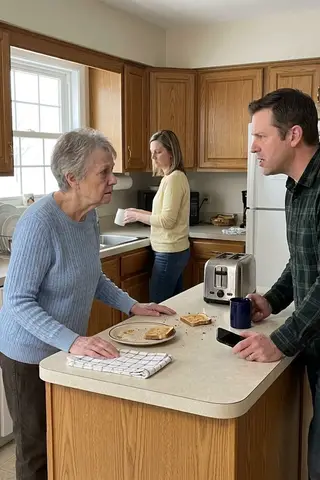
 Son Calls His Grieving Mother a Burden and Kicks Her Out
Chapter 1
The Cold March Wind
The crisp March air bit sharply at the edges of my wool coat, wrapping the suburban Ohio street in a biting chill that matched the numbness in my chest. Just twenty-one days after burying my husband Charles under a dishwater-gray sky, my son Bradley had stood in his immaculate kitchen, looked me dead in the eye, and told me I was a burden. He had told me to get a job or get out. His wife Melissa had stood by the sink, hiding behind her polished nails and muttering something sterile about "boundaries."
They thought they were pushing an old, broken widow out into the bitter cold with nowhere to turn. They assumed I would fold, that I would beg, or that I would quietly shrink away into some miserable corner of the world. They had no idea that the very street they thought was my end was actually the beginning of something monumental.
As I walked down the concrete sidewalk, my old canvas suitcase bumping rhythmically against my knee, the weight of forty-one years of marriage settled heavily on my shoulders. Charles was gone. The man who had held my hand through every storm, who had kept a ten-dollar bill tucked inside his old black leather Bible for emergencies, was lying beneath six feet of damp Ohio earth. And the son we had raised, the boy I had stayed up with through fevers, college applications, and heartbreak, had traded his filial loyalty for mortgage convenience and a quiet house.
I didn't cry. Tears are for people who are surprised by cruelty; I wasn't surprised. I was simply empty. But emptiness, I discovered as the school buses rumbled past and the smell of neighborhood laundry drifted through the air, has a strange way of clearing the mind. When you have already lost the love of your life, losing a split-level house with a noisy treadmill and ungrateful children loses its sting.
I made my way to the downtown public library, its heavy brick architecture offering a brief sanctuary from the biting wind. At a computer terminal that groaned and stuttered with every keystroke, I pulled up local job listings. Cashier, greeter, overnight stocker, housekeeper—my eyes scanned the meager options for a seventy-year-old widow. Then, a small, unassuming classified ad caught my eye: Companion caregiver needed for elderly gentleman. Light meals, medication reminders, quiet household. Immediate start.
An address was listed in the historic district on the north side of town—a neighborhood of grand old homes with deep lawns, mature oak trees, and wraparound porches that whispered of old money and deep secrets. I copied the address onto the back of a grocery receipt, pulled Charles’s ten-dollar emergency bill from my coat pocket, and paid my bus fare across town.
When the bus dropped me off two miles away, I hoisted my canvas suitcase and walked the remaining blocks. The air grew quieter here, the houses grander, their brick facades and slate roofs standing like silent sentinels of a bygone era. I checked the scrap of paper, counting down the house numbers until I reached the wrought-iron gate of number 412.
I stopped dead in my tracks. My breath hitched in my throat.
I knew the slope of those concrete steps. I knew the heavy brass lion-shaped knocker glinting dully in the afternoon sun. Most unmistakable of all, I knew the intricate blue-and-amber stained-glass window set into the heavy oak front door, casting jewel-toned patterns across the welcome mat.
This was not a house I had simply passed once or twice. This was a house etched deeply into the forbidden history of my bloodline. And when I looked toward the brass mailbox near the gate and read the polished nameplate bearing a surname the world thought had vanished forever, fifty years of absolute silence came rushing back like a tidal wave.
The End









