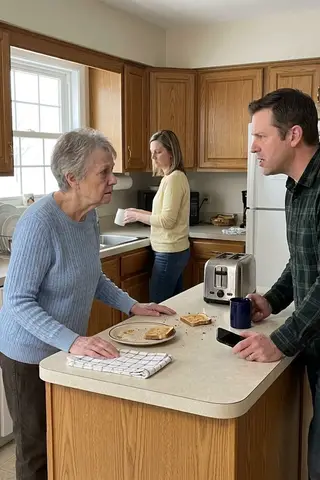
 Son Calls His Grieving Mother a Burden and Kicks Her Out
Chapter 2
The Lion’s Knocker
Standing frozen before the grand oak doors of number 412, the bitter March wind seemed to die down, replaced by a roaring silence in my ears. Fifty years. Half a century of silence, strict edicts, and carefully guarded shame had been built around this house like a medieval fortress. My father had sworn on his deathbed that our branch of the family was dead to this place, that the sins of the past had severed every tie, and that we were to starve before we ever sought mercy from the name engraved on that brass mailbox.
Yet here I stood—a seventy-year-old widow, freshly evicted by my own ungrateful son, clutching an old canvas suitcase and a grocery receipt with a job listing.
My hand trembled as I reached out and lifted the heavy brass lion-shaped knocker. It felt cool and heavy against my palm, exactly as I remembered it from the day I had snuck past the iron gates as a terrified teenager, before my father dragged me away and locked the door on our heritage forever. I let it fall once. Thud-thud. The sound echoed hollowly through the cavernous porch, vibrating straight down into my tired bones.
For a long moment, nothing happened. I wondered if the house was empty, if the elderly gentleman described in the classified ad had passed away, or if I should simply turn around and walk back out into the cold. But just as I shifted my weight to leave, the heavy oak door clicked.
The lock turned with a smooth, expensive mechanical whir, and the door swung inward.
Standing in the grand entryway was a man in his late seventies. He wore a crisp tweed vest over a white button-down shirt, silver hair brushed back neatly from a sharp, aristocratic face. But it was his eyes that caught me—pale, piercing blue eyes that held an unmistakable flash of imperious authority, softened only slightly by the deep lines of profound exhaustion and age.
He looked down at me, taking in my sensible walking shoes, my faded winter coat, and the battered canvas suitcase sitting on the porch mat.
“Can I help you?” his voice was deep, resonant, and clipped with the crisp cadence of a man used to giving orders that were executed immediately.
I swallowed hard, my throat dry as sandpaper. Fifty years of family dogma screamed at me to turn around, to run back to the anonymity of the streets, to let my son Bradley wonder what happened to the mother he threw away. But survival—and a sudden, fierce surge of defiant pride—stiffened my spine.
“I’m Eleanor,” I said, my voice steady despite the tremor in my hands. “I’m here about the companion caregiver position.”
The old man’s eyebrows shot up, a flicker of surprise crossing his sharp features. He looked past me toward the empty street, then back down at my worn suitcase.
“An agency sent you?” he asked, folding his arms across his tweed vest.
“No,” I replied, looking him straight in the eye without blinking. “I found the ad at the public library. I saw the address, and I walked here.”
He stared at me for a long, agonizing beat. I could see the analytical gears turning behind those sharp blue eyes, calculating, weighing, assessing. In his world, people didn't walk to interviews with suitcases in tow. People didn't show up at a historic estate looking like displaced refugees from a suburban split-level.
“You have a suitcase, Mrs...” he paused, waiting for my last name.
“Eleanor Miller,” I said, deliberately omitting the maiden name that would have sent shockwaves through this house fifty years ago. “And yes, I have a suitcase. Because as of this morning, I don't have a home.”
A slow, complex expression flickered across the old man’s face—something that looked suspiciously like a mixture of wry amusement and deep, shared bitterness. He stepped back, swinging the heavy oak door wide open, revealing a sweeping mahogany staircase and crystal chandeliers that caught the afternoon light filtering through the stained-glass window.
“Well, Eleanor Miller,” the old man said, a faint, dry smile touching the corners of his mouth. “It appears we both have a surplus of baggage. Come inside before you freeze. Let’s see if you can actually make yourself useful.”
The End









