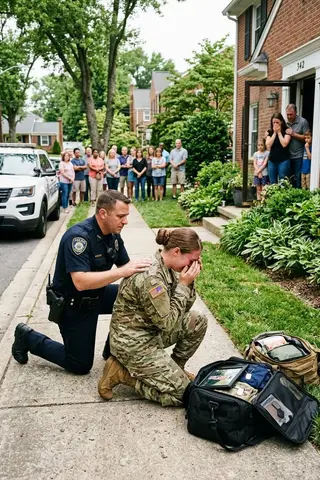
 "She’s An Escaped Convict!" Parents Call 911 When Their Deployed Soldier Daughter Returns Home In Uniform
Chapter 2
The Mailman’s Ledger
The street froze. A bicycle resting against Mrs. Ellis’s front fence had its front wheel still spinning lazily, emitting a faint, rhythmic whir-whir-whir that sounded unbearably loud in the sudden vacuum of sound. A stray dog barked once down the block, then cut itself off as if sensing the electric tension in the air. The news producer lowered her phone, her eyes darting between my dust-covered boots and the tightly shut front door of my childhood home.
No one dared to move. The weight of my parents' absolute authority over this small town hung over the pavement like a toxic fog. For years, my mother had woven a tapestry of subtle hints, prayer requests for my "troubled soul," and dramatic tears by the church coffee urn. Everyone here had pitied them. Everyone had offered casseroles of sympathy for the burden of their wayward daughter.
Then, the mail truck door creaked.
Mr. Greer climbed out onto the pavement. He wasn't wearing his postal uniform hat, and his white hair stood up in tufts where his fingers had dragged through it. In his hands, he carried a heavy, rubber-banded brick of manila envelopes and official USPS pink slip notices. His knuckles were white, his posture rigid with an indignation that had been brewing for forty-eight months.
"That girl wrote home every single month," Mr. Greer’s voice boomed across the silent lawn, cracking with emotion but holding firm. "I handled her mail. When her parents handed the letters back to me marked 'Refused—Return to Sender,' I started forwarding them directly to her unit chaplain’s office in Colorado so she wouldn't lose touch with home. I have the postal refusal notices. I have the postmarks. APO Kuwait, Fort Carson processing, combat pay receipts—every single one of them!"
A collective intake of breath swept through the crowd. Mrs. Ellis lowered her hand, her gaze locking onto the stack of papers in the mailman’s weathered hands.
For half a second, my mother’s carefully sculpted expression of grief fractured. The mask slipped, revealing something raw, ugly, and entirely devoid of maternal warmth: pure, unadulterated rage. She realized in that instant that her narrative had slipped out of her control.
Inside the house, a muffled thud echoed through the wood. My father grabbed my mother by the elbow, yanking her violently backward away from the sidelight window. A heavy deadbolt slammed home with a metallic echo. Then another. And a third. Each lock dropping into place sounded like a slammed door on thirty years of family history.
From behind the barricaded oak door, my father’s voice roared with vicious spite: "If she wants the truth so badly, show them what she buried in the back room!"
Before Sheriff Daniels could process the command, a sharp crash came from the second-story bedroom window. The glass rattled violently as the wooden sash flew open.
A heavy, black canvas duffel bag came hurtling through the air, dropping straight down onto the porch boards with a dull, heavy thud that kicked up a small cloud of dust. Stenciled across the side in bold, faded block letters I had painstakingly drawn with a laundry marker before basic training were the words: EMILY PARKER.
My knees buckled slightly, but I caught my balance against the fender of the mail truck. That was the bag I had packed the morning I left for basic training four years ago. Inside it were items I thought had been lost forever: extra wool socks, a faded photograph of my grandmother smiling on a porch swing, my old high school track jacket, and a small, cracked St. Michael’s medal Mr. Greer had slipped into my palm on my final postal route. I hadn’t laid eyes on that bag since my parents drove me to the bus station while refusing to look me in the eye.
Sheriff Daniels rested a hand on the holster of his service pistol, his professional demeanor tightening. "Everybody back up. Step away from the porch."
"Open it!" my father screamed through the closed front window. "Show them what kind of trash she left behind when the police came for her the first time!"
Mr. Greer stepped toward me, placing a gentle, trembling hand on my shoulder. "Emily, don't look. Let the deputies handle it."
I didn't blink. I kept my hands raised, palms open, completely transparent and unafraid. "Let them open it, Sheriff. There's nothing in that bag that belongs to a criminal."
Sheriff Daniels mounted the front porch steps in two long strides. He knelt beside the heavy black canvas. The brass zipper was pulled halfway open, jammed against a thick fold of fabric. With a firm tug, the zipper parted the canvas with a harsh, tearing sound.
Something heavy and metallic slid out of the opening, clattering loudly against the wooden porch boards.
A folded piece of paper fluttered out right behind it, catching the afternoon breeze before landing face-up at the sheriff's boots. Sheriff Daniels bent down, picked up the paper, and read the bold heading stamped across the top. As his eyes scanned the text, his expression shifted from official caution to absolute, unmitigated shock.
The End









