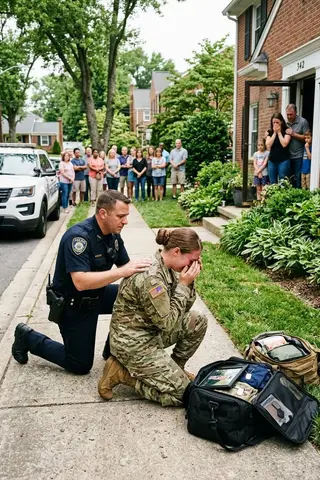
 "She’s An Escaped Convict!" Parents Call 911 When Their Deployed Soldier Daughter Returns Home In Uniform
Chapter 1
The Weight of a Locked Door
The air inside Mr. Greer’s mail truck smelled of stale coffee, old paper, and the sharp, metallic tang of anxiety. Through the cracked windshield, the white-paneled house with its familiar blue shutters looked pristine, almost blinding under the harsh afternoon sun. It was the house I had carried in my mind through four years of dust storms, rocket attacks, and 3:17 a.m. satellite phone calls. But as the police cruisers pulled up with sirens wailing and gravel flying, that house transformed into a fortress built of deception.
Mr. Greer’s hands trembled against the steering wheel. For four years, he had been my silent lifeline. While my parents told neighbors, teachers, and Pastor Ray that I was serving time in a federal penitentiary for "terrible choices," Mr. Greer knew the truth. He had seen every APO return address, every military dispatch, and every official stamp from Kuwait and Fort Carson. When my mother refused my letters, tossing them back into the mail stream like trash, Mr. Greer didn't let them vanish. He kept meticulous logs, rubber-banding the postal refusal notices beneath his kitchen calendar.
"Don't get out of the truck," he whispered, his voice cracking. "Your mother just called 911. She told them an escaped convict is standing on her lawn."
The heavy click of the truck door locking felt like a judge’s gavel slamming down. My fingers rested tightly on the canvas strap of my duffel bag. My uniform collar chafed against the sunburned skin of my neck, and the seams of my combat boots still held a powdery trace of desert sand. My DD-214 discharge papers rested securely in my chest pocket, right beside my military identification card. They were legal, irrefutable proofs of service. Yet, standing outside the home where I grew up, I realized a uniform could prove I was in the Army, but it couldn't instantly undo four years of carefully orchestrated poison.
My parents were masters of performative piety. My mother possessed a rare talent for turning a calculated sigh into a spiritual sermon, while my father stood beside her, projecting solemn dignity with a heavy hand on her shoulder. When I enlisted at twenty-one, desperate for their approval and hoping to carve out a respectable future, I handed them my emergency contact forms, my APO address, and my complete trust. They used every single piece of it to write me out of existence. Keeping me "overseas in prison" was far more convenient for their social standing than having a daughter in a combat zone who might require public anxiety or pride. It eliminated awkward questions at church bake sales and kept their pristine reputation untarnished.
Now, the consequences of their cruelty were converging on the front lawn. Three police cruisers blocked the street. Neighbors emerged onto their porches in housecoats and slippers; teachers from my high school stared in disbelief; women from the local parish gripped their aprons; and Pastor Ray stepped off the curb, clutching a black-bound Bible flat against his chest like a shield. Last to arrive was the local news van, its side door sliding open before the tires had even finished rolling.
Sheriff Daniels stepped out of the lead cruiser, his hands raised in a calming gesture. "Ma'am, I need everyone to stay calm and step back!"
My mother’s voice pierced the heavy silence, carrying across the lawn with theatrical precision. "Emily, please don't make this worse! We've suffered enough because of you!"
The cameraman adjusted his lens, swinging the heavy apparatus directly toward the passenger window of the mail truck. My stomach plummeted, replaced by a cold, steady fury—a clean, sharp emotion that kept my hands completely steady. I opened the truck door, stepping down onto the sun-baked asphalt.
"I am Sergeant Emily Parker," I called out, my voice splitting slightly down the middle. "I just finished a four-year military deployment. I am not a criminal."
The crowd shifted nervously. Mrs. Ellis, my fifth-grade teacher, raised a hand to cover her gasping mouth. Pastor Ray took one hesitant step forward before freezing. A neighbor hiding behind the safety of a mailbox whispered loud enough for the microphone to catch: "But... her mother said she was in prison."
I reached into my breast pocket, my fingers brushing the crisp edges of my military ID. "Sheriff, please, check my documentation. Look at my orders."
Before my fingers could close around the card, my father’s roar echoed from behind the closed front door. "Don't touch anything she gives you! She's a violent liar!"
The End









