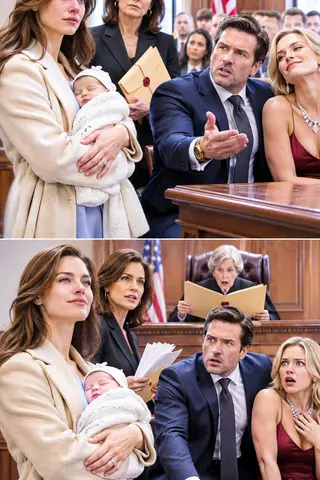
 She Walked Into Court 6 Days Post-C-Section With Her Newborn
Chapter 91
The Old Montreal Safehouse
The rain had washed the cobblestones of Old Montreal until they shone like wet slate under the gas lamps. Our private convoy moved through the narrow corridors of Rue Saint-Paul, past centuries-old grey-stone facades and wrought-iron balconies, before slipping quietly into the secure underground courtyard of the Hôtel Le Saint-James.
Evelyn Cross carried a sleeping Lily upstairs to our private suite, guarded by our executive security detail. I watched them disappear into the elevator with a mother's fierce, protective instinct. Every step I took on this foreign soil was designed to ensure that no shadow from the Whitmore past would ever cross the threshold of my daughter’s life.
In the suite’s private conference salon, Marcus Vance and David Chen were already spreading tactical maps and Quebec legal codes across a mahogany dining table. Waiting for us was Maître Jean-Paul Tremblay, our senior Montreal barrister. Tremblay was an imposing man in his late fifties with silver hair, an impeccably tailored three-piece charcoal suit, and the calm, predatory stillness of a seasoned litigator who had spent thirty years commanding the Quebec Superior Court.
"Madame Vane," Tremblay greeted me in a rich, gravelly baritone, bowing slightly over my hand. "It is a privilege to stand with you. Your reputation precedes you across the border. What you accomplished in Albany and London is being taught in civil law faculties across the province."
"Thank you, Maître Tremblay," I said, taking my seat at the head of the table. "I understand Gabriel Croft has moved quickly."
"More aggressively than we anticipated," Tremblay nodded, sliding a blue-backed legal brief across the polished wood. "At five o'clock yesterday, Croft’s counsel filed an emergency petition for an *ordonnance de sauvegarde*—an emergency safeguard order—under Article 509 of the *Code de procédure civile*. He is asking Justice Sylvie Archambault to order the immediate opening of Vault 7-B tomorrow morning at nine-thirty. His petition asserts that Croft Sovereign Capital’s Canadian affiliate, Laurentian Sovereign Partners, is the sole residual beneficiary of Arthur Whitmore’s 1944 Bretton Woods maritime deposit."
"And the motion to seal?" Marcus asked, leaning in.
"Justice Archambault granted it *pro tempore*," Tremblay replied. "The hearing will take place behind closed mahogany doors in Chambers 3.12 at the Palais de justice. No reporters. No public gallery. No open record until the judge signs the decree."
David pulled open his laptop, turning the screen toward us. "Croft thinks he’s being clever. He filed an affidavit of service claiming that notice was served on the Whitmore estate by registered mail to an abandoned PO Box in Charlotte, North Carolina. He timed the mailing so the return receipt wouldn't bounce until forty-eight hours after the hearing concludes. By then, he plans to have twelve metric tons of gold bullion loaded onto heavy transport trucks bound for a private refinery in Val-d'Or."
"Twelve metric tons," I murmured, studying the 1944 custody receipt David had illuminated on his screen. "Eight hundred million dollars in sovereign gold, minted with the United States Treasury’s wartime seal and earmarked for the reconstruction of displaced families after the Second World War."
"Croft’s claim rests entirely on a single document," Tremblay explained, tapping the paper. "A purported 1944 Bretton Woods Assignment Protocol, allegedly signed by Arthur Whitmore and witnessed by a Canadian notary named Émile Bouchard. Under Quebec civil law, an authentic act signed before a notary carries almost absolute evidentiary presumption under Article 2818 of the *Code civil*. Unless we can prove *faux criminel*—criminal forgery—the court is obligated to honor the instrument."
"Arthur Whitmore never executed a valid assignment in Canada without an offshore contingency clause," I said, cold precision sharpening every word. "And he never acted alone. David, what did you find on Émile Bouchard?"
David grinned, his eyes gleaming with the triumph of an auditor who has found the fatal discrepancy. "Émile Bouchard was indeed a licensed Quebec notary in 1944. But here is the problem Gabriel Croft overlooked: Bouchard was hospitalized with severe pneumonia at the Hôtel-Dieu de Montréal from July 12 to August 3, 1944. The Bretton Woods conference concluded on July 22. The protocol Croft submitted is dated July 20, 1944—stamped with a notary seal in Old Montreal while Bouchard was in an oxygen tent three miles away."
Marcus smiled, a predator scenting blood. "And what about the physical ink?"
"David sent an encrypted request to the Royal Canadian Mounted Police forensic science laboratories in Ottawa two hours ago," I said calmly. "We obtained a high-resolution spectral scan of Croft's filed probate exhibit from the court clerk's digital archive. What did the spectrometer reveal, David?"
"Synthetic blue phthalocyanine dye," David answered quietly. "A modern ballpoint formulation invented in 1954 and popularized in Canadian legal offices in the late 1960s. The document wasn't signed in 1944. It was manufactured in the 1970s by Arthur Whitmore as a fraudulent contingency asset—and Gabriel Croft just walked into court with a stolen, backdated instrument."
Tremblay leaned back in his chair, a slow, appreciative smile spreading across his weathered face. "Under Quebec law, uttering a forged authentic act before the Superior Court is an automatic indictable offense under Section 366 of the Criminal Code of Canada. Gabriel Croft believes he has locked the doors to keep the world out."
"He didn't lock the world out," I said, opening my leather briefcase and placing the ancient obsidian and gold Vane Admiralty Seal onto the center of the table. "He locked himself in a cage with the rightful owner. Tomorrow morning, we close the door."
***
The End









