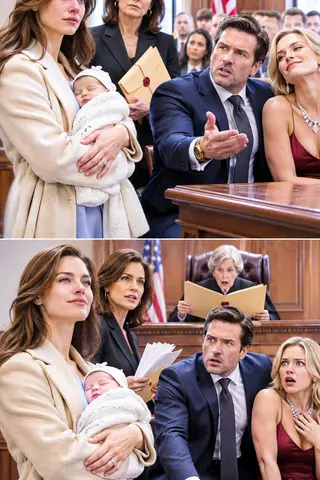
 She Walked Into Court 6 Days Post-C-Section With Her Newborn
Chapter 43
The Paper Fortress
The ornate courtroom of Judge Horace Caldwell on the twenty-second floor of the Daniel Patrick Moynihan United States Courthouse felt like a mausoleum of antiquated privilege. Dark oak wainscoting rose twenty feet toward coffered ceilings, and heavy velvet curtains framed the towering windows.
Sitting at the plaintiff’s table was Donald Blackwood himself.
He was a man in his early seventies, impeccably groomed, with slicked-back silver hair, cold reptilian eyes, and a tailored double-breasted Savile Row suit. Beside him sat a phalanx of six partners from one of Wall Street's most ruthless litigation defense firms, their briefcases spilling over with indexed binders.
When Marcus and I walked through the swinging wooden doors, Blackwood did not turn his head. He merely smiled with thin, patrician disdain, whispered something to his lead counsel, and adjusted his solid platinum cuff links.
"All rise!" the bailiff barked.
Judge Caldwell emerged from behind the heavy velvet curtain. He was a frail-looking man in his late seventies with rheumy eyes and an expression of perpetual irritation. He sat down behind the bench, shuffled through Blackwood’s papers, and peered down at us over gold-rimmed bifocals.
"Counsel, we are here on an emergency application for an immediate preliminary injunction and appointment of an equity receiver in *Apex Sovereign v. Eleanor Vane Global Endowment*," Caldwell intoned, his voice raspy. "I have reviewed plaintiff’s submissions. The debenture appears facially valid and duly recorded. The encumbered real property represents substantial value that may be dissipated if construction continues."
Blackwood’s lead counsel, a sharp-featured litigator named Jonathan Vance—no relation to Marcus—rose immediately.
"Your Honor," Jonathan Vance said smoothly, "Apex Sovereign holds a valid, perfected three-point-two-billion-dollar secured debt claim. Madame Vane’s non-profit has begun pouring concrete and encumbering parcels that belong to our client under a senior covenant. We ask for an immediate injunction halting all work, freezing the endowment’s accounts, and compelling Madame Vane to submit to an immediate forensic deposition regarding the commingling of foreign trust assets."
"Madame Vane’s counsel," Caldwell droned, looking down at Marcus. "Do you have any coherent legal answer to why this court shouldn't enter the injunction right now?"
Marcus stepped to the lectern, perfectly composed. "Your Honor, we do. More than an answer, we have an absolute defense founded upon criminal fraud. I yield our presentation to Clara Vane, Sovereign Protector of the Endowment."
A sharp murmur rippled through Blackwood’s legal team. Caldwell frowned deeply. "Madame Vane is a named party, Mr. Vance, not licensed counsel."
"I am appearing as the fiduciary trustee and sovereign conservator of the estate, Your Honor," I spoke, stepping beside Marcus and placing a single, slender black leather portfolio flat on the wood. "Under Federal Rule of Civil Procedure 65, an ex parte injunction requires an indisputable showing of likelihood of success on the merits. The plaintiff’s claim is not only meritless—it is a criminal forgery."
Blackwood’s face darkened instantly. "Your Honor," his counsel interrupted loudly, "this is insolence and slander!"
"Let her speak, counsel," Caldwell muttered, his curiosity reluctantly piqued. "What proof of forgery do you have, Madame Vane?"
"David," I signaled quietly.
David stepped forward and handed four certified document exhibits directly to the court clerk.
"Exhibit A," I announced, my voice cutting through the room with forensic clarity. "The 1988 debenture submitted by Apex Sovereign purports to have been notarized on October 14, 1988, by an official named Brenda Miller. We have submitted the official New York Department of State Licensing Division records. Brenda Miller did not take the notary oath until August 22, 1991. The document is chronologically impossible."
Caldwell’s bifocals lowered. He grabbed Exhibit A, his rheumy eyes narrowing as he checked the dates.
"Exhibit B," I continued, unyielding. "The sovereign land patent for the Queens waterfront was issued directly to Eleanor Vane in 1964 with an unalterable reversionary restraint: no Whitmore entity, including Arthur Whitmore, ever possessed legal authority to pledge the fee simple estate. This debenture was signed by Arthur Whitmore using an unauthorized corporate shell that was formally dissolved by the State of Delaware in 1982—six years before this instrument was purportedly drafted."
Blackwood shifted uncomfortably in his leather chair. The smug smirk was completely gone from his lips.
"And finally, Exhibit C," I said, looking directly at Donald Blackwood. "The Hague Sovereign Register's final judgment, entered four months ago, extinguishing all secondary and residual debts of the Whitmore dynasty. Donald Blackwood did not purchase a valid debt. He purchased a fabricated zombie paper from an offshore bankruptcy trust, knowing it was worthless, in a desperate attempt to extort thirty-two billion dollars from a public maternal charity."
The silence in the courtroom was absolute.
Judge Caldwell looked up from the documents, his face flushed with embarrassment. He turned a venomous gaze upon Jonathan Vance and Donald Blackwood.
"Counsel," Caldwell said, his voice dropping into a harsh gravelly rasp, "did you verify the notary commission on this instrument before certifying it under Rule 11 to this federal court?"
Jonathan Vance swallowed hard, his hands trembling against his legal pad. "Your Honor... our client provided the certified historical archives... we believed—"
"I don't give a damn what you believed!" Caldwell barked, slamming his gavel down onto the wooden block with a violent crack that echoed off the high ceiling. "Application for emergency injunction is denied! Subpoenas are quashed! Plaintiff is ordered to show cause within forty-eight hours why this action should not be dismissed with prejudice and referred to the United States Attorney for criminal prosecution!"
***
The End









