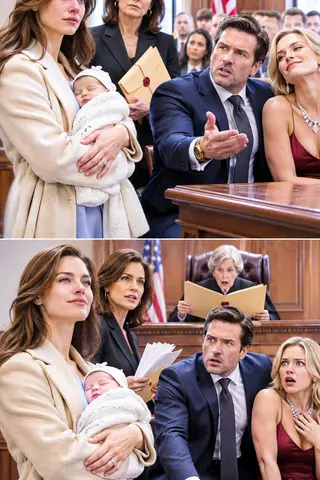
 She Walked Into Court 6 Days Post-C-Section With Her Newborn
Chapter 82
The Comptroller's Shadow
The New York State Capitol in Albany stood like a fortress of granite and sandstone atop State Street. Its massive Romanesque arches and carved stone corridors felt worlds away from the glass-and-steel modernism of Lower Manhattan, steeped instead in a century of backroom deals and entrenched political dynasties.
At two o'clock that afternoon, Marcus, David, and I walked into the executive suite of the Department of Taxation and Finance.
Sterling Vance was seated behind an expansive cherry-wood desk beneath an oil painting of Governor Nelson Rockefeller. He was a man in his late fifties with slicked-back silver hair, horn-rimmed glasses, and the relaxed posture of an official who believed his authority was beyond appeal. Flanking him was a sharp-faced state attorney named Laura Gable.
"Mrs. Vane," Deputy Commissioner Vance said, offering a curt nod without rising. "I assumed your legal team would simply wire the bond. One hundred and eighty-two million is pocket change for the Eleanor Vane Global Endowment, from what I read in the *Wall Street Journal*."
"The Eleanor Vane Global Endowment does not pay extortion to satisfy political debts, Commissioner Vance," I said, sitting across from him without waiting for an invitation. "And we certainly do not pay bogus assessments manufactured by shell companies funded by the family of an indicted felon."
Vance’s eyes narrowed slightly, though his smile remained fixed. "Mrs. Vane, let’s be clear about how New York State tax law operates. Under Article 9-A, an administrative assessment by the Department carries an immediate presumption of validity. The burden of proof is not on the State to defend the assessment; the burden is entirely on the taxpayer to prove non-liability before our administrative tax tribunal."
Laura Gable stepped forward, placing a thick ring-binder on the table between us. "The 1968 conveyance from Charles Vane’s estate to Whitmore Agricultural Holdings severed the charitable trust language. Arthur Whitmore claimed the land as commercial real estate on his state filings for thirty years. You cannot resurrect a century-old charity status just because you reclaimed the deed in federal court last year."
"Arthur Whitmore committed systemic tax fraud across four decades, Ms. Gable," I replied evenly. "A fact established by three federal judges, the Second Circuit Court of Appeals, and the Supreme Court of Bermuda. A fraudulent corporate designation by a convicted syndicate cannot extinguish an ancestral charitable deed registered under the New York Charitable Trusts Act of 1893."
"That is a legal argument for the appeals court, Mrs. Vane," Vance said coldly, tapping the desk. "In the meantime, the ten-day statutory cure clock is running. If sixty million dollars in escrow is not deposited by five o'clock on Friday, a warrant of distraint will be executed, and the Dutchess County property will be seized by the State Police and placed into administrative receivership."
"Receivership managed by whom?" Marcus asked sharply. "By Empire Sovereign Partners?"
Vance didn't flinch, but a muscle jumped in his jaw. "The court will appoint a qualified asset manager to protect the State's lien. If your residents have to be relocated during the audit period, that is an operational consequence of your refusal to post bond."
I looked Vance directly in the eye, feeling the familiar, razor-sharp focus that had carried me through every battle from Danbury to Boston. They were threatening ninety-four traumatized women and their children with armed eviction to force a massive cash payout into an upstate escrow account controlled by political cronies.
"We will not pay the bond, Commissioner," I said, standing up. "And you will not set foot on that property. Because before five o'clock on Friday, you are going to discover that Arthur Whitmore’s paper trail is not a weapon against me. It is a noose for every politician who accepted his money."
The End









