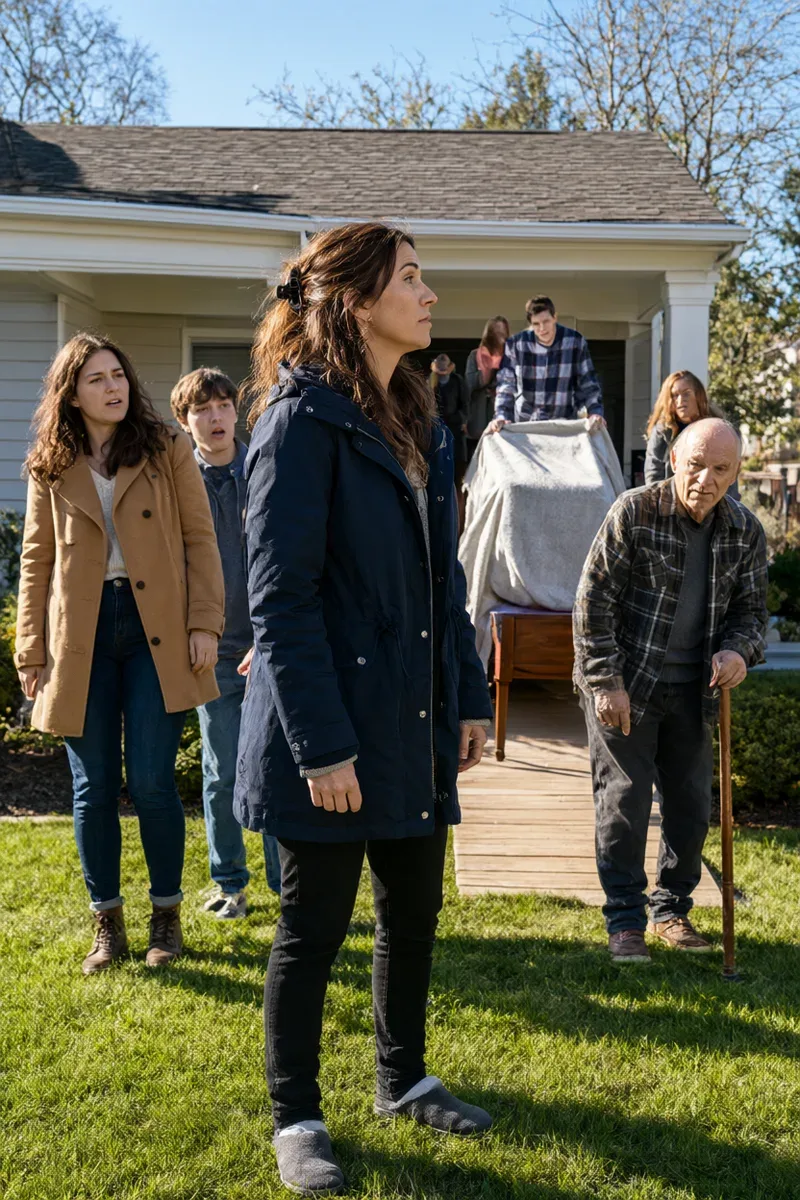
 Rennie in March
Chapter 4
The Price of a Lesson
"The first of March," I said.
"Brookfern. The senior place off Route 9." Annick looked at the banana bread. "He fell on the cellar stairs in December. Lay there four hours before the mail carrier heard him yelling. He didn't tell me for a week. I found out from the hospital bill."
"I didn't know."
"Nobody knows anything with him. That's his whole system. Good luck. He's in a mood. He's been in it since 1974."
The front door opened. Lazare stood in it with his cane. "Annick. Stop telling the neighbors my business."
"Dad, the neighbor brought you bread."
He looked at the loaf as if it might be a summons. Then he looked at me, and his face gave a little at one corner. "Sit down, Mrs. Marczak." He pointed his cane at the two wicker chairs on the porch. "Not inside. Inside is boxes."
Annick went in. I sat. It was thirty-one degrees and the wicker crackled under me.
"He came over the first Friday in November," Lazare said, without being asked. "He put a twenty in my mailbox. I came out and asked if he had lost his mind. He had a piece of paper. He wanted to know if I could read it."
"Music?"
"Music." He lowered himself into the other chair in stages. "I said I could read it. He asked if I could teach him to play it. I said lessons cost money. I thought that would send him home. He asked how much. I told him my wife charged twenty dollars a lesson in 1979. I meant it as a joke. Your son does not hear jokes. He took it as a quote."
I laughed before I could stop it. He did not, but his mouth moved.
"He comes Saturday mornings while you're at work. He plays like a man fixing a gutter. Too much force, no patience. But he shows up, on time, with his hands washed. Solange would have liked him. She liked students who were bad and stubborn. She said the good ones were boring."
Through the front window I could see a dark upright against the far wall, its lid closed, and on the shelf beside it rows of cassette tapes in plastic cases, each with a hand-lettered label.
"What's he learning? Is it something of his father's?"
"Mrs. Marczak." He said it the way Bas said Mom. "You're asking me to break a confidence with a fourteen-year-old. I'm seventy-nine. I don't have many people left to disappoint. I'd like to keep it that way."
"And the note? 'Twice that on Saturday'?"
"Practice. He does fifteen minutes a day on a cardboard keyboard. I told him to double it." He looked at me a little longer, and I think he worked out what I had thought it meant, because he snorted.
"The piano goes on the twenty-eighth," he said. "A dealer from Dayton. My daughter arranged it. She arranges everything now."
"That's two weeks before—" "I know when it is." "Then he'll never finish."
"He's fourteen. Children are made of rubber." He picked up the banana bread, turned it over, and set it on his knee. "It's not my problem, Mrs. Marczak. Thank you for the bread."
That night I stopped outside Bas's door. The light was still on underneath it. I could hear a soft dry tapping, fingers on cardboard, and his voice under his breath, counting. Then it stopped, and my son said, quietly, to an empty room: "Okay, Dad. From the top."
The End