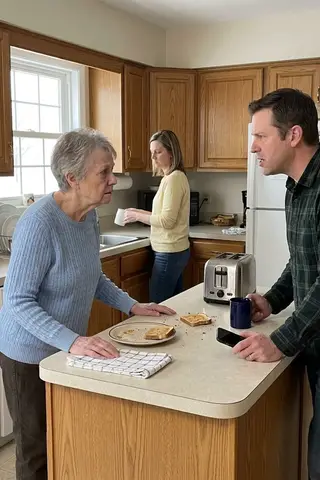
 My Son Evicted Me 21 Days After His Father’s Funeral
Chapter 5
The Ledger of Regret
Richard Campbell was seventy-five years old, carried a leather briefcase that had belonged to his father, and possessed the sharp, predatory composure of an old hawk. When he walked into the library of the Sterling estate, he did not look at the books or the grand oil paintings; he looked directly at me.
"Eleanor," he said, bowing his head with genuine reverence. "The last time I saw you, you were standing in the county records office, signing a marriage certificate that cost you a place in high society."
"I never wanted high society, Richard," I said, setting a fresh cup of black coffee beside his ledger. "I only wanted Charles."
"And you got the best of him," Campbell replied softly. He turned toward Harrison, who sat behind the massive mahogany desk where millions of dollars in industrial contracts had been signed during Ohio’s golden age. "Harrison, I have the complete audit of the Sterling Trust as requested."
Harrison leaned forward, his hands resting flat on the leather desk blotter. "Read it."
"The primary liquid holdings, commercial real estate portfolios, and bond reserves have accrued without substantial disbursements for forty-eight years," Campbell stated, adjusting his gold-rimmed spectacles. "Because Charles was the sole direct descendant designated under the 1968 deed of trust, his refusal to sign the reconciliation documents caused the assets to compound under standard municipal management. Currently, the principal estate, excluding this property and its grounds, is valued at thirty-eight million four hundred thousand dollars."
The room seemed to shrink. Thirty-eight million dollars.
I thought of Charles mending his work boots with shoe goo to save forty dollars. I thought of how we debated for three weeks before buying a new microwave when the old one caught fire. Charles had known this mountain of gold existed, and he had chosen fifty years of grease under his fingernails and quiet dinners with me over a single drop of his father's poisoned well.
"And under the current will?" Harrison asked.
"Under the current will, dated twelve years ago," Campbell said, looking up over his glasses, "in the event of your passing without direct acknowledged heirs, sixty percent goes to distant cousins in Maryland who haven't visited you since 2004, and the remainder goes to the State Historical Trust."
"Tear it up," Harrison said without a second of hesitation.
Campbell didn't even blink. He reached into his briefcase, pulled out a thick document bound in blue ribbon, and set it on the desk. "I anticipated this morning's discussion. What are your instructions, Harrison?"
Harrison looked across the desk at me. His eyes were no longer cold; they were filled with an urgency that bordered on desperation.
"Everything," Harrison said, his voice vibrating with absolute certainty. "Every acre. Every stock certificate. Every brick of this house. The liquid accounts, the trusts, the foundations. Name Eleanor Miller—born Eleanor Vance—as the sole, unrestricted executor and primary beneficiary. She is the mother of Charles’s child. She is the woman who honored my son when I was too proud to see his worth."
"Harrison, no," I said, my voice catching. "I didn't come here for your money. I came because I had ten dollars in my purse and an ad told me an old man needed someone to make his soup."
"You did not ask for it, which is the only reason you deserve it," Harrison said fiercely, striking his palm against the mahogany. "Charles turned his back on this gold because he thought it was stained with pride. Help me clean the stain, Eleanor. Do not let my life's work rot in the hands of strangers who never loved my boy."
Campbell smiled faintly, already unscrewing the cap of a heavy fountain pen. "There is, of course, the matter of the grandchild. Bradley Miller."
The air in the room grew instantly thin. Harrison’s expression hardened until he looked like an ancient judge handing down an inescapable sentence.
"Bradley Miller has already collected his inheritance," Harrison said coldly. "He took it in the form of a folding chair by his father’s grave, a watch he couldn't stop looking at, and a front door he locked against his mother. Draw the papers, Richard. Leave the boy exactly one dollar, provided he collects it in person."
The End









