 My Son Evicted Me 21 Days After His Father’s Funeral
Chapter 4
The Weight of Cold Toast
Across town, in the manicured subdivisions of Oak Ridge, Melissa Miller was having what she referred to as an "unmanageable morning."
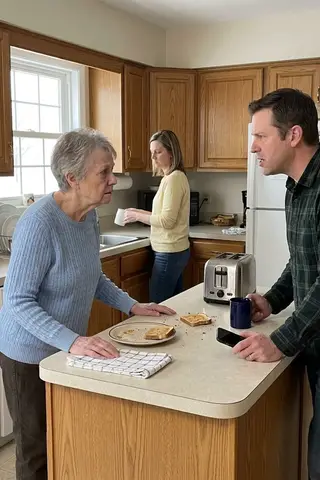
The kitchen sink was full of unwashed cereal bowls. The dishwasher had not been emptied, and the countertops were sticky with orange juice that seven-year-old Maya had spilled twenty minutes before the school bus arrived.
"Bradley!" Melissa screamed from the top of the basement stairs, her silk robe trailing behind her. "Did you take Maya's permission slip? Why isn't the laundry switched over? I have a client call in fifteen minutes and the house looks like a shelter!"
Bradley came out of the bathroom, tucking his dress shirt into his trousers with hurried, irritated movements. He looked tired. Bags hung beneath his eyes, and his tie was crooked.
"I had to send three emails before seven, Melissa," he snapped, grabbing his briefcase. "Why didn't you pack Maya's lunch?"
"Because your mother usually does it!" Melissa hissed, crossing her arms. "I thought you said getting her out would clear the air. You said having her around was making the house depressing with all her sighs and Charles’s old sweaters. Well, it's been three days, Bradley! Who is going to watch Maya when she has half-days? Who is going to clean this kitchen?"
Bradley rubbed his forehead, an uneasy knot twisting in his gut. When he had watched his mother walk down their driveway three mornings ago, he had told himself it was a matter of principle. Boundaries. That was the term Melissa had found on her podcasts. Eleanor was seventy, but she was able-bodied; she had a small widow's pension from the state, barely nine hundred dollars a month. She could find a subsidized studio apartment near the bus lines. She was an adult.
Yet every time he looked at the kitchen counter where his mother had left his warm toast every morning without fail, the knot in his stomach pulled tighter.
"She'll call," Bradley muttered, more to reassure himself than his wife. "She's probably staying at one of her church friends' guest rooms. She'll realize she can't make it on her own, she’ll apologize for acting so helpless, and then we can set some real ground rules. A proper chore schedule. A financial contribution from her check."
"She better," Melissa grumbled, picking up a cold, half-eaten piece of toast from the plate Bradley had abandoned. "Groceries were two hundred dollars more this week because nobody made soup from scratch. It’s absurd."
Bradley grabbed his coat and stepped out into the crisp morning. As he backed his company-leased sedan down the driveway, he looked toward the sidewalk where his mother had dragged her canvas bag. For a fleeting second, an image flashed through his mind: Eleanor sitting beside his bed when he had pneumonia at age ten, wiping his forehead with a damp cloth through three straight nights without sleeping.
He shook his head, turned on the radio to drown out the silence, and drove toward his office.
Meanwhile, three miles away on Ridge Road, the kitchen of the Sterling estate was warmer than it had been in thirty years.
I had tied a clean linen apron around my waist, rolled up my sleeves, and cleared away the dust of three decades. On the cast-iron stove, a pot of steel-cut oats was simmering with cinnamon and diced apples. The aroma drifted into the hallway, chasing away the scent of loneliness and rubbing alcohol.
Harrison Sterling sat at the long oak breakfast table in his wheelchair, his hair neatly combed, wearing a crisp white dress shirt under a dark blue cardigan I had found in Charles’s old childhood wardrobe. His eyes followed me as I set a warm porcelain bowl in front of him, along with a pot of fresh black coffee.
"Charles liked his oats with brown sugar," Harrison said quietly, watching the steam rise.
"He did," I smiled, pulling out the chair opposite him. "And two drops of cream. Never three."
The old man picked up his silver spoon with hands that were remarkably steady today. He took a bite, chewed slowly, and looked at me across the wide table.
"He had a good mother, and he had a good wife," Harrison said, his voice deep and solemn. "My son was a wealthier man than I ever gave him credit for."
The front doorbell chimed—deep, resonant, and clear.
"That will be Campbell," Harrison said, setting his spoon down without a trace of hurry. "Let him in, Eleanor. It’s time to take inventory of what belongs to the Sterling name."
The End









