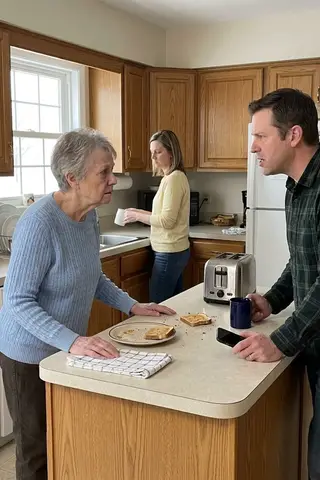
 My Son Evicted Me 21 Days After His Father’s Funeral
Chapter 1
The Ghost in the Brass Mailbox
The iron gate stood slightly ajar, rusted at the hinges and groaning under the March wind. I tightened my fingers around the frayed handle of my canvas suitcase, my knuckles white and aching from the cold. For two miles across town, I had convinced myself that the address scribbled on my receipt was merely an arbitrary collection of numbers on a quiet residential street. But geography does not lie, and neither does memory.
The house sat deep on a gentle rise, framed by towering, leafless white oaks that scratched at the low gray clouds. It was a grand Victorian manor built of cut limestone and dark timber, weathered by decades of northern Ohio winters yet stubbornly magnificent. I knew the exact curve of the wraparound porch. I knew the dark slate tiles on the turret roof. Most of all, I knew the stained-glass window to the left of the double entrance: an arch of deep cobalt and honey-amber depicting a soaring hawk.
Fifty years ago, I stood on that very porch in a cheap summer dress, my hands trembling while the young man beside me threw his brass house key into the hydrangeas and swore he would never set foot inside again.
That young man had been Charles.
When Charles took my hand that sultry July evening in 1974, he walked away from a dynasty. He abandoned the family name, took his mother's forgotten maiden name, and swore to build a life where love was not measured by bank ledgers or social standing. For fifty-one years, we lived in quiet neighborhoods, driving second-hand sedans and budgeting for dental work. We never spoke of this street. When our son Bradley was born, his birth certificate bore the name Miller, clean of the heavy shadow that had haunted his father’s youth.
Now, Charles was resting beneath three inches of cold cemetery sod, his funeral flowers still rotting in the rain. And Bradley, who had Charles’s jawline but none of his soul, had pointed toward the front door and told me to earn my keep or leave.
I walked up the stone path, each step echoing through the hollow in my chest. Beside the gravel drive, mounted on a stone pillar, stood the black cast-iron mailbox. Hand-painted across the side in faded gilt lettering was the single word that Charles had spent his entire adulthood trying to outrun: STERLING.
My breath hitched. The caregiving agency had listed the employer only as "H. Sterling, Private Residence." I had assumed it was an heir, a distant cousin, perhaps a nephew. But as I climbed the wide porch steps and reached for the heavy brass lion-shaped knocker—its nose still rubbed smooth from hands that had vanished decades ago—I knew whose house this was.
I let the lion drop against the oak. The thud was loud, final, and heavy enough to wake the dead.
Within seconds, the heavy door cracked open. A middle-aged woman in hospital scrubs appeared, her coat already slung over her arm and a look of pure exhaustion etched into her eyes. She smelled of rubbing alcohol and burnt toast.
"If you're from the agency, thank God," she muttered, not even waiting for me to introduce myself. "He's fired three companions in two weeks. He threw a water glass at the wall at dawn, and I have three children at home who treat me better than this. The medical charts are on the hallway table. His name is Harrison. Good luck."
Before I could reply, she slipped past me, hurried down the steps, and pulled away in a sputtering sedan.
The heavy front door swung inward, caught by the draught. The foyer smelled of cedar, old parchment, lemon oil, and the sharp tang of medicinal tinctures. It was a stillness that belonged to a tomb. I set my old suitcase on the parquetry floor, took a deep breath, and stepped across the threshold into the past.
The End









