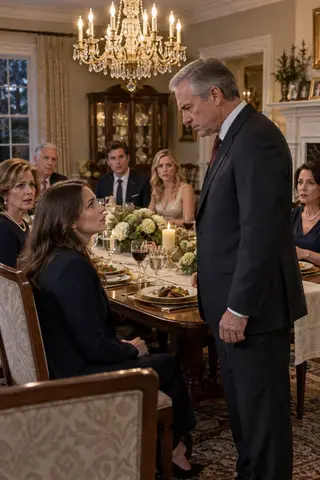
 My Mother Made Me Lie About My Job to Impress a Federal Judge. Then He Walked Across the Dining Room and Said One Sentence That Ruined Her
Chapter 9
The Dust on the Hearth
Three months passed before I set foot in Maple Grove again.
The winter had been unusually harsh in the Midwest, but by late April, the snow had finally melted, leaving behind damp earth and the first faint green shoots of spring. I drove down on a quiet Sunday afternoon, the sky overcast with soft gray clouds.
The house on Maple Grove looked smaller than I remembered. The manicured lawn was overgrown with dandelions, and the grand decorative wreaths my mother usually hung on the front porch were noticeably absent.
The front door unlocked before I could even reach the porch steps.
My father stood in the doorway. He looked thinner, his hair entirely silver now, wearing an old flannel shirt that hung loosely around his frame. But when he saw me, the exhausted lines around his eyes softened into a look of overwhelming relief.
“Emily,” he breathed, stepping out onto the porch and wrapping his arms around me. He held on tight, his hands gripping my coat as if terrified that I might dissolve into the mist. “You came.”
“I told you I would, Dad,” I said gently, patting his back before stepping inside.
The house was eerily quiet. The heavy floral potpourri that my mother insisted on burning in every corner had faded, replaced by the faint, comforting smell of brewing black coffee and old paper.
I walked into the living room and immediately looked at the fireplace.
The mantelpiece was completely bare.
The five framed pictures of Ryan in his little league uniforms and high school graduation gowns were gone. The brass trophies, the polished ribbons, and the elaborate gilded candleholders had all been removed. Even the heavy ceramic angel and the fake ivy plant were nowhere to be seen.
There was only a single, dark line of dust marking where the frames had sat for over two decades.
“Where is everything?” I asked softly.
“I boxed them up,” a quiet, hoarse voice spoke from the corner of the room.
I turned around.
My mother was sitting in the high-backed armchair near the bay window, a wool blanket pulled over her lap despite the mild spring temperature. She looked as though she had aged ten years in three months. The sharp, imperious posture was gone; her shoulders were curled inward, her face devoid of makeup, her eyes hollow and dark.
“Mom,” I said, keeping my distance near the center of the Persian rug.
She looked at me for a long, agonizing moment. For the first time in my entire existence, she didn't look through me to see who was watching. She looked directly at my face, seeing the woman standing before her.
“Ryan came by two weeks ago,” she whispered, her voice rough, like someone who hadn't used her vocal cords in days. “He brought his taxes to show your father. He wanted your father to help him file his sales commissions.”
She swallowed hard, her hands clutching the edges of the blanket.
“He told me... he told me he was happy, Emily. He told me he was making his own way, living in his little apartment, cooking his own meals. And then he told me that if I ever lied about him to a single person again, he would never step foot in this house for the rest of his life.”
A single tear spilled over her lower lid, tracking down the hollow crevice of her cheek.
“He said he learned how to be honest from watching you,” she whispered.
I stood there, feeling the weight of her words settle into the room. It was not a grand apology. It was not a cinematic speech of maternal redemption. But it was something far more rare for a woman like Evelyn Carter: it was an admission of defeat. The fantasy had starved to death, and she was finally forced to reckon with the empty plate in front of her.
“I was ashamed of myself, Emily,” she choked out, looking down at her trembling hands. “My entire life, I felt like a nobody in this town. My father was a failed merchant. My family had nothing. When I had Ryan, he was so beautiful, so easy... I thought if I made him perfect, people would finally look at me and think I had done something extraordinary.”
“And what about me, Mom?” I asked, my voice calm, steady, free of the old childhood bitterness. “What was I supposed to be?”
She closed her eyes, the tears streaming freely now.
“You were too smart,” she wept softly. “You saw right through me. Even when you were seven years old, you looked at me with those big, clear eyes, and you knew I was pretending. I couldn't control you, Emily. Your success didn't need me. And every time you achieved something on your own, it just reminded me of how small I really was.”
The truth, laid out in the quiet living room, was almost anticlimactic. She hadn't hidden me because I was weak; she had hidden me because my strength threatened her fragile, manufactured world.
I reached into my bag, pulled out a small, rectangular package wrapped in brown craft paper, and walked over to the bare fireplace.
I placed it gently on the wooden mantel, right in the center.
“What is that?” my father asked from the doorway, his voice thick with emotion.
“It’s a gift,” I said, looking at my mother. “You don't have to keep it there. But if you ever decide to put things back on this mantel... remember that a family isn't a museum of trophies. It’s an honest record of who we are.”
The End









