 My Mother Made Me Lie About My Job to Impress a Federal Judge. Then He Walked Across the Dining Room and Said One Sentence That Ruined Her
Chapter 1
The Glass Drops
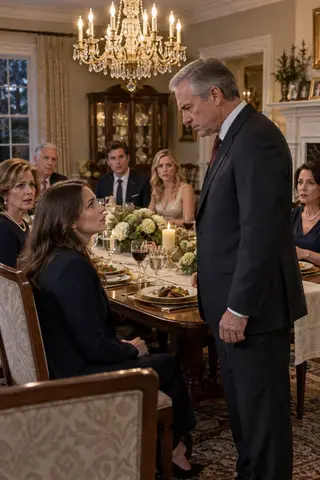
The silence in my parents’ dining room was so absolute that I could hear the rhythmic hum of the refrigerator humming through the walls. Judge Harrison remained standing directly at my shoulder, towering over the mahogany table. His wine glass caught the warm yellow glow of the chandelier, suspended motionless in midair. His piercing gray eyes never drifted from my face.
My mother let out a small, breathless laugh that sounded like dry paper snapping in the wind. She dabbed the corner of her mouth with her linen napkin, her knuckles bleached white from the pressure.
“Oh, Arthur,” she said, her voice pitched an octave higher than normal, desperate to sound playful. “I introduced her earlier! That’s Emily. Our Emily. I told you, she just does general office work up in Chicago. Filing, administrative routines, that sort of quiet thing. We don’t bore our guests with her little clerical duties. Ryan, darling, tell Judge Harrison about that commercial territory you’re taking over next month!”
Judge Harrison did not turn his head toward Ryan. He did not blink. He kept his eyes locked onto mine, his brow furrowing into deep, unmistakable lines of profound confusion.
“Clerical duties?” he repeated, each syllable clipped and measured like a legal ruling. “Office work?”
My father kept his chin firmly glued to his chest, staring at his half-eaten pork chop as though it held the answers to the universe. Ryan, sitting two chairs over with his arm loosely draped around his fiancée Megan, looked between the judge and me, a nervous smirk beginning to twitch at the edge of his lips.
“Emily Carter,” the judge said again, this time with absolute certainty. “You are the Emily Carter who spent seven months tearing through the Cook County court dockets and the third precinct’s closed-door settlement files.”
The air left my mother’s lungs in a faint, strangled hiss.
“I am,” I said softly.
“Arthur?” his wife, Eleanor, leaned forward across the crystal glasses, her eyebrows raised in sudden, genuine recognition. “Is this the woman whose investigative series you spent three entire weekends reading at the lake house? The one who forced the state supreme court to reopen the evidentiary hearings on municipal misconduct?”
“The very same,” Judge Harrison said. He finally set his wine glass down on the table with a firm, resounding click against the wood. “Her five-part investigative series didn't just expose corruption, Eleanor. It completely reshaped the evidentiary standards our federal bench uses for evaluating body-camera suppression motions across the entire seventh circuit. Her work was nominated for a Pulitzer Prize this past spring.”
Megan gasped, her hands flying to her mouth. She turned her wide, astonished eyes toward me. “Wait... Emily Carter? The reporter? I read your feature on the South Side precinct whistleblowers! My law professors assigned that exact article as required reading in our civil rights seminar last semester!”
My mother looked as if someone had physically struck her across the face. Her complexion drained of all its carefully applied color, leaving behind an ashen, brittle mask. She reached blindly for her water goblet, her hand trembling so violently that the ice cubes rattled like dice in a cup.
“There... there must be some sort of mistake,” Mom stammered, casting a frantic, pleading glare across the table at me that screamed deny this right now. “Emily doesn't do legal work. She lives in a drafty little apartment, Arthur, she’s always had a difficult time settling down into a stable, respectable path. We’ve always had to worry about her stability—”
“There is no mistake, Evelyn,” Judge Harrison interrupted. His tone was no longer polite dinner-table chatter; it was the icy, authoritative voice he used to silence unruly attorneys in his federal courtroom. “I personally awarded Ms. Carter the Midwest Press Association’s Justice in Media medallion six months ago in downtown Chicago. I had the privilege of speaking with her for twenty minutes backstage. I would recognize her face anywhere.”
He turned back to me, the confusion on his face giving way to something far colder, something deeply perceptive. He looked at my place card, shoved into the lonely, drafty corner of the table. He looked at the empty bread basket sitting in front of me, which my mother had instructed me to refill three separate times during the first course. He looked at Ryan, who was decked out in a custom three-piece suit, sitting dead-center under the brightest chandelier bulbs.
“So I ask again,” Judge Harrison said, his voice dropping into a quiet register that resonated through the entire house. “If you are one of the most respected investigative journalists in the Midwest... why did your mother just introduce you as an office clerk who shouldn't embarrass her family?”
The End









