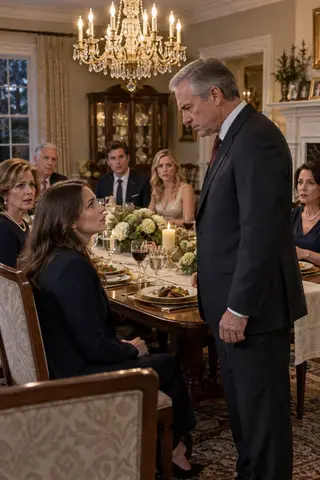
 My Mother Made Me Lie About My Job to Impress a Federal Judge. Then He Walked Across the Dining Room and Said One Sentence That Ruined Her
Chapter 6
The Long Road North
By eleven o'clock that night, the house on Maple Grove had cleared out like a theater after a disastrous premiere.
The Harrisons had departed in their sleek black town car. Megan had left with them, though not before walking back into the house, wrapping her arms tightly around my neck, and whispering in my ear: “Thank you for being the only honest person in this house tonight. Please call me tomorrow.”
Ryan had gone upstairs to his old childhood bedroom, the door closed and locked behind him. The sound of his quiet, rhythmic pacing could be heard through the ceiling boards.
I walked through the quiet living room toward the front door, my overnight bag slung over one shoulder. I had originally planned to spend the entire weekend in Indiana, sleeping in my old room under the eaves. But remaining in that house for another hour felt impossible, like breathing toxic dust.
As I passed the fireplace, I stopped.
The mantelpiece was dimly illuminated by the moonlight filtering through the bay window. There they were. Five gleaming frames of Ryan, catching the silvery light. And tucked deep behind the ceramic angel, barely visible unless you leaned your head sideways, was my faded school photograph.
I set my bag down on the floor.
I walked over to the hearth, reached my hand behind the cool, smooth porcelain of the angel’s wing, and pulled my picture out into the open.
I looked at the seven-year-old girl in the frame. Missing front tooth, crooked bangs that Mom had cut with kitchen scissors, wearing a bright yellow sweater. A little girl who had spent decades performing miracles just to be seen by a woman who was blind by choice.
I didn't put the picture in the center of the mantel.
I slipped it into my blazer pocket, right next to Judge Harrison’s business card. I didn't need to be on that mantel anymore. That fireplace was a monument to a fantasy that had finally burned to the ground.
“Emily?”
I turned around. My father was standing at the edge of the hallway, holding a ring of keys in his hand. He looked older than his sixty-two years, his shoulders rounded, his hair thin and gray under the dim light.
“I’ll walk you to your car,” he said softly.
We walked down the gravel driveway in complete silence. The autumn air was crisp and cold, smelling of damp earth and dying leaves. My compact sedan sat parked beneath the towering oak tree at the curb, covered in a light sheen of evening dew.
When we reached the driver’s side door, Dad stopped. He stared down at his worn leather loafers, his hands shoved deep into the pockets of his corduroy jacket.
“I knew,” he whispered.
The confession was so quiet I almost thought the wind had made the sound.
“What did you say, Dad?”
He lifted his head, his eyes glistening with fresh tears in the amber glow of the streetlamp. “I knew about the picture. When you were seven. I came downstairs that morning before your mother woke up, and I saw that you had moved it to the center. I stood right there in the living room, Emily, and my heart broke for you.”
A cold knot tightened in my stomach. “Then why did you let her put it back?”
“Because I was weak,” he said, the words dragging out of him like heavy stones. “Your mother... she has this darkness in her, Emily. A bottomless pit of insecurity. If things aren't perfect, if she isn't the envy of everyone in town, she turns into a hurricane. And early on, I decided that keeping peace in the house was more important than doing what was right. I let her make Ryan her doll, and I let her push you into the shadows, because pushing you into the shadows was quiet. You were strong. You didn't scream or break things. You just worked harder. And I used your strength as an excuse to be a coward.”
I stood there on the cold gravel, listening to my father strip away the last remaining illusion of my childhood. All those years, I had thought Dad was simply oblivious, a quiet man lost in his own world. But he had seen everything. He had watched the injustice unfold day after day, year after year, and had chosen his own comfort over his daughter’s dignity.
“Dad,” I said, my voice steady, though my chest ached with a profound, hollow grief. “Being strong wasn't a choice for me. It was survival. And leaving me alone in the dark didn't keep the peace. It just ensured that the explosion would happen when you least expected it.”
He buried his face in his hands, his shoulders shaking with silent, ragged sobs.
“I’m going back to Chicago,” I said, opening the car door. “I need space, Dad. Real space. Don't call me to mediate between Ryan and Mom. Don't call me to fix this family. You built this dynamic together, and the two of you are going to have to live in the wreckage.”
I got into the car, turned the key in the ignition, and watched the headlights cut through the Indiana darkness. As I backed out of the driveway, I glanced in the rearview mirror one last time. My father was still standing beneath the oak tree, shrinking into the distance until the shadows swallowed him whole.
The End









