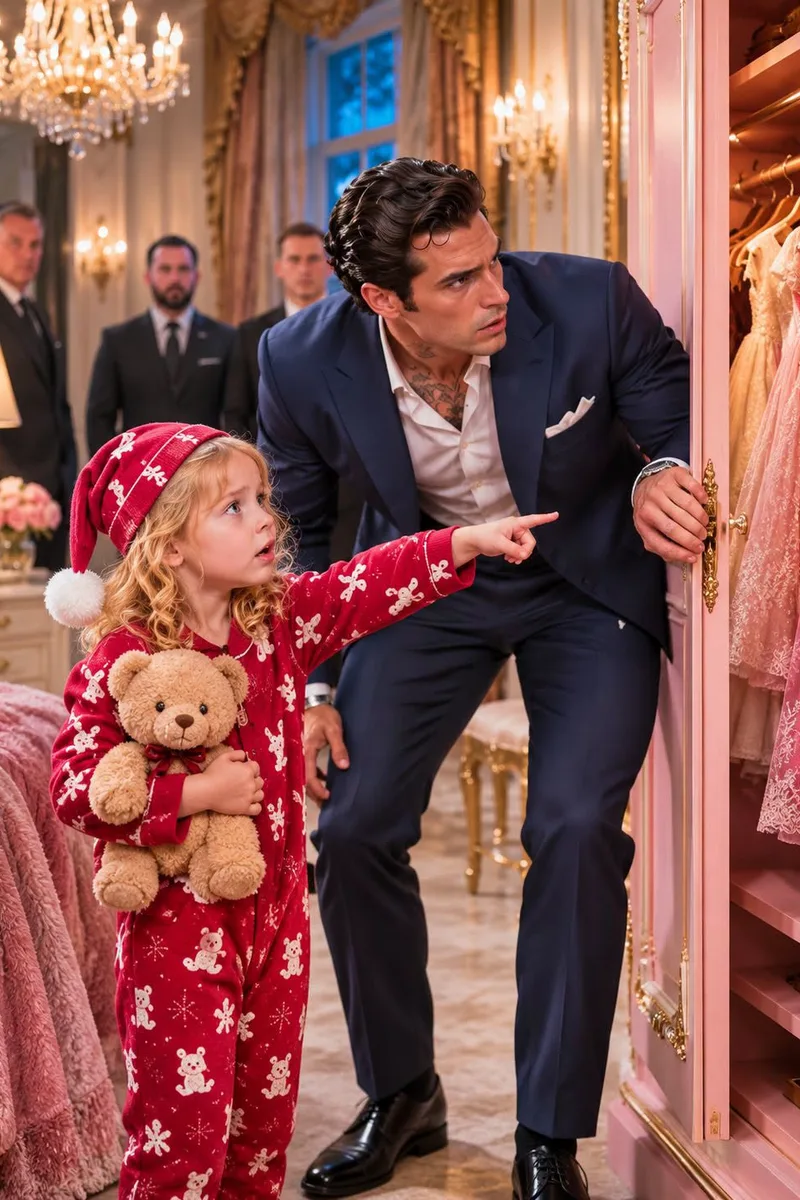
 My Five-Year-Old Daughter Told a Mafia Boss Someone Was Hiding in Her Closet, and He Believed Her
Chapter 5
The Report I Was Afraid to Sign
My first week at the hotel was mostly spent learning names. Ms. Patel introduced me to the kitchen staff, the overnight supervisor, and the reception team, each of whom had a different way of telling me where supplies belonged. It was ordinary work. I liked it enough that I caught myself smiling during a conversation about missing towels. Then, halfway through a shift, Detective Vega called and asked whether I could come to the station the following morning for a formal statement.
She explained that the investigators were considering charges related to unlawful entry and surveillance, but the evidence still required review. They had identified a person who had used a borrowed maintenance credential to access parts of the Moretti estate. The account used for that credential belonged to a legitimate contractor who said he had not been working there on several of the recorded dates. Investigators wanted my recollection of Sophie's reports, not a theory about who had sent the intruder.
I agreed, then spent the rest of my shift worrying that my words would make the situation worse. I had already told officers that I'd dismissed Sophie's complaints. What if the formal statement made me look careless? What if I had forgotten an important detail?
At closing time Ms. Patel found me checking the same inventory twice. I told her I needed time off for a police interview involving my daughter. She did not ask for the details. She arranged coverage and told me to take care of my family.
At home Sophie was helping Grandma bake muffins. Flour dusted her hair and the cuffs of her pajamas. She asked why I looked sad. I told her the police wanted to ask me questions about what happened at the big house.
She considered this, then asked whether she would have to see the man with the red light. I said no one had told me she would, and I would ask before agreeing to anything involving her. I sat on the floor and helped her make paper stars while my mother finished the muffins.
The next morning I met Detective Vega with my attorney present. Vega asked about the first time Sophie described the monster, the nights she had woken crying, and the methods I used to check her room. I answered as carefully as I could. When I admitted that I'd told Sophie it was probably a shadow, my voice broke. Vega offered me a moment. She did not accuse me. She said investigators needed the record to be accurate, including mistakes that made me uncomfortable.
I described the night Vincent fetched me from the kitchen and the way Sophie ran into my arms outside Dante's study. The detective asked what Dante had said, and I repeated his instruction that Sophie's account be taken seriously. I also described his later offer of a driver and guards, and my refusal. My attorney reminded me that those events were relevant to safety arrangements but did not establish who had entered the service space. I was grateful she was there to keep the discussion grounded.
At the end Vega showed me a photograph of the small dark device recovered near the closet and asked whether I'd ever seen one like it. I said I had not. She explained that it appeared capable of observing an area and transmitting information, but technical examination was ongoing.
I resisted asking whether it had recorded Sophie. Vega said investigators were reviewing what data might be recoverable and would share child-safety findings when they could. I had to accept that an answer I wanted immediately might not yet exist.
Then she asked me to review the typed statement. Reading my own words on paper made them feel more final. I saw how many times I'd written that I thought Sophie had imagined something, and how often Sophie had returned to the same description anyway.
I asked to correct one sentence. It said I had checked the closet thoroughly; I had checked only what I could see from the doorway. Vega made the correction without hesitation. I signed the statement, still shaking, because the truth included my failure to look harder.
Outside the station my attorney told me I had done the difficult part. I said the difficult part had been Sophie's. The lawyer nodded. She asked whether I planned to discuss the statement with Dante.
I said I would tell him only what the police permitted and what affected my employment or safety. I had spent enough years in the mansion assuming every piece of news had to pass through the man who owned it. I wanted the investigation to belong to the people charged with conducting it.
That afternoon I called Sophie's counselor and told her I'd given a statement. The counselor said I could reassure Sophie that adults were doing their jobs, without asking her to carry responsibility for the outcome. We discussed routines for the next few weeks: school visits, ordinary play, and a simple way for Sophie to ask for help if she felt frightened. I wrote the plan down. It contained no secrets and no promises that the world would never scare her again.
Vincent called that evening to say the police had finished examining the area around Sophie's old room, though the wider inquiry continued. Her belongings could be released. He asked whether I wanted someone from the mansion to bring them to South Bend. I said a documented courier delivery would be better. He agreed. Then he apologized again for the incomplete access records. I told him I hoped he would use what he'd learned to change procedures, not spend his life repeating the apology to me.
Dante left a message after Vincent spoke with him. He said he had instructed his attorneys to preserve company records and cooperate with police requests. He also said he understood I was not returning to the mansion. I listened twice. His acceptance mattered, but I no longer needed it to make my decision. I had signed a statement under my own name and found work under my own qualifications. I was tired, frightened, and unexpectedly proud of the distinction.
At bedtime Sophie asked whether she could have a night-light shaped like a moon instead of the little lamp Grandma had given her. We found one online and ordered it. She said the moon was different from a red eye because it shone on everyone, not just her.
I asked where she had learned that. She shrugged and tucked her bear beneath the blanket. I kissed her forehead and told her I was glad she'd told Dante about what she saw. Her voice came back through the dark: "I'm glad you believe me now too." I stayed beside her until she slept.
The End









