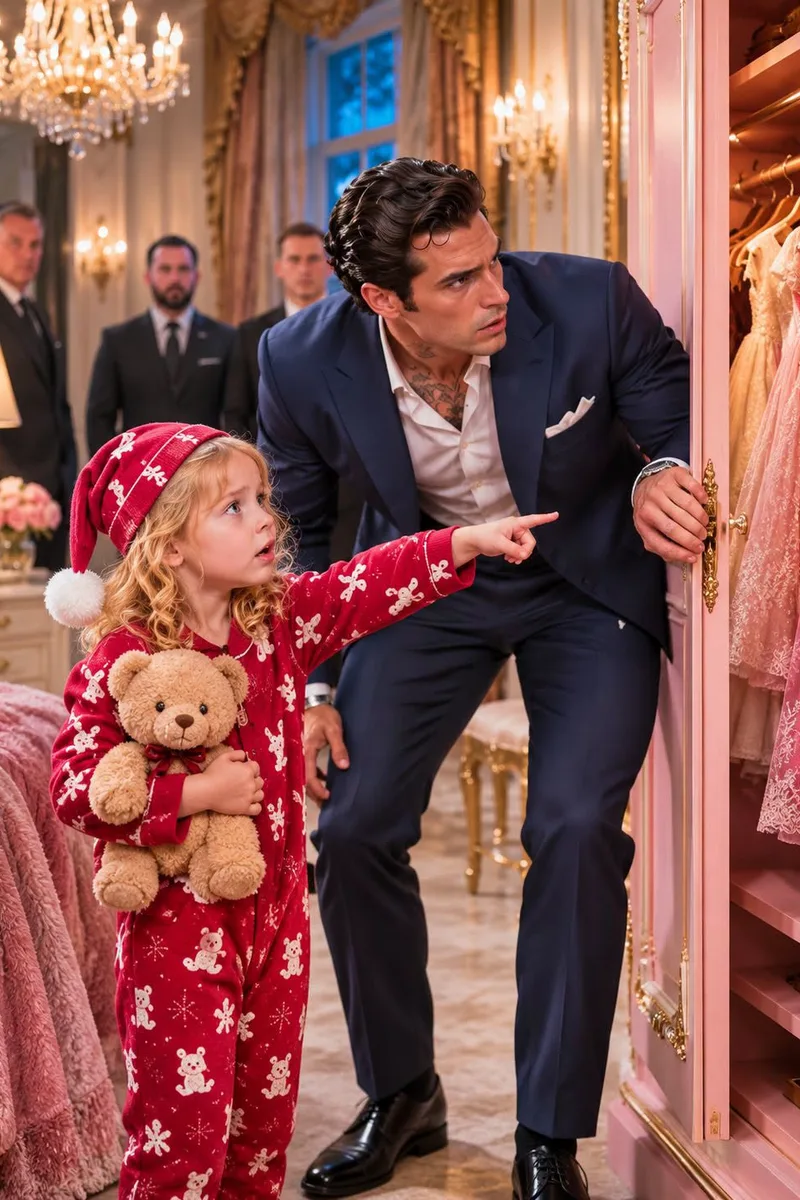
 My Five-Year-Old Daughter Told a Mafia Boss Someone Was Hiding in Her Closet, and He Believed Her
Chapter 10
The Closet Door
By the time Sophie turned six, her school photograph showed a wide smile and a missing front tooth. She insisted on wearing the same yellow-star shirt she'd loved at five, though the sleeves were too short. I stood behind the photographer and watched her straighten the collar herself. She had once been a child who couldn't bear to close a closet door. Now she was annoyed because the photographer kept telling her to sit still when she wanted to show her new tooth. I almost laughed aloud.
The legal case had not ended in a single miraculous hearing. Paul's attorney contested parts of the evidence, prosecutors presented the records they could support, and the court considered the issues through the proper process. I stayed informed through the victim advocate and my lawyer without attending every session. Eventually Paul pleaded guilty to unlawful entry and prohibited surveillance under an agreement reviewed in open court.
The judge imposed supervision and conditions intended to prevent further access violations. It was not an answer to every question, but the admission established responsibility for the conduct that had frightened Sophie. I did not ask her to celebrate. She was a child, not a juror, and she had already done the brave thing that mattered to us.
The investigation did not publicly establish every person who had sought information from inside the Moretti estate. The police identified improper access and communication linked to the charged conduct, but some questions about who had wanted the information remained unresolved. Dante was angry about that uncertainty, according to Vincent. I understood. It was difficult to live with missing pieces. But I had learned that inventing an answer to make fear stop could be its own kind of harm.
Dante sent Sophie a birthday card through the office address we had agreed upon. It had a picture of a yellow moon and a note saying he hoped her new year would be full of ordinary adventures. She smiled when I read it aloud. Then she set it beside the paper bridge she'd kept from school and ran to join her friends in the courtyard. I was glad he had believed her. I was also glad she could remember his kindness without feeling that she belonged to his world.
Vincent's last letter arrived a few weeks later. He told me the household's new reporting policy had already been used by staff to identify a safety problem before anyone was hurt. He did not describe the details, and I didn't ask. The important part was that a worker had spoken and been taken seriously. I wrote back that I hoped the procedure would outlast the people currently in charge. He replied with a simple thank-you. I placed the correspondence in a folder and stopped checking it every day.
At the hotel Ms. Patel offered me a permanent supervisory role. The raise was modest, but the position included training responsibilities and a schedule that fit Sophie's school hours. I accepted after reading the contract and asking a few questions about overtime. The conversation was so normal it almost made me cry. Nobody asked me to pledge loyalty to a family, or keep secrets about a household's private life. I was being asked whether I could do a job, and the terms were written where I could examine them.
Sophie helped me celebrate by making a paper crown. She placed it on my head and announced that I was queen of the kitchen. I told her I'd settle for being good at finding missing ingredients. She declared that queens could do both.
We ate pizza from a box on the floor because the table was covered with school projects. I looked around the apartment and saw how fully it had become ours: mismatched chairs, drawings on the refrigerator, a coat hook at Sophie's height, and books stacked beside the couch.
One rainy night Sophie woke from a dream and called for me. I went to her immediately. She said she'd seen the red eye again, but this time it had been in a cartoon she'd watched at a friend's house. I asked whether she wanted to talk about it or simply sit together.
She said she wanted me to check the closet. I opened it, showed her the shelves and the clothes, and stood beside her until she said she was satisfied. I did not tell her she was too old to be scared.
Afterward she asked why I had believed her only after Dante did. I sat on the edge of her bed and answered as honestly as I could. "I thought I knew what was in your room," I said.
"I wanted you to feel better, so I told you it was a shadow instead of asking enough questions. I was wrong." She considered that for a long time. Then she asked whether grown-ups could be wrong about other things. I said yes, and that the important part was learning to listen and correct what they could.
"Will you believe me next time?" she asked. I wanted to promise I would know immediately whether every story she told was true. Instead I said I would listen carefully, check what could be checked, and take her fear seriously even if I didn't understand it yet. She nodded. The answer seemed to satisfy her more than a grand promise would have. She asked me to leave the moon night-light on and went back to sleep with her teddy bear under her arm.
My mother visited the next morning and found me making pancakes. She asked whether Sophie had slept well. I said she had eventually, and told her about the conversation. My mother smiled sadly. "That's parenting," she said. "You keep finding out what you don't know." She helped me flip the pancakes, and we talked about school supplies and the coming holiday rather than the mansion. I realized I hadn't mentioned Dante in days. His decision had changed the course of our lives, but it no longer governed every hour of them.
That afternoon Sophie took me to the courtyard to show me a chalk drawing. She had drawn three houses connected by a winding road: Grandma's, ours and the school. Beside our house she drew a moon and a small child holding a teddy bear. "That's me," she said, pointing.
"And that's where I can tell you things." I asked what the road meant. She said it was how we got to places, and that roads were better when you knew where you were going. I took a picture and let her return to her friends.
Before bed I put the photograph beside my employment contract and the folder of court documents. The papers told the story of a danger people had slowly learned to name. The photograph told another story: a child with a home she could describe, a mother who had learned to listen, and a life that was no longer arranged around someone else's power.
I checked the hallway lamp, kissed Sophie goodnight, and closed my own door halfway. From the next room she called, "Mama?" I answered at once. "I'm here." She went back to sleep knowing I had heard her.
The End









