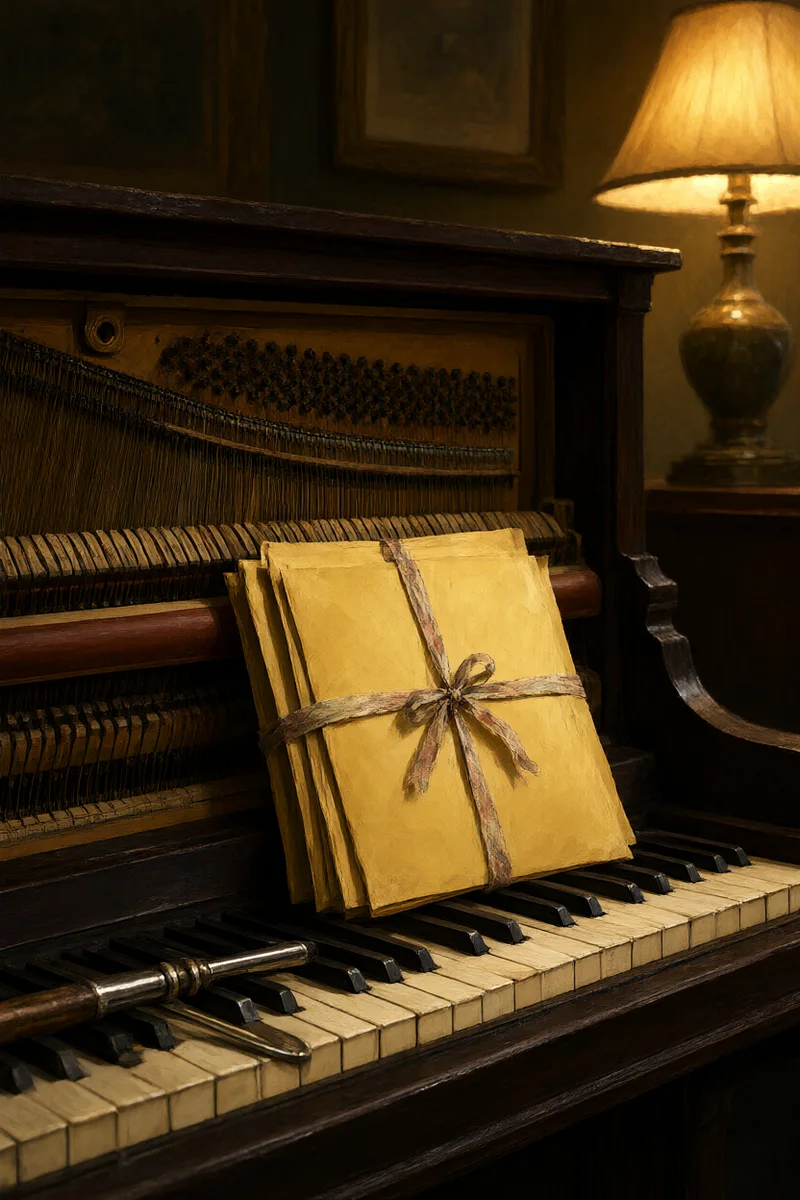
 Letters Behind the Soundboard
Chapter 4
The Side of the Last Key
Every tuner signs his work somewhere the customer never looks. Gus Halloran signed his on the side of the top key.
Wren went back to the shop in the dark, lifted the fallboard off the Varga upright, and drew out the eighty-eighth key like a long wooden tooth. The pencil column ran most of its length. G.H., Apr 68. G.H., Oct 68. Twice a year, as regular as church, all the way down to G.H., Nov 94.
It did not stop there. He had gone on tuning that piano every spring and fall until his hands gave out in 2012. She counted the entries. Thirty-six visits after the one where Miss Varga handed him the bundle, and on every one of them he had sat with his knees a foot from it.
Birchfield House let visitors in at nine. Her father was eighty-four and at his best in the mornings. She found him in the sunroom with a crossword, and she put the strip of red felt on the newspaper in front of him.
He looked at it. Then he took his glasses off, and that was how she knew he was going to tell the truth, because he had never been able to lie without them.
“Where'd it shake loose?” he said.
“The D below middle C.”
“It was always going to be that rib.” He rubbed his eyes. “Sit down, Wren.” She stayed standing.
“Seventy-six,” he said. “I was coming back from a job in Marlow, late, the night the boy went. There was a dark pickup pulled off on the quarry road. Marsh came round asking, and I told him. He said, Pruitt's? And I said, could have been. Half the county drove a dark pickup. By the time it was typed up, could have been had turned into was, and I signed it. I had a shop six months old and you in a crib. I wasn't going to argue with a constable over one word.”
“And in ninety-four?”
“She gave me the packet in her front hall and I read the top one in the van. Ten o'clock at the Marlow depot. And there's me, eighteen years on record putting his brother at the quarry.” His hands had started their tremor on the armrests. “I meant to take them Thursday. Then it was the Thursday after. Come spring they were still in my case, and I put them where I'd never have to carry them again and nobody could say I'd burned them.”
“You tuned around them. Thirty-six times.”
“I wedged them tight so they wouldn't buzz. I heard them anyway.”
“There was a little girl asking if she had an uncle, Dad.”
He didn't answer that. After a while he said, “Will he come here? Pruitt?”
“I don't know what he'll do. I wouldn't blame him.” She left the felt lying on his crossword.
Her phone rang before she had the van in gear. She had given Daniel Pruitt her number the night before and had not expected him to use it.
“I've been on to directory assistance since eight,” he said, without a hello. “There's no Tomas Pruitt in Port Selby and there never has been. So I rang the address on the back of the envelope. It's still a boatyard. A woman answered, young by the sound. I asked for Tom Pruitt and she said nobody of that name. I nearly put the phone down.” His breathing was loud on the line. “Then she asked who was calling. I told her. And she laid the receiver on something, didn't hang up, and I heard her go off shouting across the yard.”
“Shouting what?”
“Dad,” Daniel said. “And then she called him Tom Varga.”
The End









