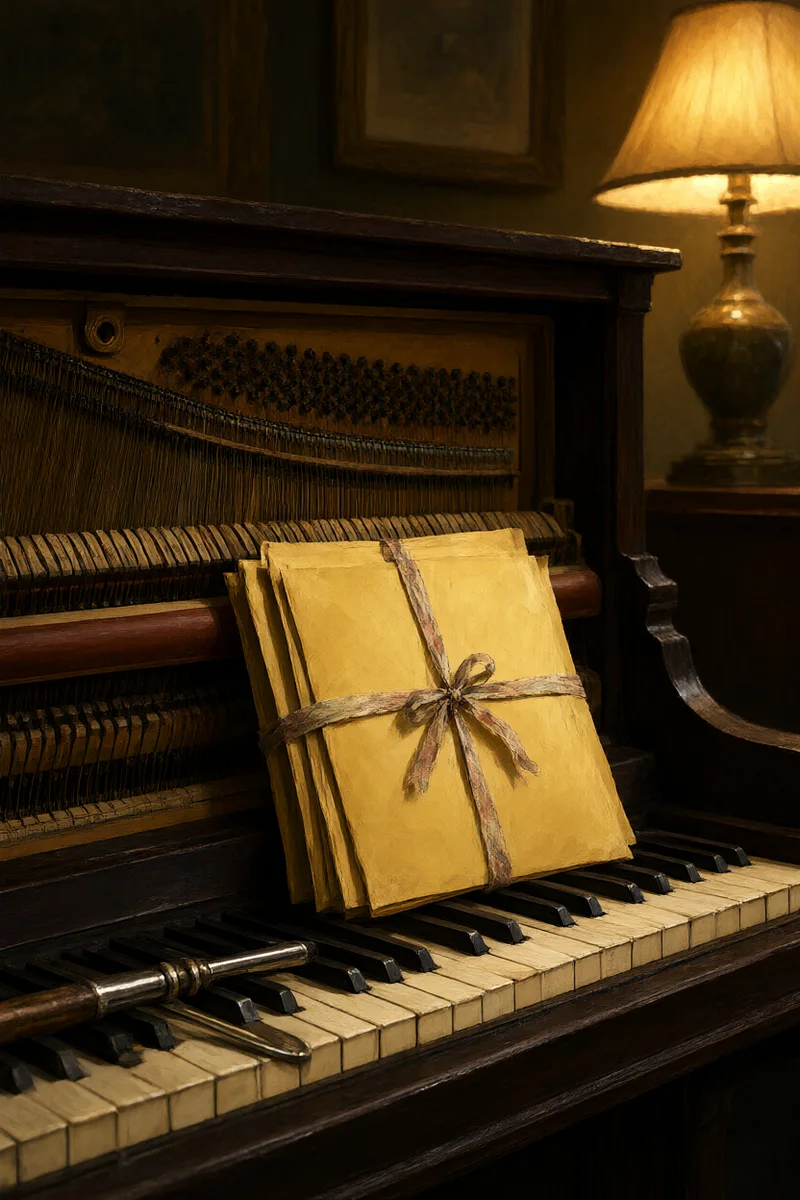
 Letters Behind the Soundboard
Chapter 1
A Rattle on the D
Wren Halloran paid forty dollars for the Varga piano, and the nephew running the estate sale looked relieved enough that she suspected she could have had it for twenty.
It was a walnut upright from the 1920s, with a cigarette burn on the lid and a tone under the dust that made her stop talking in the middle of a sentence. Edith Varga had taught half of Addle Creek their scales on it. She had died in April at ninety-one, and by October her house on Calloway Street was down to price stickers.
Wren had never had her hands inside it. Her father had tuned that piano for decades, and when he retired in 2012 Miss Varga had announced that her ears were going and it no longer mattered.
Two men from the feed store helped get it into the shop. Wren gave it a day to settle, then sat down and played every note from the bottom up, the way her father had taught her before he taught her anything else.
Eighty-seven keys answered cleanly. The D below middle C rattled. It was a papery buzz, like a wasp caught in a lampshade.
She checked the obvious things first. No loose screws in the bottom board, no pencil rolling around behind the kickboard, no coin on the keybed. The buzz was coming from the back.
She walked the piano out from the wall and knelt behind it. A dust cloth was stapled over the back posts, black cambric gone brown with age. One corner had been lifted at some point and tacked down again with newer staples. It wasn't factory work. It was careful work, though.
Wren pried the staples out with a tack lifter and folded the cloth back.
Between the second post and the soundboard, pressed flat against a rib, sat a bundle the size of a paperback. It was bound with a strip of red tuning felt, knotted twice, the ends cut on a slant.
She eased it out. Envelopes, eleven of them by the edges, the paper gone soft as cloth. No stamp on the top one. No postmark. The address was written in a schoolteacher's upright hand, and when she fanned the corners, the same hand had written the same address again and again.
Mr. Daniel Pruitt, 14 Larch Row, Addle Creek.
Wren sat back on her heels on the shop floor.
Larch Row was three streets over. She passed the end of it every time she walked to the bank. And she knew the name the way everyone in town knew it, the way you know which bridge somebody once jumped from.
In the summer of 1976, sixteen-year-old Tomas Pruitt went out one night and did not come home. They dragged the flooded quarry for a week. They questioned his older brother for three days, because the two of them had been heard shouting in the yard, and because a witness had put Daniel's truck on the quarry road. Nobody was charged. Nobody was found. Daniel Pruitt stayed on in the house on Larch Row and the town stayed out of it, and that arrangement had held for fifty years.
Wren had been four months old that summer. She had inherited the story along with the shop.
She turned the bundle over. On the flap of the top envelope, small, in pencil, Miss Varga had written a date.
15 August 1976.
The boy had vanished on the fourteenth. Wren knew that too; the Courier ran the photograph every tenth anniversary, a thin kid squinting beside a bicycle.
Whatever Edith Varga had needed to say to Daniel Pruitt, she had started saying it the very next morning. Then it had ended up inside the one object in her house that nobody would ever think to open.
Wren put on her coat.
The End









