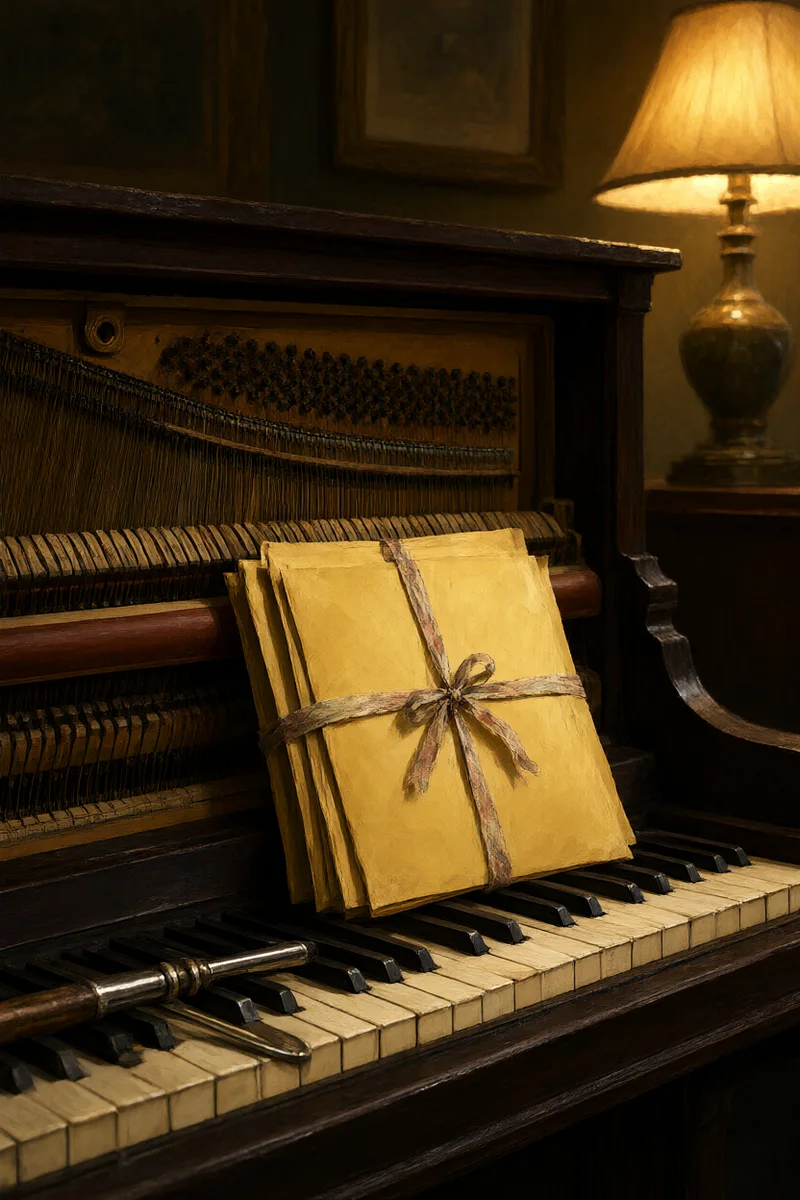
 Letters Behind the Soundboard
Chapter 3
Care of Miss Varga
They read the rest at the kitchen table while the light went out of the window. Daniel opened each one himself now, read it, and passed it across, and Wren laid them in a row by their pencilled dates.
None of them was finished. Ten letters across eighteen years, and every one stopped partway down the page, like somebody turning back at a door.
From 1979: “A card has come from Tomas at Christmas, care of my cousin Ilse, who has him working in her boatyard. He asks after you. I have written back that you are well also, which I do not know, because I cross the street when I see you, and I am the only one with no excuse for it.” From 1983, a single line: “I sat outside your house in the car on Sunday for an hour with the engine running.”
From 1989: “Your father was buried on Tuesday. The reason for my promise is in the ground, and I find that I have become the reason myself. How does a woman knock on a door and say, I let them think it of you for thirteen years”
“She came to the funeral,” Daniel said. “Brought a casserole. I thought it was decent of her. Nobody else came.”
The eleventh envelope was different: thicker than the rest, and with a stamp. It had been through the post. The postmark said Port Selby, 2 November 1994, and it was not addressed in a schoolteacher's hand. Mr. Daniel Pruitt, care of Miss E. Varga, 9 Calloway Street.
Daniel made a small sound. He touched the capital D, which had a hook on it like a fishing barb.
“He always made them like that. She used to mark him down for it.”
The envelope had been slit along the top with a knife. He drew out a single sheet of lined paper, and this time he did not pass it over. He read it aloud himself, slowly, a man walking on ice.
“Danny. Miss Varga says Dad's five years dead, and that you've known where I am a good while and would sooner let it lie. I can't blame you. I got out and left you in that house with him. But I'm thirty-four and I have a little girl who wants to know if she has an uncle, and I'd like to hear it from you and not from a piano teacher. The yard's address is on the back. If nothing's come by spring I'll take that as your answer and not trouble you again. Tom.”
He put the page down. “I never knew where he was. I never knew he was anywhere.”
“She told him you did.”
“She told him I didn't want him.” He got up, went to the sink and ran the tap over nothing. “Thirty-two springs.”
There was one more thing in the envelope, a half-sheet folded small. Wren opened it because he had his back turned. It was Edith Varga's hand again, less steady, and for once the writing ran to the bottom of the page and was signed.
“Daniel. I have lied to both of you and I cannot bring these to your door. I have been a coward since 1976. I have asked Mr. Halloran to carry them; he passes Larch Row every Thursday on his way to the Dunns'. You will have them this week. Do as you like about me afterward. E.V., 9 November 1994.”
“Halloran,” Daniel said from the sink. He had turned around. “Gus Halloran, the tuner. That'd be your”
“My father.”
She was looking at the strip of red felt on the table. Both ends were cut on a slant. Her father cut every strip of felt he ever used on a slant, so that he would know his own work when he met it again.
The End









