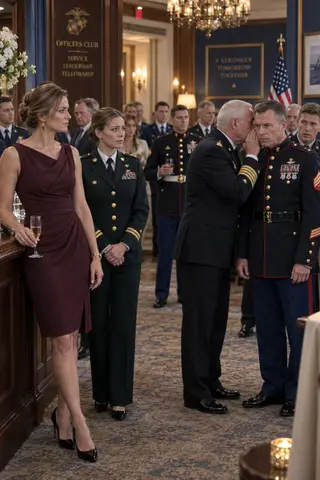
 He Told A Woman In A Dress That Ladies Fly Desks
Chapter 8
The Crisis Simulation
Three days later, the symposium transitioned from theoretical presentations to the high-stakes synthetic battle lab at Naval Air Station Oceana.
The synthetic arena was a massive, dimly lit dome filled with tiered tactical consoles, digital radar displays, and real-time telemetry links. Here, the Navy and Marine Corps tested new doctrine using multi-million-dollar simulators that replicated high-end combat against near-peer adversaries.
Fifty senior officers sat in the elevated observation gallery, watching the glowing blue and red tactical tracks on the central holographic board.
At Console One sat the simulation strike lead: Lieutenant Commander Marcus Cole, Marlowe’s former lead pilot, flying an F-35C simulator. At the central command console stood myself, overseeing the dynamic strike package, with Lieutenant Keira Lin managing our surface-to-air radar tracking links.
"Scenario begins in sixty seconds," the exercise director’s voice boomed over the intercom. "Red Force has deployed long-range anti-ship cruise missiles along the strait. Blue Force carrier group must neutralize the coastal battery within ten minutes or the carrier takes multiple hits."
Cole’s voice crackled over the tactical net from his simulator pod down the hall. "Strike lead copies. We’re pushing high-altitude supersonic penetration. We’ll paint the targets from forty thousand feet and drop long-range glides."
It was Marlowe’s old doctrine—arrogant, rigid, and relying entirely on technological stealth while ignoring the dynamic weather layering programmed into the scenario.
"Negative, Strike Lead," I spoke into my headset, my voice calm and authoritative. "The weather model indicates heavy radar-reflective chaff and low-level cloud cover over the target zone. Your laser designators won't penetrate from forty thousand feet. You'll drop blind."
"With respect, Captain," Cole’s voice came back, tight with residual loyalty to his disgraced mentor. "Our stealth profiles are designed for high altitude. We don't drop into the dirt. We can make the lock."
"He’s deviating from the brief," Keira whispered, her eyes tracking the glowing blue dot of Cole's aircraft on her display. "He’s committing to the high-altitude run, ma'am."
"Let him try," I said quietly. "Watch the red telemetry."
Thirty seconds later, Cole’s flight reached the release point.
On the massive tactical display, three simulated glide bombs detached from his aircraft. But as they entered the heavy cloud bank, their guidance telemetry scrambled. The radar tracks wobbled, lost lock, and detonated harmlessly on empty sand dunes three miles from the enemy missile battery.
Instantly, the simulator's artificial intelligence reacted.
BEEP-BEEP-BEEP.
A cluster of red threat rings bloomed across the screen.
"Warning: Surface-to-Air Missile Launch," the computer announced. "Target: Blue Strike Lead."
"I'm spiked! I'm spiked!" Cole’s voice suddenly climbed an octave, the cool professionalism shattering under the synthetic pressure. "Chaff isn't working! Missile tracking at Mach 4! I can't break lock!"
From the observation gallery, Admiral Vance and the visiting Pentagon observers leaned forward, their brows furrowed. The simulation was spiraling toward a catastrophic Blue Force defeat in front of the entire operational testing board.
"Lieutenant Lin," I said, my voice cutting through the panic on the net like a scalpel. "Give me low-level radar corridor through the southern valley."
"Corridor mapped, Captain," Keira answered instantly, her fingers flying over the console with lightning speed. "Ridge line provides radar masking below two hundred feet. Minimum clearance fifty feet above terrain."
I flipped the toggle on my master tactical override.
"Strike Lead, transfer operational control of trailing element to Valkyrie-Actual," I commanded. "Break right, deploy towed decoys, and pull maximum Gs into the cloud deck. I am entering the net."
I sat down at the secondary flight tactical interface, sliding my fingers into the familiar throttle and stick controls of the wing commander’s override station.
On the main screen, the two trailing Super Hornets—previously flying in reserve—snapped into action. Under my direct inputs, the digital aircraft pitched downward in a violent, gut-wrenching spiral, diving straight from thirty thousand feet into the jagged teeth of the coastal mountains.
"She’s too low!" an Air Force colonel whispered in the gallery. "She’ll auger in!"
"Watch her," Vance said quietly.
On the screen, my aircraft skimmed the canyon floor at five hundred and twenty knots, carving through the digital valleys, using the mountain peaks to shatter the enemy radar locks. The simulated g-meter spiked to 7.8 Gs.
"Target acquired," Keira called out, her voice ringing with absolute confidence. "Targeting pod locked on the coastal battery. Five seconds to release."
"Pickle," I said.
Two simulated precision weapons parted from my wings, skimming over the ridge and slamming dead-center into the enemy missile bunker. The massive red icon on the central display shattered into a brilliant shower of blue sparks.
"Target destroyed," the computer voice announced. "Threat neutralized. Carrier Strike Group secure. Simulation complete."
Silence hung in the dark room.
Then, from the back of the simulator bay, Lieutenant Commander Cole stepped out of his flight pod, sweat soaking his green flight suit. He walked slowly across the floor, climbed the steps to my console, and stopped at attention.
He looked at me, then at Keira, and swallowed hard.
"Captain," Cole said, his voice humbled and utterly sincere. "I was wrong. My doctrine would have killed my flight. Thank you for the save, ma'am."
I looked at him, nodding slowly. "Debrief in twenty minutes, Cole. Bring your telemetry tapes. We have work to do."
The End









