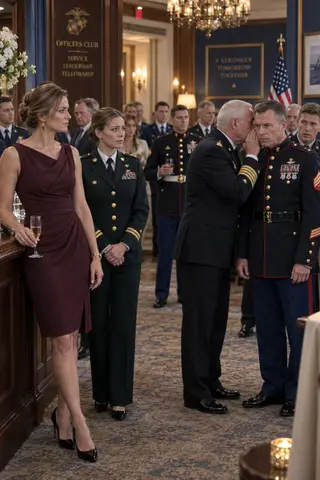
 He Told A Woman In A Dress That Ladies Fly Desks
Chapter 5
Tactical Insubordination
For forty-five minutes, the auditorium was held in a trance.
I broke down the engagement not as a heroic war story, but as a masterclass in tactical geometry. I showed the radar tapes. I played the sanitized radio logs. I demonstrated how high-speed low-altitude passes, executed with precision timing, broke the back of an enemy assault when artillery was useless.
Through it all, Colonel Derek Marlowe sat like a man strapped into an electric chair.
Every officer in that room who knew anything about the Syrian theater knew who the ground commander had been that day. Marlowe had built his entire post-combat reputation on the defense of the Al-Qaim ridge. He had received the Legion of Merit for holding the perimeter. He had paraded the story through every officer's club and promotion board for six years.
He had always claimed that his men held the ridge with pure grit until the enemy miraculously withdrew. He had conveniently left out the naval aviator who had broken the cloud deck at mach-point-nine and turned the enemy’s flanking armor into scrap iron thirty yards from his trench.
When I concluded the presentation and closed my binder, the auditorium erupted.
The applause wasn't polite; it was deafening. Flag officers, young ensigns, hardened Marine gunnery sergeants sitting in the observer gallery—everyone was on their feet. In the balcony, Keira Lin was clapping so hard her hands were crimson, a fierce, triumphant grin lighting up her face.
I raised a hand to quiet the room. "We have ten minutes for questions. Microphone in the center aisle."
Officers lined up immediately. The first two questions came from Air Force strategists asking about fuel reserves and sensor fusion. I answered them directly, citing exact flight parameters and munitions tolerances.
Then, the center aisle parted.
Colonel Derek Marlowe stepped into the light.
His fellow officers tried to pull him back; I saw Colonel Bennett reach out to grab his sleeve, but Marlowe ripped his arm away. His face was flushed with a dangerous, unstable mixture of humiliation, desperation, and wounded pride. He looked like an animal that knew it was cornered and was choosing to lunge at the hunter’s spear.
He grabbed the microphone stand. The feedback squealed through the hall.
"Captain Cross," Marlowe said, his voice grating and thick.
"Colonel Marlowe," I replied, meeting his bloodshot eyes.
"An impressive presentation," Marlowe sneered, leaning into the mic, desperately trying to project authority to the hundreds of men watching him. "Very clean. Very cinematic. But powerpoint slides don't capture the chaos of the mud. You talk about precision, but ground troops don't fight in sterile geometry. From where I was sitting on that ridge, that pilot dropped unguided ordnance within the minimum safe distance. It was reckless. It was a violation of the Rules of Engagement that could have killed thirty Marines."
A collective gasp sucked the air out of the auditorium.
Behind me, Admiral Vance stood up from his front-row seat, his face thunderous. "Colonel Marlowe, you are out of line—"
"Stand down, Admiral," I said quietly into my microphone.
My voice was soft, but the authority behind it was absolute. Vance paused, then slowly lowered himself back into his seat, his jaw set like concrete.
I stepped away from the podium and walked to the edge of the stage, looking down at Marlowe.
"Minimum safe distance for a GBU-38 JDAM is two hundred and fifty meters, Colonel," I said, my voice echoing off the walls. "Do you remember where the enemy armored personnel carrier was when it opened fire on your command post?"
Marlowe swallowed hard, his throat clicking. "That was six years ago. In the fog of war—"
"Seventy meters," I cut in. "It was seventy meters north-northwest of your foxhole. You had two wounded Marines bleeding out in the dirt. Your squad automatic weapon was jammed with grit. And you were screaming into the radio handset, begging for anyone with wings to drop on your smoke."
Marlowe's knuckles turned white on the microphone pole. "I did what any commander would do—"
"No, Colonel," I said, taking one step forward. "You didn't. When the first pass cleared the ridge, you radioed back to the carrier strike group and demanded the pilot be reprimanded for violating safety protocol—even as the enemy was retreating and your wounded were being loaded onto medevac birds."
I looked at him with cold, unwavering pity.
"You took credit for saving that ridge on your promotion board, Colonel. But you made sure the after-action report buried the pilot's callsign. You told your staff officers that a woman couldn't possibly have made that dive through the dust storm—that it must have been an Air Force strike from Incirlik."
The room was dead silent. Every eye in the auditorium was boring into the back of Marlowe's neck.
"I didn't care about the credit then, Derek," I said, dropping the formal rank and speaking directly to his soul. "I cared about bringing your boys home alive. But do not stand in this room, in front of these junior officers, and pretend that the women flying your combat cover are sitting behind desks. Because the next time you're pinned down in the dirt, it won't be your ego that saves you."
Marlowe stood frozen, his chest heaving. He tried to speak, but only a dry, choking gasp escaped his lips.
He looked around the auditorium. The men he had joked with, the captains he had postured for, the admirals whose favor he had courted—every single one of them was looking at him with utter disgust.
Marlowe let go of the microphone. It swung on its stand, whining softly, as the colonel turned on his heel and fled through the rear exit into the blinding daylight.
The End









