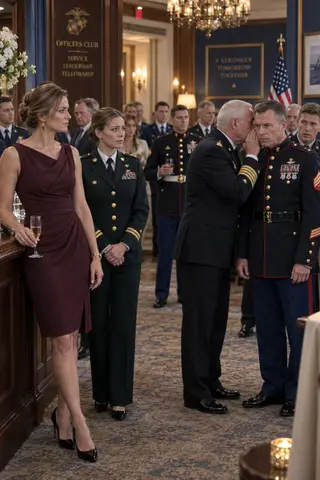
 He Told A Woman In A Dress That Ladies Fly Desks
Chapter 4
The Golden Wings and the Silver Star
She did not wear charcoal today.
I walked to the center of the stage in the full Navy Service Dress Blue uniform. The four thick gold stripes on my sleeves caught the stage lights, signifying the rank of Captain—the naval equivalent of Marlowe's eagle, but held with the operational authority of an air wing commander.
Above my left breast pocket, pinned against the crisp navy wool, sat the golden Naval Aviator Wings. They were not modern, machine-stamped metal; they were my father's wings, tarnished slightly at the tips, worn smooth by thousands of hours of high-G turns and desert sun.
Beneath the wings hung seven rows of ribbons.
At the very top, resting in the position of honor, was the pale blue ribbon of the Navy Cross—the nation's second-highest military decoration for valor, second only to the Medal of Honor. Beside it rested the Silver Star and the Distinguished Flying Cross with a bronze Combat 'V' device.
As the applause swelled and then settled into a tense, respectful quiet, my gaze swept across the front rows.
I found Colonel Derek Marlowe immediately.
He was standing four rows back in the center aisle. He looked as though someone had driven a bayonet through his spine. His chin was raised, but his mouth hung slightly open, his eyes fixed on the top row of my ribbons. His breath was coming in short, visible hitches.
Beside him, his fellow colonels were staring at me, then looking sideways at Marlowe, their expressions shifting from polite curiosity to sudden, horrifying realization. Word of the previous night's barroom insult had clearly circulated, but none of them had imagined this.
"Be seated," I said.
The command was quiet, delivered without shouting, but six hundred bodies dropped into their chairs in unison.
I set my leather binder on the lectern, looked out over the sea of uniforms, and let the silence hang for five long seconds. I didn't glance at my notes. I didn't rush to break the tension. In a cockpit, rushing is how you end up in the side of a mountain.
"Twenty years ago," I began, my voice carrying cleanly through the high-definition speakers, "a young woman entering naval aviation was told that certain missions were beyond her capability. She was told that dynamic combat required an instinctive aggression that could not be taught to someone who didn't fit the traditional mold."
A few heads in the audience shifted. Keira Lin, sitting high up in the balcony, leaned forward so far she was nearly resting on the railing.
"The argument was simple," I continued, holding Marlowe’s gaze from forty feet away. "They said that flying the 'hard stuff' required a constitution built for dirt and blood, while others were better suited for desks. For paperwork. For filing logs."
A cold, electric shock rippled through the front rows. Marlowe flinched as if he had been slapped with an open palm. A bead of sweat broke on his forehead, rolling down his temple and catching in the gray stubble near his ear.
"The enemy, however," I said, leaning slightly over the lectern, "does not check your gender when their surface-to-air radar acquires your signature. The mountain range does not care about your traditions when you are punching through a zero-zero ceiling at five hundred knots. The only thing that matters between the dirt and the sky is precision, courage, and the discipline to execute when everyone else has run out of ideas."
I opened my folder and brought up the first slide on the massive digital projection screen behind me.
It was not an organizational chart. It was an overhead satellite view of a jagged, barren river valley in Deir ez-Zor Province, Syria. The coordinates were clearly visible in the lower left corner: Grid 38S MB 44102 91823.
Marlowe's face went from pale to completely bloodless. His hands gripped the armrests of his theater seat with enough force to warp the plastic.
"On October 14, 2018," I said, my tone flat, clinical, and deadly calm, "a joint reconnaissance element was ambushed three miles south of this ridge. They were pinned down by an entrenched battalion equipped with 23-millimeter anti-aircraft guns and heavy mortars. The weather was classed as non-operational: heavy haboob dust storm, visibility under fifty feet, cloud base scraping the ridge."
The room was so quiet that the hum of the air conditioning sounded like a jet engine.
"Every land-based air asset in theater refused the sortie," I continued. "Standard operating procedure dictated an abort. But the ground commander on that ridge was screaming into his tactical radio that his boys had twenty minutes of ammunition left."
I paused, clicking the remote. A line of yellow flight telemetry appeared on the map, tracing a violent, impossible descent through the mountain pass.
"One two-ship flight from the USS George H.W. Bush accepted the divert," I said. "And today, we are going to talk about why that flight succeeded—and what happens when pride blinds a ground commander to the reality of the skies above him."
The End









