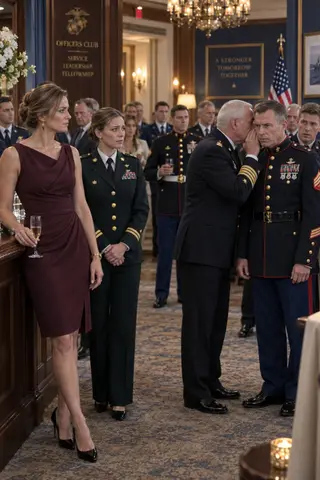
 He Laughed At The Woman In The Bar And Said 'Ladies Fly Desks.' Then The Admiral Walked Over, Whispered One Sentence, And The Colonel Turned Ghost White Before Dropping…
Chapter 6
Walking the Corridor
The private corridor behind the main ballroom was blessedly quiet. The heavy velvet drapes absorbed the distant murmur of the symposium, leaving only the steady hum of the building's climate control system and the rhythmic click of our shoes against the patterned carpet.
Admiral Vance walked with a slight limp—a souvenir from a rough ejection over the Mediterranean back in the nineties that he refused to let anyone talk about.
“You’re looking well, Sarah,” Vance said without looking sideways, keeping his eyes fixed on the double doors at the end of the hall. “Civilian life treating you right? Or are you secretly bored out of your mind working as an aerospace consultant for defense startups?”
“It has its moments,” I replied, stepping around a brass fire extinguisher housing. “Nobody shoots missiles at me during board meetings, which is a nice perk. But sometimes, when I hear a jet breaking the sound barrier overhead on a clear afternoon... I miss the view.”
Vance nodded slowly. He knew that feeling better than anyone. Aviation was a sickness you never truly cured; you only learned to manage the symptoms.
“Marlowe has been skating on thin ice for three years,” Vance said, his tone turning clinical. “Friends in high places, good political connections, excellent at kissing up and kicking down. But guys like that always trip over their own arrogance eventually. Tonight, he just happened to trip over a four-star who remembered your name.”
“You didn't have to drop the hammer quite that hard, Tom,” I said, though there was no heat in my voice.
“The hell I didn't,” Vance retorted, stopping outside a heavy oak door marked Private Conference Suite B. He turned to face me, his gray eyes piercing and unyielding. “Culture doesn't change because we write polite memos about inclusion in quarterly newsletters, Sarah. Culture changes when dinosaurs like Marlowe realize there is an immediate, devastating cost to being small-minded in public.”
He pushed the door open, revealing a quiet, well-lit conference room with a mahogany table, a steaming coffee urn, and a stack of secure tablet computers waiting for review.
“Besides,” Vance added with a faint, conspiratorial smirk, “I’ve been looking for an excuse to relieve him of command for six months. You just gave me the opening act.”
I stepped into the room, running a hand along the edge of the polished table. It was quiet here. No posturing contractors. No insecure colonels compensating for their lack of operational relevance with cheap whiskey and loud insults. Just work that mattered, done by people who understood the stakes.
“Alright, Admiral,” I said, sitting down in one of the leather chairs and pulling a stylus toward me. “Show me these impossible PowerPoint slides. Let’s see how badly the procurement office is trying to ruin naval aviation this time.”
Vance chuckled, taking a seat opposite me and tapping the screen of his tablet. “Oh, you’re going to love this, Sarah. They want to automate carrier-landing trajectory calculations using an algorithm designed by a software contractor who has probably never seen an ocean outside of a vacation brochure.”
For the next hour, the outside world vanished. We tore apart code architectures, debated sensor payloads, and argued over cross-wind tolerances with the fierce, joyful intensity of people who lived and breathed the science of flight. It was the familiar rhythm of my old life—sharp, analytical, and entirely merit-based.
The End









