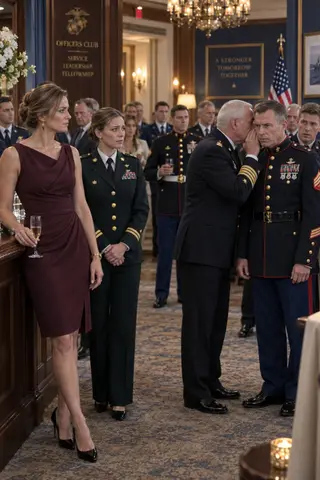
 He Laughed At The Woman In The Bar And Said 'Ladies Fly Desks.' Then The Admiral Walked Over, Whispered One Sentence, And The Colonel Turned Ghost White Before Dropping…
Chapter 1
The Weight of Silence
The hum of the HVAC unit inside the Capitol City Officer’s Club fought a losing battle against the collective drone of eighty senior officers, defense contractors, and mid-grade staffers swapping business cards like trading cards. Outside, a persistent mid-Atlantic drizzle smeared the neon streetlights into long, bleeding streaks across the glass. Inside, the air smelled like expensive bourbon, damp wool, and the unmistakable metallic tang of repressed panic.
It was the second night of the annual Joint Aviation Integration Symposium, a four-day exercise in mutual flattery disguised as strategic planning. For most attendees, it was a chance to posture, secure future post-retirement consulting gigs, or simply drink tax-payer-funded scotch while pretending to care about joint-service interoperability metrics. For me, it was a calendar obligation. A box to check. A reminder of why I had traded the deafening, beautiful roar of a twin-engine jet for the quiet, soul-crushing fluorescent glare of a Pentagon basement.
I stood near the far end of the mahogany bar, half-hidden by a marble pillar that served as my primary shield against small talk. I wore a simple charcoal sheath dress—no ribbons, no gold wings pinned to my chest, no rank insignia to broadcast my history to the room. To anyone looking, I was just another civilian contractor or administrative attaché blending into the background wallpaper. That was how I preferred it. For five years since hanging up my helmet, anonymity had been my favorite uniform.
"Excuse me, ma’am? Is anyone sitting here?"
I looked down. Standing beside me was a young woman wearing a Navy surface warfare pin on her lapel, her dress whites immaculate, her hair pulled back into a tight, regulation bun. Her name tag read Lin. Lieutenant Junior Grade Keira Lin. She had the unmistakable posture of someone who had graduated near the top of her class at Annapolis only to discover that the fleet was run by people who viewed junior officers as interchangeable spare parts. Her fingers wrapped nervously around a club soda with lime.
"No, it's all yours," I said, offering a small, reassuring smile. "Go ahead."
She exhaled a long breath, sliding onto the leather stool next to mine. "Thanks. I needed five minutes away from a contractor who wants to explain blockchain-enabled logistics to me for the third time tonight. I’m pretty sure my brain is about to leak out of my ears."
"Blockchain logistics is a proven weapon of mass distraction," I replied, catching the bartender's eye to signal for a refill of sparkling water. "If you nod aggressively enough, they usually wander off to find a full commander to bother within ten minutes."
Keira laughed, a genuine, bright sound that cut through the low roar of the room. The tension in her shoulders dropped an inch. "I'll try that next time. I'm Keira, by the way."
"Sarah," I said, omitting the last name and the former rank. In rooms like this, names were currency, and I preferred to keep my pockets empty.
"So, Sarah... what community brought you to the symposium? Are you deep in the acquisition trenches, or part of the congressional liaison team?"
It was a reasonable guess. Most women in this room who weren't in uniform were either managing congressional inquiries or buried alive in budget spreadsheets. I could have lied. I had a dozen carefully rehearsed cover stories designed to deflect further questioning without drawing notice. I could have said I worked in personnel management or operational research. It would have ended the conversation safely, allowing us both to sip our drinks in peaceful anonymity.
Instead, I looked at her open, tired face—a face that reminded me too much of my own reflection ten years prior, sitting in a ready room in the middle of the Arabian Gulf, wondering if I would ever truly belong—and the caution simply evaporated.
"Operations, mostly," I said softly, swirling the ice in my glass. "I used to fly Hornets."
Keira’s eyes widened, the polite indifference vanishing instantly, replaced by a sharp, electric curiosity. "Super Hornets? The F/A-18E/F?"
"Once upon a time," I murmured.
I didn't say it with pride or arrogance. I said it the way an old sailor might mention a shipwreck they barely survived—matter-of-factly, carrying the phantom weight of salt in their lungs. I didn't mention the three deployment cycles, the night carrier landings in zero-visibility squalls, or the combat missions over disputed airspace where the margin between coming home in one piece and becoming a statistic was measured in milliseconds. I didn't mention the bronze star resting quietly in a velvet box inside my apartment closet across town.
I just named the machine. The jet that had broken my heart, saved my life, and defined my youth.
That was my mistake. I had forgotten how sound travels in a room full of apex predators.
The End









