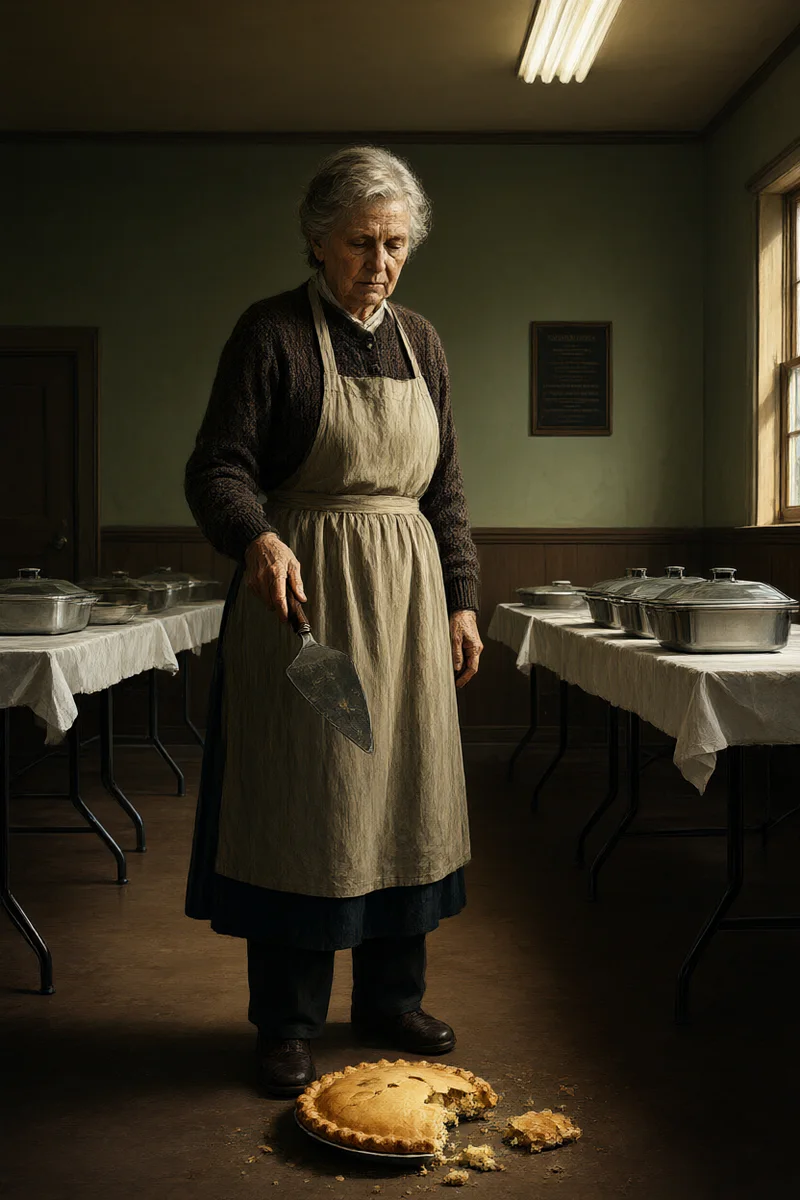
 The Harvest Supper
Chapter 5
One Table
“No,” Bernie said. “She didn't.”
She was on her feet. She did not remember standing. Seven board members and a young pastor turned to look at her, and so did Wilma, with an expression of real fury, and so did Faye from the back of the room.
“Sit down, Bernadette,” Wilma said.
“I've been sitting down for forty-two years.” Bernie came around the table to where they could all see her. She took the shoebox out from under Wilma's hand and opened it.
She told them. It took less time than it had taken in Faye's kitchen. She had said it twice now, and it was getting to be a thing that could be said. The forklift. The spare key, which was still, she told them, in the bottom drawer of the secretary's desk, because nobody had ever thought to take it out. The thirty-six dollars a month. The seven with the bar through it. She held up an envelope so they could see.
When she was done the hall was quiet except for the furnace kicking on.
The board president, a soybean farmer named Virgil Teague who had been eight years old in 1984, looked at the shoebox for a long time. “The money was all paid back,” he said finally. “By 1986.”
“Every dollar,” Bernie said. “That doesn't make it right. And it doesn't give Faye back what this church thought of her, or give Wilma back her brother.”
From the back, Faye Kimball cleared her throat. “It gives a little of it back,” she said.
Bernie turned to Pastor Jonah. He was very pale above his beard.
“I'd like you to take my name off the wall,” she said. “I'd like to turn in my keys. All of them. I'll stay on through the end of the year and train whoever you pick.”
They argued with her. Virgil Teague argued with her and two of the women on the board argued with her, and Pastor Jonah said it was a matter for grace, which was kind of him. But she had decided in the car outside Faye's house, and it held. A woman could not have her name over a door she'd once used a spare key on. That much she knew.
On Sunday after service they took the tablecloth down and the plaque came down with it, eight pounds of brass with her name cast into it. Virgil Teague carried it out to Bernie's car and put it on the back seat. It was in her garage for the rest of her life, leaning against the wall above Glen's workbench, and she did not mind looking at it.
Before the final hymn, she dropped one last plain envelope in the offering plate. It had thirty-six dollars in it, and on the front, in her ordinary handwriting, Building Fund, interest, B. Lusk.
The fellowship hall stayed the fellowship hall.
In November there was a Thanksgiving potluck, smaller than the Harvest Supper, and Bernie did the seating chart one last time before she handed over the job. She put three place cards together at the end of the long table nearest the coffee urns.
Wilma brought sour cream raisin. Faye brought green tomato relish in the cut-glass dish. They did not quite look at each other while the blessing was said, and Bernie, sitting between them, could feel them both on either side of her, upright as fence posts.
After the amen, Faye picked up the relish and held it out across Bernie, toward her sister-in-law.
Wilma took it. She spooned some onto her plate, and tasted it, and set her fork down.
“It needs salt,” she said.
“It always did,” said Faye. “Harold used to say so.”
Wilma passed her the salt.
The End









