 The Harvest Supper
Chapter 2
The Spare Key
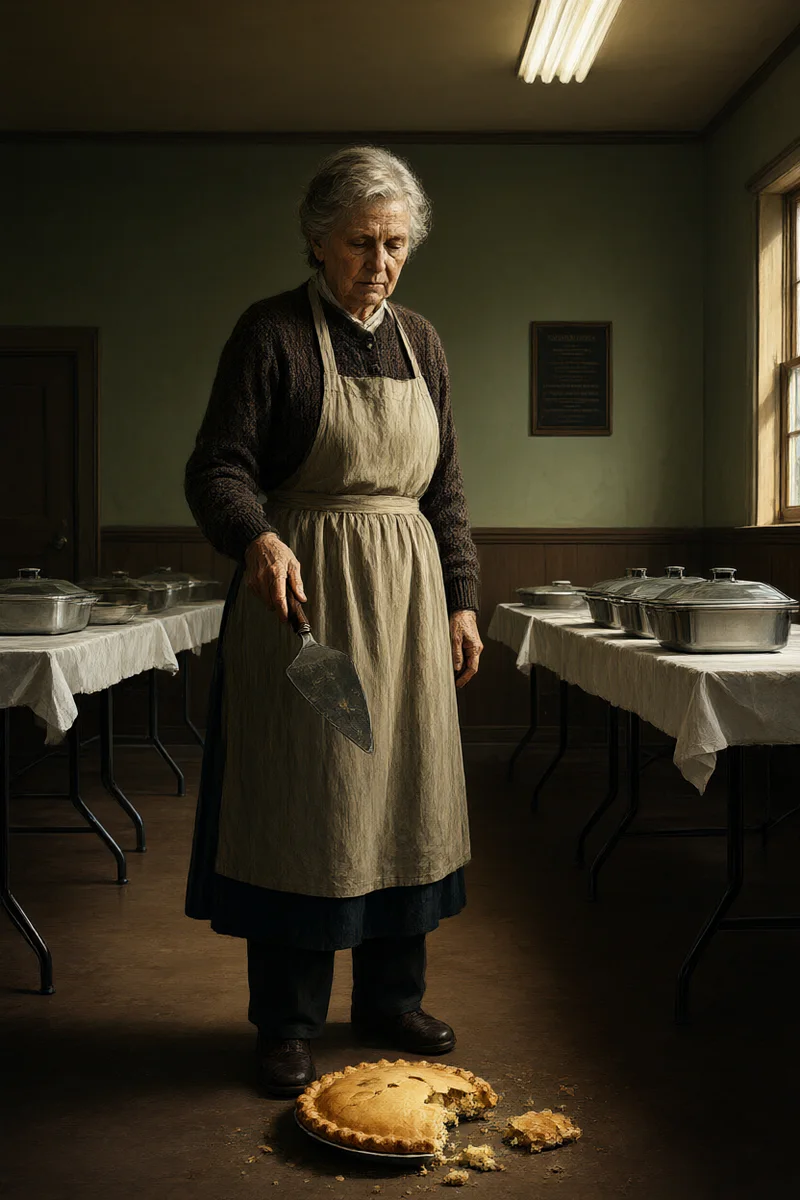
Afterward she washed dishes. It was what she knew how to do. The hall emptied in murmuring knots, and the plaque stayed under its tablecloth, and Bernie stood at the deep steel sink in the church kitchen with her sleeves pushed up and the water as hot as she could take it.
April of 1984. She had been twenty-six, and Glen had been twenty-nine, and in February a pallet of feed sacks at the mill had come down off a forklift onto his back.
The surgeon in Springfield wanted nine hundred dollars before he would schedule. The insurance would pay him back, eventually. The mill would pay Glen's disability, eventually. Eventually was eleven weeks, and Glen could not sit up in bed, and he was crying at night in a way he thought she couldn't hear.
The building fund cash box lived in the count room off the church office, a green steel box with two locks. Wilma had one key, as treasurer. Faye had the other, as financial secretary. They counted it together every Sunday after the second service, the two sisters-in-law, side by side at the little table, and they'd done it for six years without a cross word.
Nobody remembered that there was a spare set of keys in the bottom drawer of the secretary's desk. The secretary was Bernie.
She had taken nine hundred dollars on a Tuesday. She had meant to have it back by the first of May, out of Glen's first disability check. She had written it down on an index card and kept the card in her Bible. But Wilma had a dentist's appointment that week and counted the box on Friday instead of Sunday, and the count came up short, and by Sunday morning it was too late.
Wilma said Faye must have miscounted. Faye said Wilma must have the money. By June, Wilma had resigned as treasurer, and Faye's husband Harold, who was Wilma's own brother, had stopped speaking to his sister. He never did speak to her again. When Harold died in 1999 Wilma was not at the hospital, and she was not asked to sit with the family at the funeral. She sat by herself, six rows back.
Bernie had paid it back. Thirty-six dollars a month for twenty-five months, in plain envelopes marked Building Fund, dropped in the offering plate. She printed on them in capitals, in case anybody knew her hand. The fund was whole by the summer of 1986. Nobody ever connected it to anything.
And she had never said a word. Not at the start, when she was terrified. Not later, when Glen was walking again and she could have. By then it had seemed like too much time. Then it was more time. Glen died in 2009 believing the surgery money had come from her mother.
She was scrubbing the ham loaf pan for the third time when Pastor Jonah came in and sat on the stool by the walk-in. He looked about fifteen.
“I wanted to apologize,” he said. “You told me to put the card back.”
“It's not your fault, Pastor.”
“I've moved the dedication to next Sunday. After service.” He rubbed his face. “Bernie, the board president called me just now. Wilma Ostrander phoned him from her car in the parking lot. She wants a special meeting of the board on Thursday night.”
Bernie turned off the water.
“She says she's done waiting,” Jonah said. “She says she has proof of who took that money in 1984, and she has kept it all this time, and on Thursday she is going to lay it on the table.”
The End









