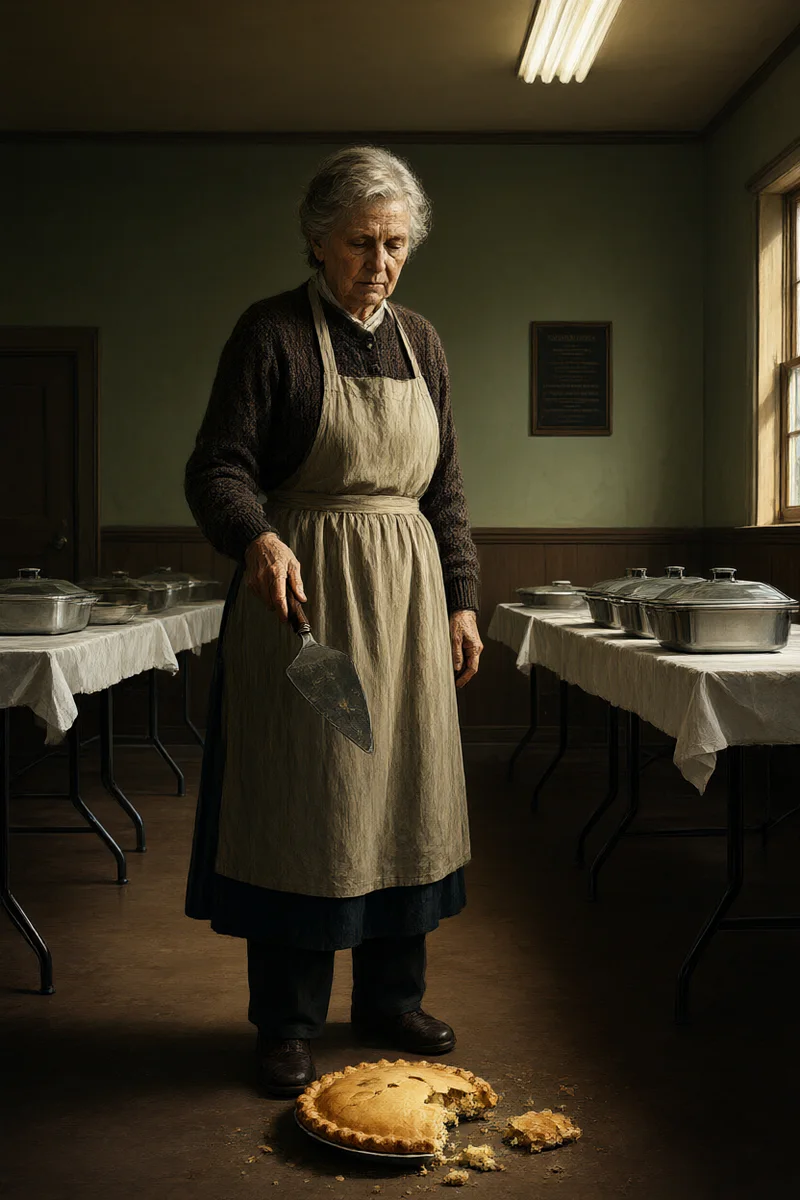
 The Harvest Supper
Chapter 4
Green Tomato Relish
Bernie drove around the county for an hour after she left Cedar Street. She drove past the feed mill, which was a storage building now, and past the cemetery where Glen was, and found herself on Locust Street in front of Faye Kimball's little yellow house without having decided to go there.
Faye was on her knees in the side yard, pulling the last green tomatoes off the vines before the frost, with a dishpan beside her. She sat back on her heels when she saw who it was.
“Well,” she said. “Wilma sent you.”
“Nobody sent me.”
Faye's kitchen was the opposite of Wilma's. There were jars on every surface, and a cat on the windowsill, and a calendar from the elevator still turned to August. Faye put the dishpan of tomatoes in the sink and did not offer tea. She stood with her back against the counter and her arms folded.
“Say it, then,” she said.
Bernie said it. She said all of it, the forklift and the surgeon and the spare key in the bottom drawer, the index card in her Bible, the envelopes. She said she was sorry. She said she should have said it in 1984 and every year since. Her voice gave out twice.
Faye listened all the way through without moving. When it was finished she unfolded her arms.
“Harold figured it out in 1986,” she said. The cat jumped down from the windowsill.
“He was on the finance committee when the fund came back whole. He went through the deposit slips. He said, Faye, somebody's been paying back nine hundred dollars at thirty-six a month for two years, and there's only one family in this church that needed nine hundred dollars in April of '84.” Faye looked out the window at the tomato vines. “We talked about it a long time. Glen was still in that brace. We decided it wasn't ours to say.”
“Then Harold knew Wilma didn't take it.”
“Of course he knew.” Faye's face worked. “But she'd called me a thief in front of God and the choir, Bernadette. She never took it back. Not once. Harold waited thirteen years for his sister to come up our front walk and say she was wrong about me, and she never came. So he never called her.”
“She couldn't take it back without naming me.”
“I know that now,” Faye said. “Do you think I don't know that, sitting here?” She wiped her eyes with the heel of her hand, angrily. “I thought she still believed it. All this time. She thought I still believed she did it. And you,” she said, “you knew both of us knew nothing. And you let us sit at opposite ends of that hall for forty-two years.”
Bernie had nothing to answer with. It was true.
“Wilma's going to tell the board Thursday that she took it,” she said finally. “She's going to say it was her, to protect me. And to get it said before she dies.”
Faye stared at her. Then she laughed, a short, wet, disbelieving sound.
“That stubborn old fool,” she said. “And are you going to let her?”
Bernie found she was already standing.
On Thursday night the board met in the new fellowship hall, at one folding table, under the plaque still wrapped in its tablecloth. Wilma came in her church coat with the shoebox under her arm. Faye came ten minutes later and sat at the very back, by the door to the parking lot.
The board president opened with a prayer. Before the amen had settled, Wilma Ostrander stood up and set the shoebox on the table.
“I'll save us all some time,” she said. “I took the nine hundred dollars.”
The End









