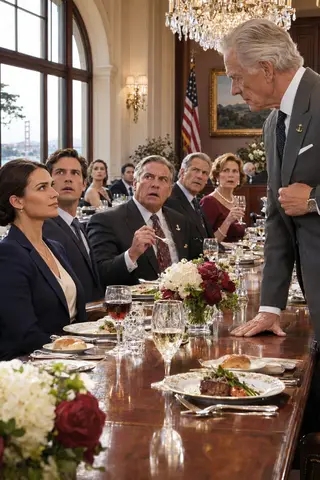
 Fake Navy Vet Humiliates Female Fighter Pilot at Elite Dinner
Chapter 9
Taking the Flight Deck
The transition from a pitching carrier deck in the North Arabian Sea to the pristine, climate-controlled corridors of Mercer Aerospace was jarring, to say the least. There was no smell of burning JP-5 fuel, no bone-jarring vibration of catapult launches, and no roar of twin GE F414 turbofans shaking the fillings in my teeth. Instead, the fourth floor of Mercer’s San Diego research campus smelled of polished marble, artisan roast coffee, and ozone from high-powered server banks.
"Good morning, Commander Peterson," Arthur Mercer’s chief of staff, a sharp-eyed woman named Elena, greeted me as the elevator doors slid open with a whisper. "Mr. Mercer cleared his entire morning schedule for your orientation. The engineering division leads are already waiting in the briefing theater."
"Morning, Elena," I replied, adjusting the cuffs of my tailored charcoal suit. Old habits died hard; my posture was still ramrod straight, and my eyes instinctively swept the perimeter for blind spots. "Let's see what we're working with."
The briefing theater was an amphitheater of curved glass and brushed aluminum. Seated around the mahogany tier were fifteen men and women, mostly senior civilian aerospace engineers, algorithmic designers, and former procurement officers. When I walked in behind Elena, the room fell dead silent. I recognized that look immediately. It was the same thinly veiled skepticism I had faced on my first deployment to VFA-103—the silent assumption that a woman had been handed a flight jacket for optics rather than ability.
"Ladies and gentlemen," Arthur Mercer’s voice cut through the room like a sonic boom. He stood near the podium, dressed in his customary dark sweater and crisp collared shirt, looking relaxed yet radiating absolute authority. "Allow me to introduce our new Vice President of Aerospace Strategy and Operations, Commander Maya Peterson. As you know, she logged over two thousand flight hours, three hundred carrier-trap landings, and led combat sorties over contested airspace before hanging up her flight suit. If any of you think building autonomous combat aircraft is purely a math problem, she is here to remind you that physics and real-world combat do not care about your clean theoretical models."
A gray-haired senior engineer near the front, whose badge identified him as Dr. Aris Thorne, shifted uncomfortably. "With all due respect to the Commander’s service record, building next-generation UCAVs—unmanned combat aerial vehicles—requires computational architecture, not stick-and-rudder intuition. We're replacing the human pilot, not catering to them."
I didn't blink. I walked down the steps with slow, measured strides, placing both hands on the edge of the conference table directly across from him.
"You can write millions of lines of pristine code, Dr. Thorne," I said, my voice quiet, level, and completely devoid of hostility. "But when an adversary's electronic warfare suite blinds your satellite uplink at Mach 1.8 inside a terminal descent, your algorithm doesn't bleed. It doesn't have an instinct for survival. A drone that can only fly in clean simulations is just an expensive target for enemy surface-to-air batteries. I'm not here to protect the human ego; I'm here to ensure that when our machines fly into hostile airspace, they actually complete the mission and survive the trip."
Dr. Thorne blinked, his jaw working silently before he offered a slow, begrudging nod.
Mercer smiled faintly from the corner of the room. "Now that we have established our baseline doctrine," the billionaire said, tapping the master control pad, "let’s pull the curtain back on Project Valkyrie."
***
The End









