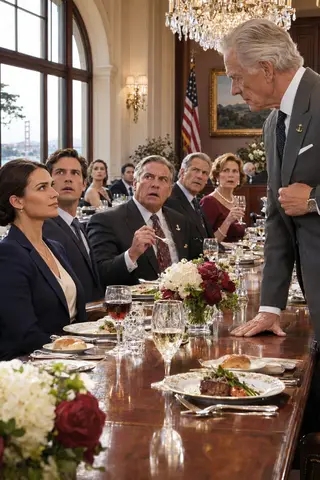
 Fake Navy Vet Humiliates Female Fighter Pilot at Elite Dinner
Chapter 10
Project Valkyrie
The holographic projector in the center of the auditorium sprang to life, casting a sweeping wireframe model into the air. It was a tailless, diamond-delta stealth platform with serpentine air intakes buried seamlessly beneath the fuselage. Its radar cross-section was so minimal it would appear to enemy radar as a sparrow, yet it carried an internal weapons bay capable of holding precision-guided munitions or modular sensor pods.
"Valkyrie is our bid for the Pentagon’s collaborative combat aircraft program," Mercer explained, walking to the edge of the holographic beam. "It is designed to fly as an autonomous 'loyal wingman' alongside manned fifth- and sixth-generation fighters. It must process real-time tactical data, identify surface-to-air threats before they paint the mothership, and execute kinetic strikes with sub-second decision cycles."
I studied the digital airframe carefully. My eyes traced the leading-edge sweep, the control surface actuators, and the infrared suppression nozzles. To a civilian, it looked like a masterpiece of futuristic aeronautics. But to someone who had spent over a decade surviving in cockpits, a glaring flaw leapt out from the structural telemetry.
"Look at the pitch-axis stabilization during transonic transitions," I said, pointing toward the computer-generated aerodynamic stress map.
Dr. Thorne frowned, leaning forward to adjust his glasses. "The platform's neural net compensates for transonic flutter via dynamic thrust-vectoring. The software simulations showed zero divergence across ten thousand simulated runs."
"Computer simulations assume an idealized atmosphere," I countered, tapping the console to freeze the simulation at Mach 0.98. "When you push through the sound barrier in humid sea-level conditions or turbulent mountain air, the localized shockwaves decouple airflow over the ventral sensors. Look at where your primary pitot-static and optical telemetry nodes are mounted—right behind the forward lip of the weapons bay."
The room went still. Thorne tapped rapidly on his tablet, running a recalculation against real-world atmospheric turbulence data that had been archived from carrier operations.
Within ten seconds, a red warning indicator flashed across the digital projection. The simulated drone's pitch-axis yawed violently out of control before snapping into an unrecoverable flat spin.
"Good God," an engineer in the third row murmured. "The boundary-layer turbulence would blind the flight computer during high-g pullouts."
"And when the flight computer goes blind, your twelve-hundred-mile-an-hour stealth platform turns into a seventy-million-dollar lawn dart," I said evenly. "We need to reposition the optical arrays forward of the boundary layer, and we need triple-redundant mechanical pitot sensors recessed along the nose chine."
Dr. Thorne looked up from his tablet, the skepticism in his eyes entirely replaced by professional respect. "That... will require redesigning the nose cowl assembly. It'll push our ground-testing schedule back by three weeks."
"Better three weeks in the hangar than an explosion during the Pentagon demonstration at Edwards Air Force Base," Mercer said firmly. He looked around the room, his piercing gaze settling on every face. "The Commander's adjustments are officially incorporated into the production prototype. Get to work."
As the team dispersed to their workstations, Ethan met me by the observation gallery overlooking the cleanroom floor. Through the multi-layered acoustic glass, technicians in white bunny suits were swarming over the matte-black carbon composite fuselage of the real Valkyrie airframe.
"Day one, and you've already saved the company seventy million dollars," Ethan whispered with an affectionate smile, handing me a fresh bottle of water. "I'd say that justifies the corner office."
"The airframe is brilliant, Ethan," I said, gazing down at the sleek machine. "Mercer’s engineering is leagues ahead of anything I saw in the fleet. But technology doesn't win battles on its own. People do. And right now, I have an uneasy feeling about the competition."
"Speaking of the competition," Ethan’s expression hardened, his smile vanishing as he lowered his voice. "I just got an alert from our media monitoring desk. You need to see this."
***
The End









