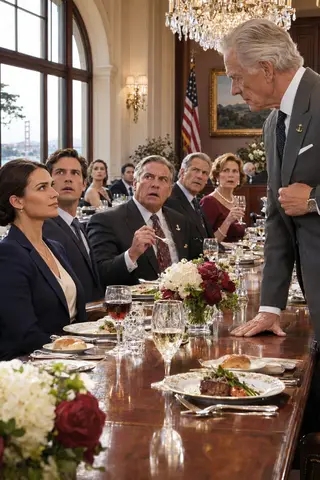
 Fake Navy Vet Humiliates Female Fighter Pilot at Elite Dinner
Chapter 4
Unmasking the Pretender
Douglas tried to recover, forcing a dry, nervous chuckle that sounded like paper ripping in an empty room.
"Well, sure, carrier landings, simulators... impressive numbers on paper," Douglas stammered, his voice lacking its previous thunder. "But anyone can log hours when you’re flying in friendly skies, right, Commander? It’s a far cry from actual strategic command under fire."
Mercer finally turned his head.
He didn't look at Douglas with anger. He looked at him the way a senior surgeon looks at an intern holding a scalpel backward—with cold, clinical pity.
"Mr. Harland," Mercer said, his voice dropping an octave, turning the private dining room into a courtroom where judgment was already being executed. "How many combat flight hours do you have logged in a Super Hornet?"
Douglas stiffened, his chin lifting defensively. "Well, my service was primarily focused on strategic logistics and procurement policy at the Pentagon annex in Virginia. A vital rear-echelon role, I might add. Wars are won by supply chains, Mr. Mercer."
"Indeed they are," Mercer replied smoothly. "And logisticians are essential. But there is a distinct difference between managing procurement forms in an air-conditioned office in Arlington and launching off the cat walk of a CVN-75 into a contested theater at 0300 hours with zero margin for error."
Mercer turned back to me, his eyes softening with professional respect.
"I spent thirty-two years in defense logistics and oversight before moving into private equity, Commander Peterson," Mercer continued, addressing the entire table now. "I’ve reviewed thousands of operational readiness reports. I know the names of the squadrons operating in the Fifth and Seventh Fleets. VFA-103 doesn't just do 'routine flights.' They are the tip of the spear. When carrier strike groups need precision strike coordination under active radar-guided missile threat, they call the Jolly Rogers."
Richard swallowed hard, his eyes darting frantically between Mercer and Douglas. The venture capitalist he had courted for six months—the man whose signature could fund his entire enterprise—was currently dissecting his oldest tennis partner piece by piece.
"Richard," Mercer said quietly, turning his gaze to my father-in-law. "You mentioned earlier this evening that you value high-stress performance, exceptional discipline, and people who can deliver results when millions of dollars and human lives are on the line."
Richard nodded stiffly, sweating under his collar. "Yes, absolutely, Mr. Mercer. Essential qualities in business and in life."
"Then I am genuinely surprised," Mercer said, his voice cutting like glass, "that you allowed a man with four years of reserve desk duty to spend the entire appetizer mocking an active-duty tactical aviator who has spent twelve years defending this country’s airspace at Mach 1.5."
The blood drained entirely from Richard’s face. He looked across the table at Douglas, whose smirk had completely dissolved into an ugly, mottled flush of embarrassment and rage.
Douglas slammed his scotch glass down onto the mahogany table, the ice rattling violently. "Now see here, Mercer! I’ve served my country with honor! I won't sit here and be lectured by a girl half my age who—"
"Quiet, Douglas," Mercer said. It wasn't a shout. It was a command issued with such absolute, bone-deep authority that Douglas physically flinched, snapping his mouth shut as if he had been struck.
Mercer turned back to me, his expression shifting from stern evaluation to something entirely unexpected: genuine admiration.
"Commander Peterson," Mercer said softly, raising his wineglass toward me. "Welcome home. And thank you for your service."
The End









