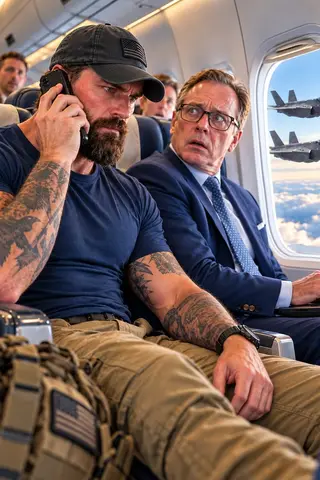
 Executive Panics When F-35s Intercept Commercial Flight
Chapter 8
Dawn of the New Mission
The morning sun broke over the Potomac River, painting the neoclassical columns of the White House in a wash of gold and amber light. Inside the executive locker rooms, I stood before a full-length mirror, staring down at a reflection I barely recognized.
Gone were the faded jeans, the worn-out combat boots, and the tactical cap. In their place hung a pristine Navy dress white uniform, pressed to absolute perfection. The gold buttons gleamed under the overhead lights, and the ribbons—including the Navy Cross and the Purple Heart—rested in immaculate rows above my left breast pocket.
Yet, as I looked closer, I could still see the faint edges of ink peeking out from beneath my cuffs—the Trident and the unit coordinates that no uniform could ever truly cover up. Those marks weren't just tattoos; they were a map of my soul, permanent reminders of the fires I had walked through.
There was a soft knock on the changing room door.
"Come in," I said.
The door swung open, and Richard Vance stepped inside. He was wearing a sharp, charcoal-gray tailored suit, but unlike yesterday on Flight 237, there was no laptop clenched in his hand, and no arrogant corporate glare in his eyes. He looked tired, humbled, and deeply respectful.
"Master Chief," Richard said, stopping a few feet away. "The Secret Service detail is waiting to escort us to the South Lawn. The press corps is already packed ten rows deep."
"You ready for this, Richard?" I asked, adjusting the stiff white collar of my uniform. "Standing in front of the national media isn't quite like auditing spreadsheets in a corner office."
Richard offered a self-deprecating smile, running a hand through his hair. "Yesterday, if you told me I’d be standing on the White House lawn alongside a legendary Navy SEAL to announce the dismantling of an international terror syndicate, I would have had you institutionalized. But after flying beside you... I think I can handle a few camera flashes."
He reached into his jacket pocket and pulled out a small, neatly folded black velvet box, placing it gently on the wooden bench beside me.
"What's this?" I asked, looking down at it.
"My brother is a Lieutenant Commander stationed with naval intelligence in Norfolk," Richard said quietly. "When I called him last night to tell him who was sitting in seat 12A of my flight, he told me something I think you need to wear today."
I popped the clasp of the velvet box. Inside rested two pristine gold anchor pins—the insignia of a Master Chief Petty Officer, forged from solid brass, polished to a mirror finish.
"He said you lost your original set during the extraction in Syria," Richard continued, his voice steady and sincere. "He wanted you to wear his. As a symbol that even when you take off the uniform, your brothers are never really gone."
I stared at the gleaming anchors, feeling a heavy lump form in my throat. For the first time since I boarded that plane in San Diego, the phantom pain in my left leg seemed to fade away.
"Thank you, Richard," I said, my voice barely above a whisper. I picked up the anchors, pinned them securely to my collar, and squared my shoulders. "Let's go face the music."
The End









