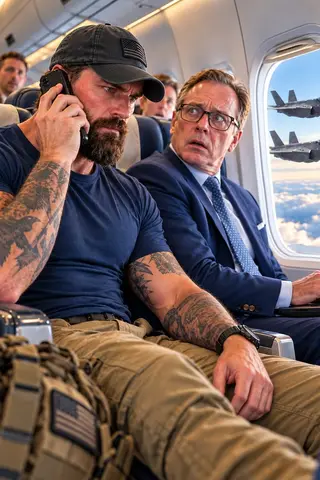
 Executive Panics When F-35s Intercept Commercial Flight
Chapter 3
Descent into Andrews
The descent into Joint Base Andrews was unlike any landing I had ever experienced in my life. Commercial airliners typically follow a polite, curving glide path into major airports, communicating calmly with civilian towers. Not today. Flight 237 dropped out of the cruising altitude like a hawk diving on its prey, flanked tightly by our twin F-35 guardians whose afterburners painted orange ribbons across the bruised twilight sky.
Captain Rodriguez flew the bird with surgical precision, guided step-by-step by military tactical controllers on the ground. Through my window, I watched the endless sea of concrete runways, massive hangars, and heavily fortified security perimeters of Andrews unfold beneath us.
Inside the cabin, the atmosphere was electric. The low hum of whispered conversations buzzed continuously. People weren't afraid anymore; they were captivated. They were riding the back of history, sharing recycled cabin air with a ghost from the shadows who had suddenly been dragged back into the light.
Richard Vance cleared his throat nervously. "Master Chief... when we land, what happens to us? To me? Am I going to be interrogated by the Secret Service?"
"Relax, Richard," I said, stowing my encrypted satellite phone back into the tactical pouch of my carry-on bag. "You’re just collateral damage in a very high-level scheduling conflict. Stay in your seat, let the federal agents clear the aircraft, and you’ll be catching your connecting cab to downtown D.C. before you know it."
"And you?" Richard asked, his eyes lingering on the scarred knuckles of my right hand. "Where do they take you?"
"Somewhere I don't want to go," I muttered under my breath.
The heavy Boeing touched down with a deafening screech of reversing thrust and screaming rubber. The spoilers popped up on the wings, throwing a shudder through the airframe as we decelerated at a punishing G-force that pushed every passenger forward against their seatbelts.
As the aircraft taxied off the main runway toward a remote, high-security tarmac reserved for presidential and military transport, I saw them.
A fleet of black Chevrolet Suburbans with tinted windows and flashing strobe lights was idling in a precise, militant formation beside a massive C-17 Globemaster. Flanking the vehicles were two full squads of U.S. Marines in dress blues, standing at rigid attention, their rifles held across their chests with immaculate discipline. And standing directly in front of the open stairs of a transport van was a man I hadn't seen in six months—Admiral Thomas Sterling, my former commanding officer, wearing a chest full of ribbons that gleamed under the floodlights.
The plane came to a complete stop. The engines spooled down, whining softly into silence.
The "Fasten Seatbelt" sign chimed off, but not a single passenger stood up. Every single head turned toward row 12, waiting to see what the legendary, invisible warrior of the Navy SEALs would do next.
The End









