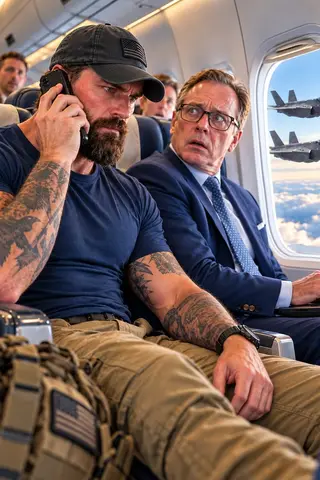
 Executive Panics When F-35s Intercept Commercial Flight
Chapter 1
The Code Red at 35,000 Feet
The secure satellite phone in my hand vibrated with a sharp, insistent pulse, cutting through the rising tide of panic inside the economy cabin of Flight 237. Around me, 147 passengers were pressing their faces against the double-paned windows, gasping at the sleek, lethal silhouettes of the two F-35A Lightning II fighters flanking our port side. Their gray, angular fuselage gleamed in the harsh desert sun, cutting through the thin stratosphere air with terrifying precision.
The corporate executive sitting beside me in seat 12B looked like he was about to faint. His knuckles were bleached white where he gripped his leather laptop case, and his expensive silk tie seemed suddenly too tight for his throat. He looked at me—at my tactical cap, my scarred hands, and the faint ink of a Trident peeking out from my rolled-up sleeve—as if I were holding a live grenade.
"What is happening?" he stammered, his voice cracking with a high-pitched panic. "Why are those jets out there? Who are you?"
Before I could answer, the cockpit intercom crackled to life again. But this time, it wasn't Captain Rodriguez speaking. A harsh, metallic burst of static filled the cabin, followed by an external radio transmission patched directly through the plane's public address system. The pilot of the lead fighter wasn't talking to air traffic control; he was broadcasting on the emergency military frequency, routed straight into the cockpit speakers.
"United Two-Thirty-Seven, this is Viper Leader. Intercept confirmed. We have visual lock on your target coordinate. Requesting immediate confirmation: Is Master Chief Marcus Cole aboard your aircraft?"
Silence fell over the cabin so fast it felt like a physical blow. One hundred and forty-two strangers, plus five terrified flight attendants, collectively stopped breathing. Every single pair of eyes pivoted away from the windows and locked onto me.
The executive beside me physically recoiled, pressing himself as far against the fuselage as his seatbelt would allow. "Master Chief?" he whispered, his eyes wide with horror and confusion. "You... you're military intelligence? Are we under terrorist attack?"
I didn't answer him. My thumb slid the heavy metal toggle on my encrypted satellite phone, accepting the secure channel routed directly from the Pentagon's tactical command center.
"Viper Leader, this is Cole," I said into the receiver, my voice steady, hardened by a decade of black-ops operations that never made the evening news. "I copy. State your vector."
"Master Chief," the pilot’s voice came back crisp, laced with absolute professional reverence. "Secure channel established. Washington command has an urgent directive. You are not going to the Pentagon for a quiet ceremony tomorrow, sir. The President has elevated your citation. You are being redirected right now."
The entire cabin strained to hear every word, hanging onto my every syllable as if I were holding the key to their survival. The flight attendant standing nearest our row—a young woman with a nametag reading Sarah—clutched her drink cart, her knuckles white, her eyes searching my face for reassurance.
"Redirected where?" I asked, my frown deepening as my wounded left leg sent a sharp, familiar spike of pain through my knee.
"Air Force One, Master Chief," Viper Leader replied smoothly. "We are here to escort Flight 237 to an expedited touchdown at Joint Base Andrews. The Commander-in-Chief wants you personally."
The End









