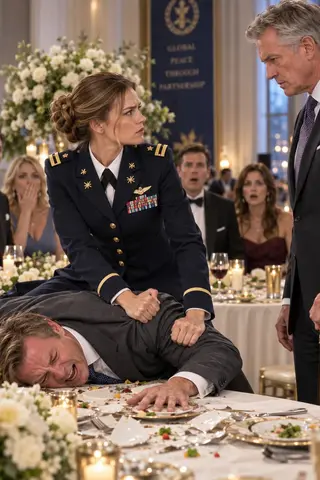
 Billionaire Trash-Talks Female Navy Pilot at Elite Dinner Party
Chapter 28
Gathering Storm in the Straits
The tactical flag command center aboard the USS Gerald R. Ford was bathed in the dim, blood-red luminescence of combat status alert.
Rear Admiral David Vance (no relation, though Thorne liked to joke that all cold-blooded aviators shared the same bloodline) stood at the head of the circular holographic plotting table. Flanking him were Captain Thorne, the ship’s intelligence chief, and the carrier strike group’s senior surface warfare officers.
I stepped into the room still wearing my flight suit, the damp ocean salt still clinging to my collar.
“Glad you’re here, Commander,” Admiral Vance said, tapping a touchscreen that brought up a high-resolution satellite reconnaissance feed of the South China Sea. “Thirty minutes ago, our forward maritime reconnaissance aircraft intercepted a high-priority distress broadcast from an allied commercial replenishment convoy sixty miles west of Palawan.”
The image zoomed in, revealing three large civilian-crewed logistics tankers surrounded by six fast-attack missile corvettes flying no national flags.
“Rogue maritime mercenaries,” Thorne explained, leaning over the table with his knuckles white against the metal frame. “Funded by the same international shadow syndicate that Arthur Sterling and his foreign partners were peddling our military telemetry to. They’ve established a dynamic blockade across the shipping lane, using high-frequency spoofing transmitters to jam all civilian satellite communications.”
“Why not send a surface strike group to escort them out?” I asked, analyzing the overlapping red threat rings illuminating the screen.
“Look at the southern peninsula,” the intelligence chief said grimly, tapping a jagged finger of land thirty miles from the convoy. “The mercenaries have covertly deployed an experimental shore-based S-500 surface-to-air missile battery along the cliffs, combined with an ultra-high-powered active electronically scanned phased-array radar. The moment any conventional manned aircraft approaches within eighty miles, they’ll light up the sky with Mach 7 hypersonic interceptors. A standard F/A-18 strike package would be flying into a slaughterhouse.”
The Admiral looked around the room. Every surface warfare commander stared at the floor. The geopolitical stakes were suffocating. If the allied tankers were boarded and their crews executed, the shipping lanes that carried forty percent of the world’s maritime trade would fall into lawless panic. But if the carrier launched a manned strike and lost eight naval aviators to coastal missiles in peacetime, the political fallout would trigger a congressional firestorm.
“That SAM battery has a saturation limit,” I stated, my voice breaking the heavy silence like a gunshot.
Admiral Vance shifted his gaze toward me, his eyebrows knit tight. “Explain, Commander.”
“The S-500 radar network is optimized to track high-altitude, high-radar-cross-section targets,” I said, drawing a finger across the holographic projection. “Its weakness is low-altitude, saturation-level clutter. If we send a manned flight, our pilots have to pull out before they enter the lethal envelope. But if I take four Valkyries in at sea-skimming altitude—fifty feet above the waves, flying Mach 1.4 beneath the horizon radar curve—we can execute an autonomous electronic-deadlock strike.”
“And you?” Thorne asked, his voice unexpectedly tense with concern. “You’d be flying the command node bird right at the edge of the radar’s search horizon.”
“I’ll sit at thirty-five thousand feet, drawing their primary radar emissions and acting as the electronic lightning rod,” I answered coldly. “The moment they turn their tracking radars on my Super Hornet, the Valkyries will break through the surf, triangulate the emitter’s exact frequency, and drop hypersonic anti-radiation penetrators down the throat of their radar bunker.”
Thorne looked at Admiral Vance. The Admiral held my gaze for five seconds, seeing the terrifying, unshakeable resolve that had dragged me out of Arthur Sterling’s poisonous dining room and into the command of the fleet’s deadliest asset.
“Authorization granted,” Admiral Vance barked. “Squadron 201 is cleared for hot combat deployment. Weapons free upon positive hostile radar lock. Bring those tankers home, Commander.”
The End









