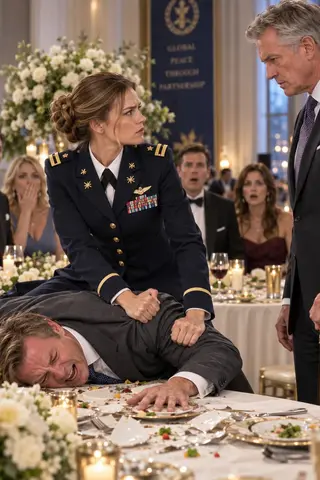
 Billionaire Trash-Talks Female Navy Pilot at Elite Dinner Party
Chapter 21
The Pentagon Gauntlet
The marble corridors of the Dirksen Senate Office Building in Washington, D.C., echoed with the hushed murmurs of lobbyists, three-star generals, and senior defense aides. Three months had passed since the incident in San Francisco, but the scent of blood had not left the political waters. While the Department of Justice had dismantled Arthur Sterling’s fraudulent syndicate and Marcus had begun serving his fifteen-year federal sentence, the real battle for Cole Aerospace’s autonomous future was just beginning.
I walked down the central aisle of Hearing Room 216 wearing my Service Dress Blue uniform. On my shoulders rested the silver oak leaves of a Commander; on my left breast, the Strike/Flight Air Medal, the Distinguished Flying Cross, and the gleaming gold wings of a Naval Aviator. Behind me walked Harrison Cole, his heavy cane tapping rhythmically against the stone floor, his face an impenetrable mask of weathered granite.
At the center of the elevated congressional dais sat Senator Gregory Caldwell, Chairman of the Senate Armed Services Subcommittee on Tactical Air and Land Forces.
Caldwell was an old-guard politician from Texas whose reelection campaign had been bankrolled for twelve years by Apex Aeronautics—the legacy defense contractor whose obsolete, cost-overrun fighter program was about to be cancelled to fund our X-49 Chimera. Caldwell had also been a longtime personal friend and private investor in Arthur Sterling’s ruined hedge fund.
“Commander Elena Vance,” Senator Caldwell began, leaning forward over his microphone, his voice dripping with venomous theatricality designed for the C-SPAN cameras. “Your sudden ascension from an operational squadron pilot to the Sovereign Program Executive of Cole Aerospace is unorthodox, to put it mildly. You were involved in a violent public brawl at a private residence in San Francisco. You expedited federal counter-intelligence actions that conveniently destroyed your estranged husband’s family enterprise. And now, you sit before this committee demanding an eighty-billion-dollar sovereign procurement authorization for an autonomous aircraft that eliminates traditional human command structures.”
Caldwell shuffled his papers with loud, theatrical disdain, glaring down at me through gold-rimmed bifocals.
“Tell me, Commander,” Caldwell sneered, “is the United States Navy prepared to hand the keys to our national defense to a machine developed by a rogue pilot with a demonstrated penchant for insubordination and domestic violence?”
A few aides behind Caldwell whispered and smirked. It was the same tired ambush Marcus and Arthur had attempted, just wrapped in congressional privilege.
I adjusted the microphone before me. My pulse remained at fifty-eight beats per minute. When I spoke, my voice rang clear and absolute, cutting through the cavernous chamber like a cold blade.
“Senator Caldwell,” I said calmly, “Apex Aeronautics has spent eleven years and forty-two billion dollars attempting to develop the F-44 Skywarden. During their last three unmanned integration tests over the Gulf of Mexico, the platform suffered two total telemetry losses, one uncommanded engine flameout, and an avionics crash that nearly sent an armed drone into a civilian oil platform. The American taxpayer paid Apex four billion dollars in performance bonuses for an airframe that cannot fly in heavy rain.”
Caldwell’s face tightened, a blotchy red creeping into his jowls. “Commander, you will address my questions regarding your temperament—!”
“My temperament, Senator, was forged in forty-two combat sorties over disputed airspace,” I interrupted, my tone level and unyielding. “While Apex executives were hosting private golf tournaments at your donor retreats in Dallas, I was landing an F/A-18 with shattered hydraulic lines on a pitching carrier deck at midnight. The X-49 Chimera has logged two hundred and fourteen flight hours without a single systems anomaly. In live-envelope testing, it outperformed two operational fighter wings, intercepted an unflagged fifth-generation hostile aggressor in international airspace, and did so at one-fourth the projected operating cost of Apex’s failed airframe.”
I looked straight into Caldwell’s cold eyes, refusing to flinch.
“If you wish to protect your campaign donors’ balance sheets at the expense of our national security, Senator, that is your political prerogative. But do not sit behind that seal and lecture an active combat officer on discipline. If we face a peer adversary tomorrow over the Taiwan Strait, our pilots will not be saved by your press releases. They will be saved by machines that can out-fly, out-fight, and out-kill anything in the sky. And that is precisely what the Chimera does.”
The committee room went dead silent. Behind me, Harrison Cole let out a low, satisfied breath.
Senator Caldwell sat frozen, his mouth slightly agape, unable to summon a coherent rebuttal under the unflinching glare of the television lenses. Two seats to his right, the ranking member of the committee leaned into her microphone, cleared her throat, and said simply, “Thank you, Commander Vance. The committee has no further questions. Authorization is approved.”
The End









