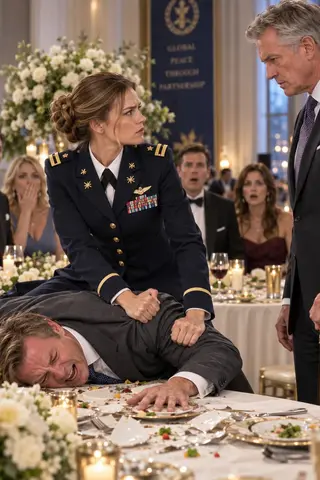
 Billionaire Trash-Talks Female Navy Pilot at Elite Dinner Party
Chapter 27
The Pitching Deck
The flight deck was a choreographed tempest of organized chaos.
Fifty-knot winds ripped across the four-and-a-half-acre flight surface as Sea State 5 tossed the ninety-thousand-ton supercarrier like a cork in a flooded gutter. White sea spray crested the edge of the bow, evaporating instantly into a salty mist against the scorching metal blast deflectors.
I climbed the ladder of my customized command Super Hornet, settling into the familiar, narrow womb of the cockpit. Once the ground crew sealed the canopy and the hiss of pure oxygen flooded my mask, the external storm died down to a muffled vibration. Through my tactical data-link visor, I brought the squadron’s master neural network online.
Fifty feet behind me, the twin vectoring turbofans of Valkyrie One spooled up with an eerie, high-frequency whine that cut cleanly through the guttural roar of the carrier’s conventional jets.
“Viper-Nine, this is Flight Deck Control,” the air boss’s voice boomed through the 5MC flight deck speakers and straight into my headset. “Electromagnetic Aircraft Launch System (EMALS) Catapult One and Catapult Two are set. Swarm synchronization verified. Wind across the deck is thirty-four knots, gusting forty-eight. The deck is yours, Commander.”
I snapped my salute to the catapult officer on the deck. The yellow-shirt crouched low, touched the deck with two fingers, and whipped his arm forward like a baseball pitcher launching a strike.
The EMALS cat fired.
In two-point-two seconds, twenty-four tons of high-performance fighter were hurled from zero to one hundred and sixty knots. The violent punch slammed my spine against the ejection seat as the nose dropped toward the churning white water of the bow before catching the teeth of the relative wind and clawing into the gray Pacific sky.
Three seconds later, Catapult Two fired.
Valkyrie One shot into the sky with terrifying, mathematical smoothness. Without a human body to protect against compression forces, the autonomous platform pitched up instantly at a seventy-five-degree angle, executing a zero-altitude afterburner climb that left a thunderous double-crack echoing off the carrier’s island superstructure.
Within forty seconds, Valkyries Two, Three, and Four were airborne, falling into a flawless, razor-tight fingertip formation off my wings. The distance between our wingtips was precisely thirty-six inches—a formation tolerance that seasoned Blue Angels pilots could only maintain in smooth, dry air during airshows. We were doing it at eight hundred feet over a churning ocean during a gale-force Pacific squall.
“Air Boss to Viper-Nine,” the radio crackled, the voice carrying a sudden, stunned hush. “Telemetry shows zero deviation across all four drones. Wingtip distance is holding steady at three feet through turbulence. That... that is unreal.”
“Copy, Air Boss,” I responded calmly, banking the formation into a wide, climbing sweep around the carrier’s battle perimeter. “Now let’s show Captain Thorne how they land.”
Landing an aircraft on a carrier is commonly described as a controlled crash. Landing in Sea State 5, with the carrier’s stern rising and falling fifteen feet in the swell, is a nightmare that tests the nerve of even the most hardened combat veterans.
I brought my flight into the groove at Angel Three, ordering Valkyrie One to initiate autonomous carrier recovery.
The black machine lined up on the glide slope. Where human pilots constantly chased the meatball, fighting crosswinds with tense, jerky rudder adjustments, the Valkyrie’s distributed sensor skin read the micro-variations of the carrier’s aerodynamic wake ten thousand times per second. Its carbon-fiber control surfaces fluttered with insectoid speed.
The drone descended smoothly toward the pitching steel deck.
The titanium arresting hook dropped cleanly. The wheels slammed onto the wet non-skid surface with a sharp screech of burning rubber, and the hook snagged the number-three arresting wire dead center. The massive hydraulic wire snapped taut, arresting fifty thousand pounds of stealth combat aircraft within three hundred feet.
Before the deck crews could even catch their breath, Valkyrie Two hit the wire with identical, surgical perfection.
Inside my cockpit, I watched the final drone clear the landing corridor and taxied toward the elevator.
“Captain Thorne,” I said over the private command channel, “are your catapults clear for the rest of my squadron?”
There was a long silence over the comms. When Thorne finally spoke, the mocking condescension had vanished completely, replaced by the profound, quiet respect of a warrior who knew he had just witnessed the dawn of an entirely new era.
“Commander Vance,” Thorne answered gruffly, “clear your schedule for the briefing room tonight. We have a real problem developing near the Scarborough Shoal, and I want your black phantoms leading the spear.”
The End









