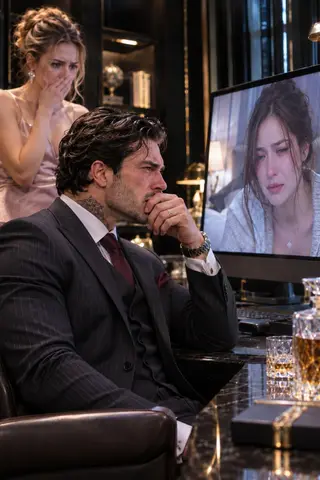
 Billionaire Husband Laughs Off Wife’s Depression
Chapter 66
Letters Across the Sea
By mid-November, the first winter squalls began sweeping across the Oregon coastline, rattling the fir branches and throwing curtains of silver rain against the studio glass.
Inside, the cast-iron stove radiated steady, fragrant heat from seasoned birch logs. My desk was scattered with letters from our international network.
The first was from Lucca. Madame Hélène Laurent wrote in her elegant, spidery French hand, detailing the autumn olive harvest at Villa di Luce:
*'The yield this season has exceeded all expectations, ma chère Claire. Maya has cast three monumental bronze figures in the Pietrasanta foundry—they stand now among the ancient olive groves, looking toward the Tyrrhenian Sea like sentinels of stone and light. Next spring, we will welcome our first exchange fellows from Master Morimoto's academy in Kyoto. The world is getting smaller, yet infinitely wider. Art critics in Rome and Milan continue to request interviews with you, but I have followed your instructions: I inform them that Claire Vance lives where the ocean begins, and she answers only to the morning light.'*
Beside Madame Laurent’s letter lay a scroll of heavy, textured mulberry paper sent from Kyoto by Master Kenji Morimoto himself. Written in disciplined black ink, it contained only a four-line poem in classical Japanese, accompanied by Aoi’s handwritten English translation:
*The stone sits in the torrent,*
*Unmoved by the roar of the water.*
*When the river clears,*
*The stone is still there, polished and bright.*
Along with the scroll was an invitation from the National Museum of Modern Art in Tokyo, requesting a joint retrospective of my work alongside historical Japanese masters of the post-war era.
Ten years ago, an invitation of that magnitude would have triggered an avalanche of corporate planning, PR campaigns orchestrated by Alexander's media team, and frantic rehearsals of what I should wear and say to impress international collectors.
I picked up my pen, dipped it into walnut ink, and wrote a polite, graceful refusal.
I thanked the trustees for their extraordinary honor, but explained that my current work belonged not to exhibition halls or auction houses, but to the living apprentices who shared our studios and the coastal landscape that nourished my soul.
I sealed the envelope, set it on the ledger table, and looked out at the churning gray ocean.
To have the power to say 'no' to the world's most prestigious stages—not out of bitterness, but out of total creative fulfillment—was the purest form of sovereignty I had ever known.
***
The End









