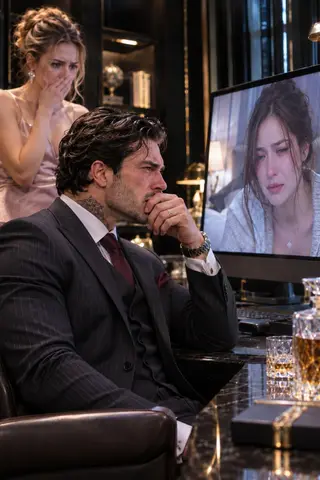
 Billionaire Husband Laughs Off Wife’s Depression
Chapter 60
The Open Sea and the Rising Wind
On the morning following the council gathering, the sanctuary was hushed and serene.
The visitors had dispersed to the studios, the gardens, and the stone terraces. A gentle offshore wind was blowing from the east, clearing away the morning mist to reveal an ocean of luminous, sapphire glass that stretched without interruption toward the western rim of the earth.
I walked down to the bluff alone, carrying no sketchbook, no brushes, and no portfolio.
I wore my old woolen fisherman’s sweater, comfortable denim trousers, and sea boots. In my pocket was only a small, polished pebble of dark Oregon basalt that I had picked up from the garden path—a stone smoothed by ten thousand tides, unyielding and cool against my palm.
I stopped at the edge of the granite cliff, where the wild headland plunged two hundred feet down into the crashing surf.
A pair of bald eagles wheeled high overhead in the thermal updrafts, their white heads catching the golden morning light as they soared in effortless, sweeping circles over the water. They were not fighting the wind; they were riding it, using its invisible power to rise higher and higher into the boundless sky.
I looked back over my shoulder at the sanctuary.
The timber roofs of the communal hall, the studios, the Archive, and the residency cabins sat nestled naturally among the giant Sitka spruces, looking as if they had grown out of the coastal soil like ancient cedar mushrooms. Smoke rose gently from the chimney of the lower workshop, where Nadia was boiling natural plant dyes. From the sculpture shed came the faint, musical chime of Claudel’s chisels striking Carrara marble.
They did not need me to supervise them. They did not need me to protect them. The ground was granite. The laws were sealed. The light was self-sustaining.
I turned back to face the Pacific.
Ten years ago, in that freezing, gilded penthouse high above the gray waters of Lake Michigan, I had looked into the mirror and seen a dead woman walking. I had believed Alexander when he laughed and told me that my sadness was a chemical flaw, a hysterical weakness, an embarrassment to his prestigious name. I had believed him when he told me that without his wealth, his influence, and his protection, I was nothing more than an incompetent failure who could not survive in the real world.
How magnificent it was to remember that laughter now—not with pain, not with anger, but with the quiet, triumphant humor of someone who had discovered that the cage door had been unlocked all along.
Alexander had his quiet mountain in Montana. He had his silence, his cabin, his eighty acres of wild timber, and the vast, solitary sky of the Bitterroots. He had paid his debt in full, not to me, but to his own conscience, by surrendering every tool of domination he had ever possessed. I wished him no ill. I wished him only the grace to let his soul heal in the quiet shade of the pines, far beyond the reach of my life.
Our ledger was closed. The balance was zero.
A sudden, powerful gust of sea wind surged up the face of the bluff, lifting the woolen shawl from my shoulders, whipping my hair across my face, and filling my lungs with the sharp, intoxicating fragrance of salt, kelp, and cold open water.
I took a deep, full, unhurried breath.
My hands were empty, and my horizon was clear.
Ahead of me lay thousands of unpainted canvases, tens of thousands of unmixed colors, and an infinity of mornings waiting to be born. I smiled into the rising wind, turned toward the bright, expanding light, and walked forward into the open day.
The End









