 Adopted The Boy 10 Families Abandoned
Chapter 2
The Shadows Of The Past
The adoption process was a bureaucratic marathon of background checks, financial audits, and endless interviews with social workers who seemed determined to find a hidden flaw in my application. They grilled me about my grief counseling, my mental health history, and whether I was truly prepared to handle the unique challenges of a teenage foster youth. Every time they brought up Luke's turbulent history—the ten failed placements, the behavioral notes in his file, the warnings from previous caseworkers—I felt a protective spike of anger rise in my chest.
They saw a statistic, a case file, a revolving-door project that required damage control. I saw a brilliant, fiercely loyal kid who was simply searching for a place where he wouldn't be treated like temporary baggage.
Throughout the entire process, Luke remained a model of polite restraint. From the very first day he officially moved his few belongings into the guest bedroom, he treated every square inch of the house as though it were made of spun glass. He was hyper-vigilant, constantly scanning the environment for invisible tripwires.
After breakfast on his second day with me, before I had even finished my coffee, I walked into the kitchen to find him standing over the sink, meticulously scrubbing his own plate, rinsing it twice, and placing it neatly in the drying rack.
"Luke, you don't have to do that," I said gently, leaning against the doorframe. "We have a dishwasher, and even if we didn't, you're a guest—well, more than a guest. You live here now. Chores are shared."
Luke paused, a sponge in his hand, his shoulders stiffening slightly before he forced a small, polite smile. "It's no trouble, Mom—uh, ma'am. Sorry. Habit."
"You can call me whatever feels natural," I told him, keeping my voice soft.
Whenever I came home from the grocery store with heavy paper bags, before I could even switch off the engine of my sedan and unbuckle my seatbelt, the passenger door would click open. Luke would be standing there, his long arms already reaching into the trunk to haul the heavy loads before I had even touched them. When I protested that I could handle my own groceries, he just smiled and said, "It's easier with two pairs of hands, right?"
He watched my every move like a hawk, anticipating needs before I even voiced them. One Saturday afternoon, while carrying a load of laundry down the hall, I nearly tripped over a loose wooden riser on the top step of the porch that had been wobbling for months. I caught myself on the railing, my heart pounding against my ribs.
I didn't think much of it, but by the time I came back downstairs an hour later with a cup of tea, Luke was kneeling on the front porch with a toolbox spread out around him. He had driven down to the local hardware store on his bicycle, bought heavy-duty wood screws and a tube of industrial adhesive, and was busy reinforcing the entire staircase. By sunset, the step was as solid as a bank vault.
"There," he said, wiping a smear of grease from his forehead with the back of his forearm, looking up at me with a hopeful expression. "Won't wobble anymore. You don't have to worry about tripping."
"Thank you, Luke," I said, a lump forming in my throat. "You didn't have to do that."
"Just making sure things are safe," he muttered, looking down at his sneakers with uncharacteristic shyness.
Then came the morning that changed everything, or so I thought at the time. It was a crisp Tuesday in late October. Luke was standing by the front door, pulling on his windbreaker and adjusting the strap of his heavy canvas backpack over his shoulder. He grabbed his lunchbox from the counter, turned around, and flashed me a quick, easy smile.
"See you later, Mom," he said cheerfully, turning the doorknob.
He froze dead in his tracks. His hand remained gripping the brass handle, his body going completely rigid. It was as if he had just realized he had spoken in a foreign language. He didn't turn around, but I could see the back of his neck flushing bright red, the tension radiating off him in palpable waves.
Like the word had slipped out accidentally, bypassing his internal filter and betraying a secret desire he was desperately trying to keep locked away.
I felt a tear prick the corner of my eye. For three years, that word had been a ghost in this house. Hearing it spoken naturally by a teenage boy who was slowly weaving his way into my shattered heart felt like the sun breaking through a three-year winter storm.
I didn't want to make him uncomfortable or trap him in his vulnerability. I kept my voice light, steady, and warm.
"Have a good day, sweetheart," I called out gently.
Luke let out a breath he seemed to have been holding for a week, nodded quickly without looking back, and slipped out the door, pulling it shut behind him.
After that morning, the dam broke. He started calling me Mom all the time—at the dinner table, when asking for permission to stay out late for a school project, when calling from the supermarket to ask if I needed anything else. And with every passing week, I kept waiting for the boy everyone else had described.
I waited for the explosive temper tantrums. I waited for the sullen, disrespectful backtalk. I waited for the rebellious streak, the midnight sneaking out, the property destruction, the defiance that ten different families had supposedly found completely intolerable.
He never appeared.
Luke was polite, studious, helpful, and kind. He kept his grades up, helped me weed the garden, and spent hours helping me organize old photo albums without ever complaining. The "impossible, troubled" teenager did not exist. There was only a sensitive, observant boy who fit into the empty spaces of my life as if he had been custom-made for them.
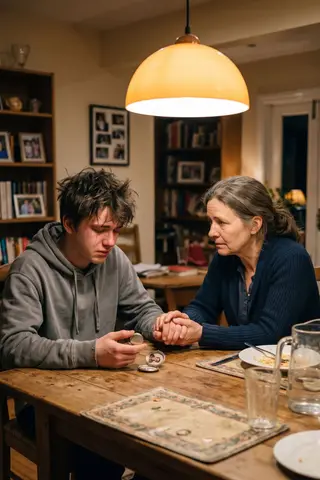
Yet, underneath the calm surface, there were subtle cracks I should have noticed sooner. Sometimes, late at night when the house was dead quiet, I would wake up and hear floorboards creaking upstairs. I’d get up to check, peering down the hallway, and find Luke sitting at the top of the stairs in the dark, staring out the high window into the empty street, clutching something small in his clenched fist. When I asked him what was wrong, he would quickly tuck his hand into his pocket, smile a tight, strained smile, and say, "Just couldn't sleep, Mom. Everything's fine. Go back to bed."
I trusted him. I loved him. I believed that love, time, and stability were finally working their quiet magic, healing the deep wounds left behind by a broken foster care system.
I had no idea that the calm was only the eye of a hurricane, and that the ground beneath our feet was about to split wide open.
The End









