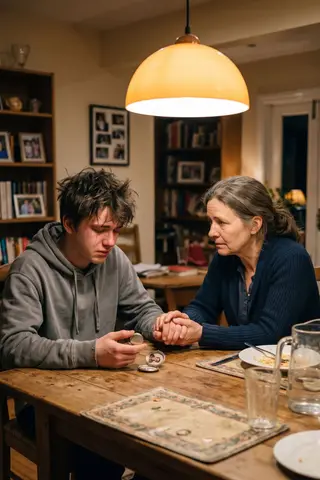
 Adopted The Boy 10 Families Abandoned
Chapter 1
The Silence After The Storm
Three years had bled into one another, leaving behind a hollow echo that still haunted the hardwood floors of my home. If you listened closely enough during the dead of night, you could still hear the faint clatter of cereal bowls from the kitchen, or the muffled sound of teenage laughter spilling out from the hallway upstairs. But the noise was a ghost. Maya and Leo had been gone for thirty-six months, snatched away in a fraction of a second on a rain-slicked interstate by a semi-truck that ran a red light.
The funeral had been a blur of black umbrellas, weeping neighbors, and a suffocating, heavy fog that seemed to settle permanently over my chest. For the first year, I barely functioned. I lived on black coffee, cold toast, and the fading scent of laundry detergent lingering on their jackets in the front closet. Friends dropped by with casseroles, offering platitudes that felt like salt in an open wound. "Time heals all wounds," they said. "You're a strong woman," they whispered. But strength isn't something you choose; it’s a heavy winter coat you are forced to wear when you’re freezing to death, whether it fits you or not.
By the second year, the grief morphed into something even more terrifying: profound, deafening silence. The house was too clean. The mail carrier stopped leaving flyers because he knew no one was responding. The refrigerator hummed a lonely tune in the kitchen, and every room upstairs remained exactly as they had left them—beds made, posters of bands taped to the walls, textbooks stacked neatly on desks. Walking past those closed doors felt like holding my breath underwater. I would stand in the hallway, my hand hovering over the doorknob of Leo's room, waiting for the oxygen to run out.
Friends eventually stopped calling as frequently. People grow tired of grief; it makes them uncomfortable, reminding them of the fragile thread by which we all hang above the abyss. They wanted the old Sarah back—the cheerful, smiling woman who organized bake sales and volunteered at the community center. But that Sarah was buried six feet deep under two polished headstones.
It was a Tuesday afternoon when the breaking point finally arrived. I was sitting at the kitchen table, staring blankly at a dust mote dancing in a stray shaft of sunlight, when I realized I hadn't spoken a single word out loud since Sunday morning when I answered the phone for a telemarketer. My own voice had become a stranger to me. If I stayed in this house much longer, breathing in the preserved memories of a life that was dead and gone, I was going to lose my mind entirely.
I needed a change. Not a vacation—vacations end, and you have to come back to the wreckage. I needed a purpose. I needed a living, breathing soul in this mausoleum to remind me what it felt like to care for someone, to cook a hot meal, to hear footsteps echoing down the stairs that weren't just the phantom whispers of my imagination.
The next morning, without giving myself time to overthink it and talk myself out of it, I drove down to the county foster care agency. The building smelled of floor wax, old paper, and institutional coffee—a sterile, melancholy aroma that immediately set my nerves on edge. A receptionist with tired eyes and a name tag that read "Brenda" pointed me toward a large, sunlit multipurpose room where children of various ages were being supervised by caseworkers.
Most of the younger kids were clustered around a low table, aggressively coloring outside the lines of various cartoon books or wrestling over plastic building blocks. Their laughter was bright and sharp, cutting through the heavy air of the room. But away from the chaos, sitting quietly near a tall frosted window, was a teenage boy.
He had a thick paperback book resting flat on his knees, though he wasn't reading it. His gaze was fixed outside, watching the autumn leaves swirl across the parking lot. He looked about sixteen, with messy dark hair that fell lazily across his forehead and broad shoulders that carried a slouch of profound resignation. He wore a simple gray hoodie that was a size too big for him.
As I watched, a little girl sitting a few feet away reached for a box of crayons, her elbow catching the edge of the table. A rainbow cascade of wax tumbled across the linoleum, rolling under chairs and scattering in every direction. The little girl's lower lip quivered, and she looked ready to burst into tears.
Without a word, without sighing or showing the slightest bit of annoyance, the teenage boy folded his book, set it gently on the windowsill, and knelt on the floor. With methodical precision, he crawled around collecting every single stray crayon, matching them to their proper box, and handed them back to the girl with a soft, reassuring nod. She smiled through her tears, and he simply patted her head before returning to his seat, picking up his book right where he had left off.
Something in my chest—a muscle that had felt completely dead for three years—twitched.
I stood up from the hard plastic chair in the waiting area and walked over to Brenda, who was tapping furiously away at an ancient desktop computer.
"Excuse me," I said, my voice sounding rusty from disuse. "Who's that boy sitting by the window?"
Brenda paused her typing, glanced up over her wire-rimmed glasses, and squinted toward the corner of the room.
"That?" she asked, her tone dropping into a guarded flatline. "Oh, that's Luke."
She shook her head slowly, a gesture full of practiced exhaustion. "No, honey. You don't want to look at Luke. Trust me."
Something about the dismissive, clinical way she said it rubbed against my grain. It felt unfair, judgmental, and entirely too quick.
"Why not?" I asked, crossing my arms over my chest.
Brenda lowered her voice, leaning conspiratorially across the counter as if sharing classified government intelligence. "He's been placed with ten families in the last four years."
I stared at her, stunned. The numbers refused to compute in my brain. "Ten?"
"TEN," she repeated, ticking them off on her fingers. "Some kept him for a few months. Others barely lasted two weeks. But he always comes back. He ends right back up in our intake system like a bad penny."
She paused, offering a tight, cynical smile. "He's complicated."
That word hung in the air between us like a foul odor. Complicated.
The label struck a nerve so deep it made my teeth ache. Years earlier, after their father passed away from a sudden aneurysm, my own son Leo had teachers call him "difficult" and "withdrawn." He had stopped playing soccer, spent hours staring out his bedroom window, and refused to talk about his feelings. People had looked at him with pitying, uncomfortable eyes, slapping convenient diagnostic labels on a grieving child because they didn't have the patience to sit with his pain. I knew firsthand how much brilliance, kindness, and desperate need for love could hide behind one convenient, dismissive label.
"I'd like to meet him," I said quietly.
Brenda blinked, her eyebrows shooting up toward her hairline. "Mrs. Miller, you didn't hear me. He's a revolving door. He pushes people away. He's got an attitude problem, or behavioral issues, or—"
"I heard you just fine," I interrupted, my voice hardening with an authority that surprised even me. "I said I want to meet him."
Brenda sighed, shrugged her shoulders, and muttered something under her breath about stubborn women learning the hard way. She gestured toward the corner. "Go ahead. But don't say I didn't warn you."
I walked across the scuffed linoleum floor, my footsteps echoing in the large room. As I approached his chair, the boy looked up. The moment our eyes met, he didn't slouch further down or look away with sullen teenage defiance. Instead, he immediately stood up, his tall frame unfolding smoothly, and looked down at me with an expression of polite, guarded deference.
"Please, ma'am," he said, his voice deep and surprisingly smooth. "You can sit here."
He gestured to the chair he had just vacated, stepping back respectfully.
That wasn't what I'd expected from a boy ten families had given up on. The "troubled, impossible" teenager Brenda had described wouldn't have offered an older woman his seat; he would have scowled and turned his back.
Neither was Luke what I expected. Over the next few weeks of supervised visits, weekend outings, and afternoon talks, I discovered a young man who was fiercely intelligent, surprisingly articulate, and possessed a dry, self-deprecating wit that made me laugh out loud for the first time in years. We spent nearly an entire Saturday afternoon arguing passionately over the philosophical implications of the ending of the novel he had been holding—The Count of Monte Cristo—each of us defending our interpretation of justice and mercy with the vigor of trial lawyers.
I kept coming back. Weeks bled into months. The afternoon visits turned into weekend sleepovers, and the weekend sleepovers turned into a permanent rhythm of life. The more time I spent with Luke, the less I understood the warnings that had been whispered behind his back by social workers and cynical foster parents.
Eventually, the choice became crystal clear. The house was no longer a silent mausoleum; it was a home again. And I knew, with every fiber of my being, that I wanted this boy to be my son.
The End









