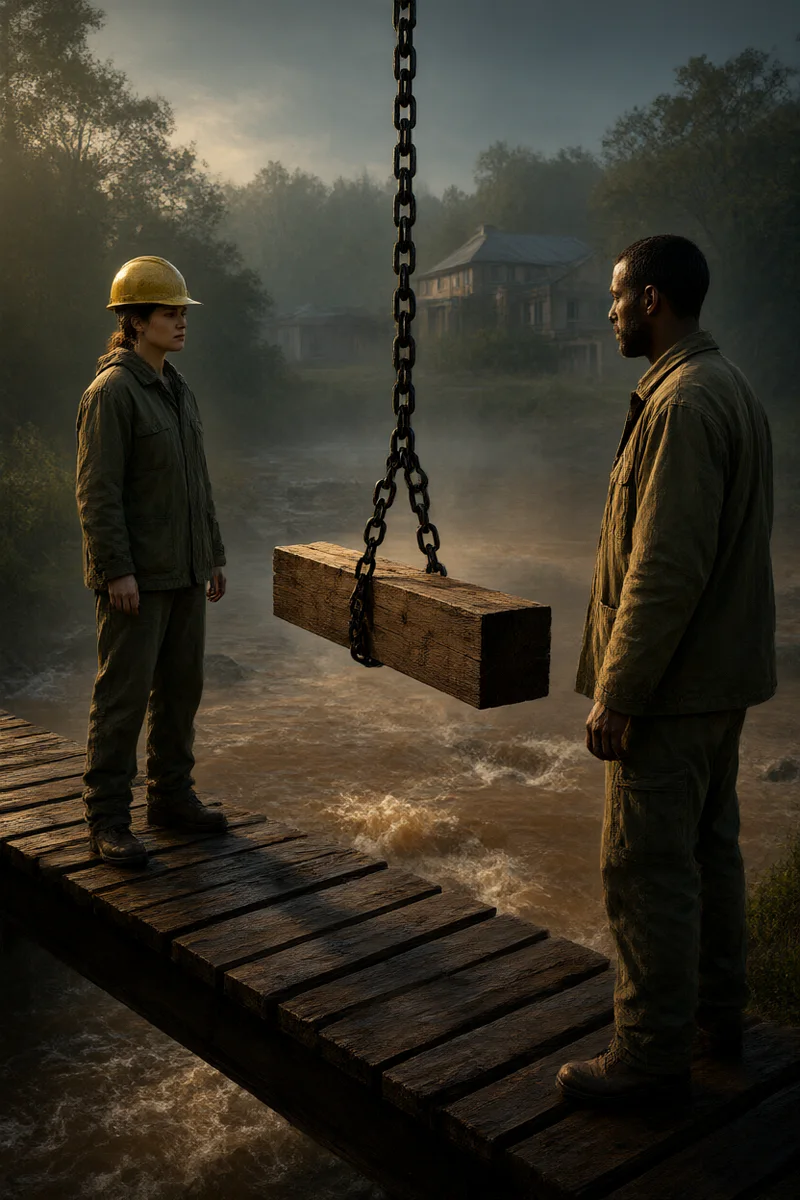
 The Span
Chapter 2
Glulam and Green Oak
“You might have said,” she told him at seven the next morning, on the Millside bank, in a wind that cut through the fleece.
“Everybody in that hall knew.” He was measuring between the abutments with a tape and a boy of about seventeen holding the other end. “It's only you that's new.”
“It's a conflict of interest.”
“It's a bridge,” Rune said. “I'd like it back.”
They disagreed about everything for the first four days.
He wanted green oak throughout, because oak was what he knew and what the old bridge had been. She wanted engineered laminated beams for the two main stringers, glued and graded and sent with a certificate, because a certificate was a number she could put in a calculation. He said glulam was plywood with ambitions. She said his oak was a tree with an opinion.
He cut joints by eye, and they were perfect, and she made him measure them anyway. She drew everything at the kitchen table of her rented flat until one in the morning and he looked at her drawings, very slowly, and found a dimension she'd transposed.
In the end they compromised. Two glulam stringers, the last pair of that length in the yard of a mill in the next county, delivered on day six. Oak for everything else: deck, posts, rails, the cross-bracing that he cut and pegged on trestles in the field beside the river while she checked each piece with a moisture meter.
The volunteers came every day after work and all weekend: a retired plumber, two sisters who did fencing, the seventeen-year-old, whose name was Callan and who did whatever Rune did a second after Rune did it. Rune's daughter Ottilie, twelve, took the tea orders in a notebook and corrected people's spelling of their own names.
“She's on the bus,” Rune said once, when Dagny asked. “Forty minutes each way. She reads the whole time. Gets off looking grey.”
On the eighth day it rained, and they sat in his van with the windows steaming while it came down on the half-poured footings. He offered her his flask. She took it and noticed that he had remembered she didn't take sugar.
“Why did you call me County in front of everyone yesterday?”
“Because you call me Mr Halloway in front of everyone.”
“That's your name.”
“That's my dad's name. He's dead.” He looked at the rain. “Rune'll do. I won't break.”
She tried it. It came out awkward. He smiled at the windscreen.
On the ninth day, when the river had dropped again, he asked her to come down to the bend below the weir. He wouldn't say why.
There was a shelf of gravel there that the flood had built, and on it, half buried, was a blackened chunk of timber nearly two metres long, with a steel plate still bolted to one end. Dagny knew what it was before she was close. The east bearing beam. The piece that sat on the abutment and carried one end of the whole span.
Rune crouched beside it and pushed a screwdriver into the wood at the bearing end. It went in to the handle without any effort at all, like going into cake.
“Wet rot,” he said. “Years of it. That's why she went. Not the truss, not the flood on its own. The bearing let go and the span dropped into the water and the water took it.”
He looked up at her.
“Your inspection report from two years ago says the east bearing was sound,” he said. “I'd like to know how you got that.”
The End









