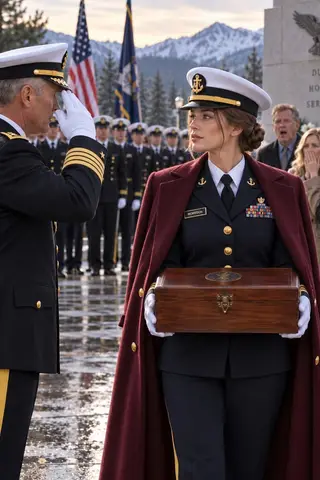
 Thrown Out on Christmas Morning, She Brought a Box to the Fort
Chapter 2
The Legacy of Colonel Walter Palmer
My grandfather, Colonel Walter Palmer, was the only person in my entire family lineage who truly understood the weight of the path I had chosen. He had served more than thirty years in the United States Army, earning a chest full of ribbons and commendations that he kept tucked away in a dusty cigar box rather than proudly displayed on his living room wall. Even long after his retirement, mysterious things used to happen at his secluded farmhouse outside the city.
I remember visiting him during my college years and watching unmarked government sedans—cars with heavy tinted windows and obscure license plates—pull up quietly down his long gravel driveway. Men and women with stars on their shoulders, wearing sharply pressed uniforms or plain civilian suits, would step out and disappear behind closed doors with him for hours at a time. When they emerged, they looked grave, respectful, and entirely transformed by whatever intelligence or counsel my grandfather had provided.
My family never cared about any of it. To my father and mother, Walter was simply an eccentric old soldier who lived too far away and refused to integrate into modern polite society. They viewed him as a relic of a bygone era, someone whose military pension was too small and whose lifestyle was too rustic. They barely visited him, and when they did, they treated his stories with thinly veiled boredom.
To me, however, he was the anchor of my universe. He was the reason I enlisted on my eighteenth birthday, bypassing the Ivy League scholarship my parents had endlessly bragged about to instead walk down to the recruitment office. Grandpa Walter didn't just teach me how to shoot or how to read a map; he taught me how to observe, how to calculate risk, and how to carry a burden that nobody else could see.
When he passed away peacefully in his sleep eight months prior to that snowy Christmas morning, the grief had hit me like a physical blow. But his passing also brought a quiet administrative shift. A week after the funeral, a stern-looking civilian attorney in a charcoal suit had tracked me down at my base and handed me a heavy, hand-carved mahogany box.
"Your grandfather’s instructions were very specific," the attorney had said, his voice dropping to a near-whisper as he handed me the box across a quiet corner of a diner. "He ordered that this go exclusively to you, Captain Palmer. No one else."
I had taken the box back to my quarters and examined it closely. It was crafted from dark, dense mahogany, polished to a dull sheen, with intricate, interlocking geometric patterns carved by hand into the wood. But what caught my eye immediately was a heavy brass latch secured by a combination lock, and resting right on top of the lid was a plain white envelope bearing my name in my grandfather’s shaky, deliberate handwriting. Across the front of the envelope, underlined twice, were words that had echoed in my mind ever since:
OPEN ONLY WHEN YOUR FAMILY SHOWS YOU WHO THEY REALLY ARE.
For eight months, that box had sat untouched in my quarters, a silent sentinel waiting for a moment of absolute clarity. Sitting in my battered, salt-stained Honda Civic with the heater wheezing weakly against the freezing morning air, I finally looked over at the passenger seat. The mahogany box was resting securely right there beside me, buckled in with the seatbelt as if it were a fragile passenger.
As my parents' house faded into the distance behind a veil of falling snow, I knew the condition had been met. They had shown me exactly who they were. And now, it was time to find out what Grandpa Walter had left behind.
The End









