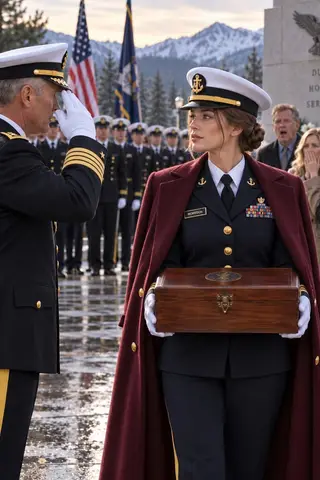
 Thrown Out on Christmas Morning, She Brought a Box to the Fort
Chapter 1
The Cold Christmas Porch
The snow was falling in heavy, silent flakes over the manicured lawns of my parents’ suburban home, turning the pristine neighborhood into a winter postcard. But on the front porch, the atmosphere was biting, bitter, and entirely devoid of warmth. My suitcase sat on the frozen wood between my boots, a battered nylon bag that had accompanied me across three continents and countless deployment zones. It looked entirely out of place against the festive evergreen wreath hanging on the front door.
"You’ve embarrassed this family long enough, Fiona," my father snapped, his breath pluming in the freezing air like white smoke. His face was flushed, partly from the cold, but mostly from the quiet, simmering rage he had harbored toward me for over a decade. To him, my career in the United States Army wasn’t a service to the country; it was a personal insult, a stubborn refusal to fit into the polished, corporate mold he had designed for his children.
Behind him stood my mother, her arms tightly crossed over her chest, a picture of disappointed disapproval. "Your sister is getting engaged tonight," she said, her voice dripping with martyrdom. "We have guests arriving in a few hours, important people from Arthur’s family. We didn't need your sullen presence or your negativity ruining Christmas."
I looked past them toward the warmth of the hallway, where the scent of baking cinnamon and roasting turkey drifted faintly through the partially open door. Just then, my sister Savannah appeared in the entryway. She was wearing a stunning red cashmere sweater that practically screamed luxury, a glass of morning champagne already in her hand. She took a slow, deliberate sip, her eyes locking onto mine with undisguised contempt.
As Dad gave my suitcase one final, aggressive shove toward the edge of the porch, Savannah raised her champagne glass mockingly in the air. "Back to your barracks, loser," she laughed, her voice clear and bright, ringing out like a small bell of cruelty in the quiet morning.
I didn't flinch. I didn't yell, and I didn't beg. For eleven years, I had served in the United States Army as a Captain, handling pressure that my family couldn't even begin to comprehend in their sheltered, comfortable lives. They knew I wore a uniform, of course. They knew I disappeared for months at a time on deployments, training exercises, and assignments that I rarely discussed due to strict operational security. What they didn't know—what they were entirely incapable of understanding—was what I actually did when I put on that uniform. They thought my silence meant failure. They thought my lack of corporate ambition meant I had amounted to nothing.
They conveniently forgot a few minor details. Like the fact that I had quietly paid for my mother’s expensive heart medication for the past two years when her insurance fell short. Or the fact that just three weeks earlier, Dad had called me in a panic, whispering desperately for a $4,000 loan because his manufacturing business was teetering on the edge of bankruptcy. I had wired the money within ten minutes, taking it straight out of my personal savings without asking for a single signature or charging a cent of interest.
Now, standing on their porch in the freezing snow, watching them slam the heavy oak door in my face, I realized just how thoroughly I had misinvested my loyalty. But I wasn't angry. As the heavy lock clicked into place inside, I felt an odd, crystal-clear sense of calm wash over me.
Years ago, my grandfather, Colonel Walter Palmer, had given me a piece of advice that had kept me alive in combat zones and sane in the military bureaucracy. "Fiona," he had told me on the porch of his old farmhouse, his faded blue eyes sharp as broken glass, "when people mistake your silence for weakness, let them. Never waste your ammunition explaining yourself to people who are determined to misunderstand you."
The End









