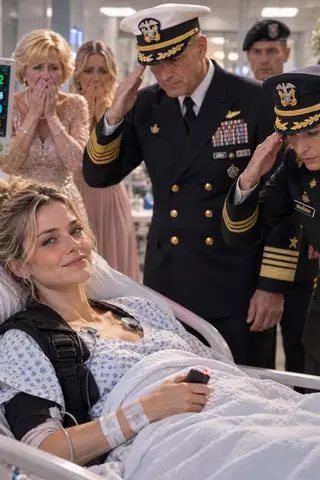
 THEY LEFT HER TO DIE FOR A WEDDING: Secret Operant Bleeds Out in ER
Chapter 1
The Descent
The hum of the emergency room fluorescent lights felt like needles being driven straight into my temples. My vision narrowed down to a single, pulsing point of light while the world around me dissolved into chaotic static. A persistent, high-pitched ringing drowned out the muffled shouts of nurses and the frantic clatter of medical carts rolling down the linoleum corridor. My breathing came in short, shallow gasps, each inhalation tasting faintly of copper and cold iron.
Just minutes ago, the monitor beside my bed had been beeping in a steady, agonizingly slow rhythm. Now, the space between those electronic pulses stretched longer and longer, hovering on the terrifying precipice of an uninterrupted, catastrophic tone. My fingers, resting limp against the stiff hospital sheet, felt as though they had been dipped in ice water. The numbness was creeping steadily up my arms, a physiological warning sign I knew all too well from tactical survival manuals. I was going into hemorrhagic shock.
Yet, despite the organ-failing agony wracking my core, my mind remained bizarrely, chillingly sharp. The training kicked in, stripping away the panic of the civilian world and replacing it with pure, mechanical calculation. I could picture the exact layout of the room, the position of the nurse's station, the swinging doors leading to the trauma bay, and the precise location of the reinforced lining inside my dark tactical jacket draped over the plastic visitor's chair.
My mother’s parting words echoed through my fading consciousness, sharp and venomous enough to cut glass. “We are not authorizing thousands of dollars in unnecessary testing because she wants attention before her sister’s wedding.”
Those words hadn't just stung; they had sealed a death warrant. My own mother, standing alongside a father who cared more about corporate stock portfolios and wedding expenses than human life, had signed an AMA—Against Medical Advice—refusal form to discharge liability and clear the path back to their picture-perfect society celebration. They had abandoned me on a gurney with a leaking spleen, internal hemorrhaging, and a collapsing blood pressure cuff while they hurried back to velvet chairs, champagne flutes, and expensive canapés.
Nurse Claire, her face pale with helpless fury, leaned over my bed, her hands pressing desperately against my cold wrists. Her lips moved, shouting words of encouragement, urging me to stay anchored to the world of the living, but her voice sounded as if it were traveling up from the bottom of a deep, dark well. “Stay with me! Look at me, don’t close your eyes!”
I wanted to tell her it wasn't up to me anymore. My body was shutting down. The trauma sustained during my final extraction in a hostile foreign territory had finally caught up with me, exacerbated by the heavy boxes of crystal and wedding shoes my sister Jessica had forced me to carry up the grand staircase just hours earlier. Jessica hadn't cared when I stumbled. She hadn't cared when blood soaked through my shirt and stained the pristine hardwood floor of the family estate. To them, my medical leave was an inconvenient theatrical performance designed to steal the spotlight from the golden child's wedding weekend.
Well, the performance was over. The curtain was about to drop on the entire facade.
Gathering every remaining shred of adrenaline, I ignored the white-hot agony tearing through my abdomen and forced my right hand to move. Inch by agonizing inch, I dragged my arm across the mattress until my fingertips brushed the coarse fabric of my jacket. I hooked my index finger beneath the heavy-duty zipper of the secret inner pocket—a compartment specifically engineered to remain undetectable during pat-downs and standard security screenings.
My fingertips grazed the smooth, brushed titanium surface of the device. It was a compact, flat emergency beacon, roughly the size of a credit card, bearing no labels, logos, or serial numbers. It didn't rely on local cell towers, Wi-Fi, or commercial satellite networks. It transmitted on an encrypted military frequency straight to a dedicated tactical operations hub, broadcasting a high-priority distress signal tied directly to my operational clearance level.
There was no cancel button. No secondary confirmation prompt. Once the seal was broken, the machinery of the federal defense apparatus would swing into motion with absolute, unyielding precision.
My vision flickered completely black for a terrifying heartbeat. The monitor beside me gave a long, mournful stutter.
Click.
I pressed the recessed activator button with all the remaining strength in my failing muscles. The internal mechanical seal snapped open with a faint, satisfying pop.
For one fleeting second, nothing happened. The hospital hummed its monotonous, sterile tune. Nurse Claire gasped as she glanced up at the cardiac monitor.
Then, the rhythmic green blip vanished. The screen transformed into a solid, unyielding horizontal line.
A single, continuous tone cut through the air. Flatline.
The End









