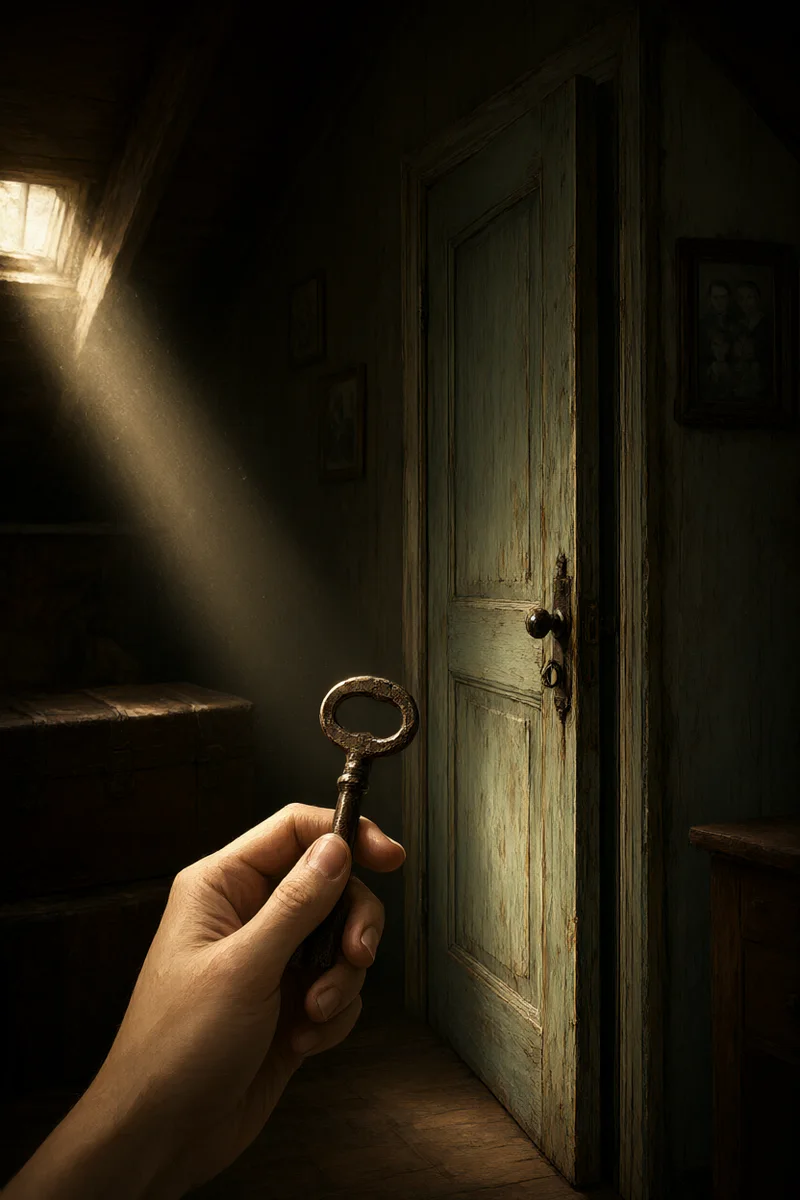
 The Rusted Key
Chapter 5
What She Opens
The date was nineteen years old.
It had been signed and notarized eight days after Gilbert Ashby's funeral, in a lawyer's office three hours from anyone who knew the family. Ellie had been fifteen. She had been living in another state, with braces, and had visited Calloway Street twice a year.
“You would have had to exert your undue influence by postcard,” Ms. Idris said. Preston opened his mouth, and for once nothing came out of it.
The letter explained the rest. Ellie read it aloud, because Blair asked her to.
“At your grandfather's funeral, eleven people told me what a loss it was to literature. You were fifteen and bored and eating a ham roll, and you said to me, ‘It's funny Grandpa never knew how his own books ended. He always had to ask you at dinner.’ You were the only person in forty-five years who noticed. I went to a lawyer the following week.
“I did not tell you, and when I fell ill and you came, I still did not tell you. I wanted to know who would come if there were nothing to come for. That was an unkind test, and I knew the answer before I set it. Forgive an old plotter her habits.
“The others have what Gilbert's name earned. I have left you my own. Finish the book. You have already done the difficult half.”
Nobody spoke. The locksmith, who had no reason to still be there, blew his nose.
Preston left first. He said his lawyer would be in touch, and his lawyer was, once, in a letter that ran to one paragraph and withdrew everything.
Blair stayed. She stood in the shed doorway for a while with her arms crossed, reading the grease-pencil years.
“She never asked me what I'd do if I were her,” she said. “Not once.” Then, before Ellie could find an answer to that, she bent and looked under the floor joists, and her voice changed back to the one she used for closings. “This thing's on skids, you know. It isn't a fixture. It doesn't convey with the house.” She straightened up. “Get a flatbed in before the first and I never saw it.”
It was the nearest Blair came to saying it, and Ellie took it.
The shed went to a rented lot behind a duplex across town, and Ellie went with it. She wrote from six until ten, in the cardigan. It was slow. She threw away most of what she wrote in March. But she knew what Bess opened; she had said it over a bowl of soup in June, and Gran had laughed until she coughed.
Bess opened the old man's own desk. The poisoner across the street was nobody. Marlow had known for forty pages that he was dying, and had invented one last case so that someone would sit and talk with him in the evenings.
The publisher wanted Gilbert's name on the jacket. They had figures to show what it was worth. Ellie said they were welcome to publish someone else's book.
The Last Evening of Judge Marlow came out the following autumn. Blair sent a photograph of it in an airport shop, with no message.
Ellie kept the first copy on the desk beside the typewriter, open to the title page, where the name everyone expected did not appear at all. It read: by Cordelia Ashby. And beneath, smaller, at Ellie's insistence and over the publisher's objection that nobody would know who she was: with Eleanor Ashby, who was asked.
The End









