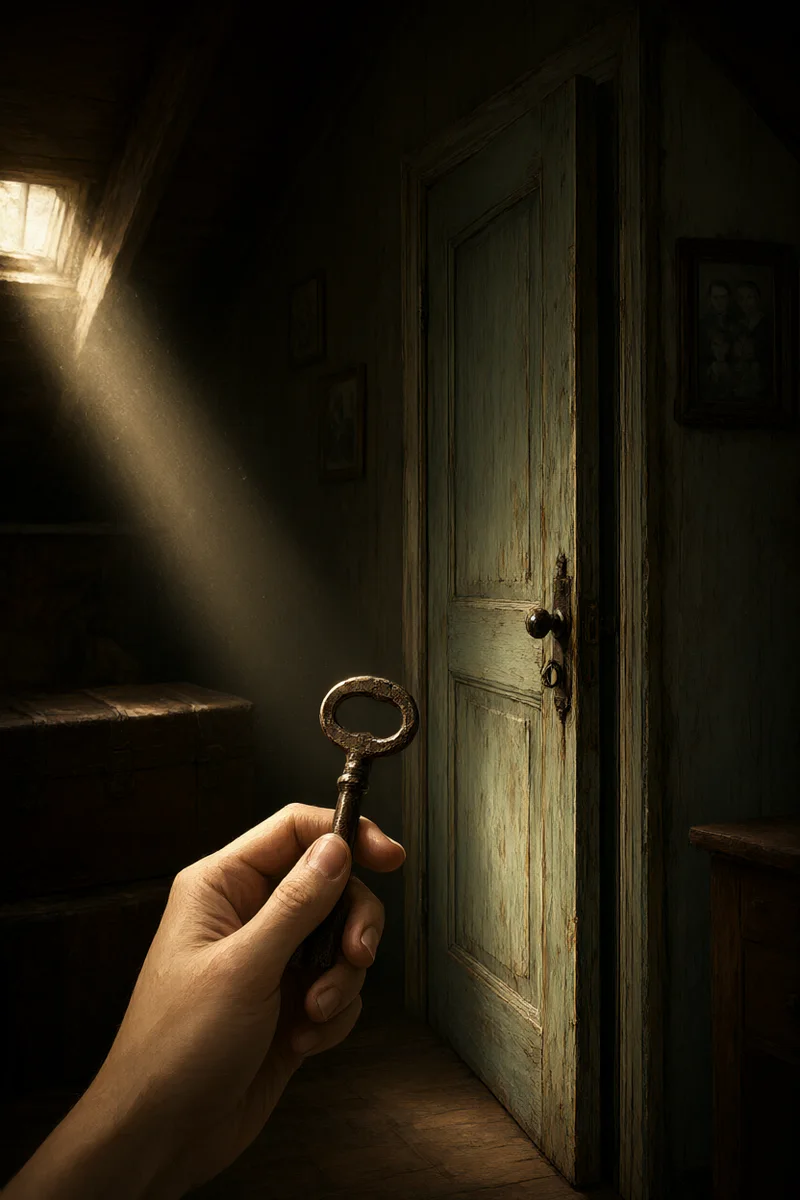
 The Rusted Key
Chapter 1
One Line
Ms. Idris read the will the way she might have read a train timetable, and for eleven minutes that suited everyone at the table.
Preston got the lake house at Tamsin Point, with the dock and the boat. Blair got the brick house on Calloway Street and everything in it. The investment accounts, which Ms. Idris described as “substantial” without looking up, were to be divided between the two of them.
Preston squeezed his sister's shoulder. Blair was already writing a figure on the back of her parking stub.
Ellie sat at the far end with her hands around a paper cup of water. She had on the navy dress she'd worn to the funeral, because it was the only one that didn't smell faintly of antiseptic hand gel.
For two years and three months she had slept in the room next to her grandmother's on Calloway Street. She had learned to crush pills into applesauce and to tell, from the hallway, the difference between a cough and a bad cough. She had given up a job at a dental practice and a one-bedroom with a balcony. She had nineteen hundred dollars in checking.
“And to my granddaughter Eleanor,” Ms. Idris read, “who knows where everything is: the enclosed, and my note.”
She slid a small brown envelope down the length of the table. It skated past Preston, who watched it go.
Inside was a key. It was the old kind, a barrel key as long as Ellie's finger, orange with rust that came off on her palm. There was a card too, in her grandmother's upright fountain-pen hand.
Ellie—it opens the only thing I ever really owned. Start at the bottom.
“Is that it?” Preston leaned over to look, and laughed, not unkindly enough. “Two years of bedpans for a key. Gran always did have a sense of humor.”
“Preston,” Blair said, without heat. To Ellie she said, “You can stay on at the house through the end of the month. I've got the stagers coming the first.” She said it like a favor and it was, technically, one.
“Thank you,” Ellie said, because Cordelia Ashby had raised her to say it.
She tried the key that night in every lock on Calloway Street. The cellar door. The cedar closet. The glass-fronted cabinet of Grandpa Gilbert's first editions, all twenty-three Judge Marlow mysteries, the books that had bought this house and the lake house and Preston's teeth. It fitted nothing. It was too big for furniture and too crude for a door.
Near midnight she sat on the back steps and turned it over under the porch light. Rust. Nothing kept indoors rusted like that.
At the bottom of the garden, behind the dahlia beds gone black with frost, stood the potting shed. It had been padlocked for as long as Ellie could remember. Gran had gone down there every morning of her life from six until ten, in a man's cardigan, and come back with clean fingernails.
Ellie had noticed the fingernails when she was small and had never thought to wonder.
The grass soaked her socks. The padlock was a brute, old iron, and the key went into it as though it had been expected. It turned with a sound like a cleared throat.
She pulled the door open and found the light cord by feel.
There was not one flowerpot. There was a desk under the window with a black typewriter on it, a kitchen chair with a cushion worn to the shape of one person, and along the back wall, floor to rafters, wooden seed crates stacked nine high, every one of them full of paper.
The End









