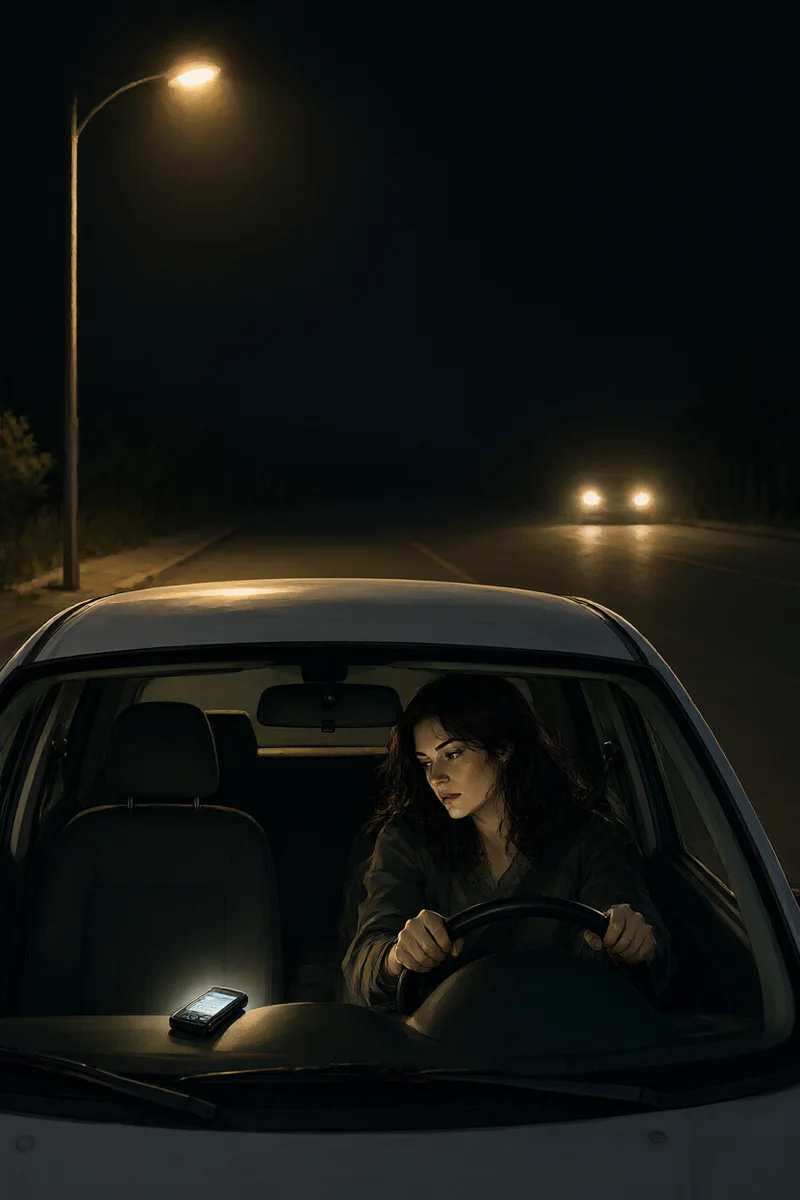
 The Last Fare
Chapter 5
Friday, Ten O'Clock
He stopped at her window: the tan raincoat, the cane, the same mild face that had worried about rain. He held out his hand.
Ronnie kept the phone against her chest. “Tell me what I said to you that night. If you're who you say.”
“Give it here.”
“I'm going to lie to a law student on Friday. I want to know I'm lying for the right man.”
He considered her. She saw that the question pleased him. Nobody had asked him about it in eleven years.
“You said, it's on a timer, I swear to God, it's on a timer. And you had one earring in. A little gold hoop. I wondered about the other one all the way home.”
She had found the other in the lining of her coat, a month after the verdict.
She put the phone in his palm. He pitched it over the rail without looking, and the river was too loud for her to hear it land.
Then a voice came up out of the door pocket, small and flat. “Ronnie, this is county dispatch. Stay in your car and lock the doors. They're at both ends.”
He looked at the door pocket. He looked at her, with the expression of a man who has been handed the wrong change.
No sirens. Two sets of headlamps came on at the far end of the bridge and one behind his car. He didn't run. There is nowhere on a one-lane bridge to run to, and he had a bad hip. He hooked the cane over his forearm and stood with his hands held out from his sides, already looking like somebody's uncle put to a lot of trouble over nothing.
The dispatcher's name was Gloria. She had been on the line for twelve minutes, and she stayed on it until a deputy knocked on the glass.
On Friday at ten, Ronnie climbed the stairs to a room over a credit union that smelled of toner. Priya Nair had a recorder on the table. At the far end sat a man nobody had told her would be there. Curtis Boyle was thirty-five now, with gray in his beard, and he kept his hands flat on the table.
She told it from the start. The scarf that stayed put. The six photographs, and the detective who said “good girl.” Twelve minutes of recording, and Dennis Garrow, who had delivered bread to the Starlite for six years and had been charged on Wednesday.
Priya said, carefully, that the state might want to look at her original testimony. Ronnie said she knew.
Boyle hadn't moved. “I had a speech,” he said. “Eleven years, you get it pretty well polished.” He looked at her for a while. “You were nineteen. They put six pictures in front of you and told you well done. I've had time to work out who I'm angry at. You're on the list.” He turned his hands over. “You're not at the top.”
“I'm sorry” was the only thing she had brought, so she said it. He didn't tell her it was all right.
“He rode in your car? Talked the whole way?”
“Twenty-two minutes. And I didn't know him.”
Boyle made a sound that was close to a laugh. “He delivered on my mother's street. I must have walked past that van a hundred times.”
The statement ran to four pages. She signed each one with the whole of it, Veronica Marie Kowal, the way it had been said to her in the dark.
Then she went down to the car, clipped the camera back onto its bracket, and turned the app on.
The End









