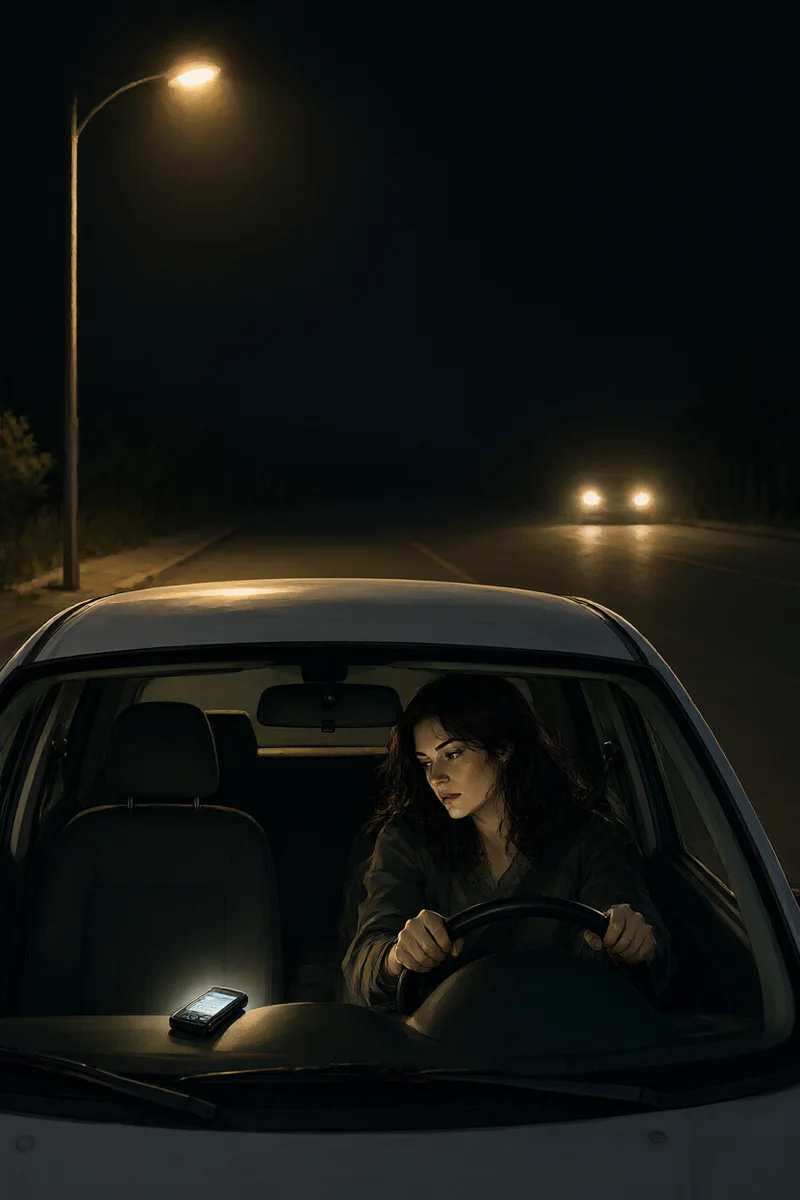
 The Last Fare
Chapter 4
The One-Lane Bridge
“I talk when I'm scared,” Ronnie said. “Read the transcript. The prosecutor had to tell me twice to just answer the question.”
The line hissed. She watched the mirror.
“He did, at that,” the man said. “I was in the third row, the second day. I'd brought a sandwich.”
He had sat and eaten lunch while she pointed at Curtis Boyle. She filed it with the rest; there would be time for it later or there would not.
Under the chamois the second phone gave her nothing. No light at its edges. It might be a dial tone down there, or a call-taker asking a cloth to state its emergency, or a line that had dropped a mile ago. She had no way to know.
But if someone was listening, they had come in late. They had a bread man and a safe. They did not have the scarf, and they did not have her. Nothing on that line yet made Curtis Boyle innocent.
“You want me to say on Friday that the scarf slipped,” she said.
“I do.”
“It didn't. You're right. I never saw a face. I saw a hood and a gray scarf, and three days later they showed me six photographs, and I picked the man I'd watched shouting at the lottery machine that night.” Her voice was steadier than her hands were. “I said I knew the voice because I wanted to know it. I've never told anybody that.”
“Well, don't make a habit of it.”
The river had come in close on the left, wide and black, giving back nothing. Reflector posts went by. A yellow sign came up out of the dark: ONE LANE BRIDGE. YIELD TO ONCOMING TRAFFIC. There was no oncoming traffic. There had not been another car since Delmar.
“Stop in the middle,” he said. “Window down.”
“Why?”
“Because that phone beside you is the only thing in the world with the two of us on it, and it's going in the river. I'd like to watch it go.”
The bridge was an old steel truss with an open grid deck, and it sang under her tires. She stopped at the midpoint. When the window came down the cold came in with the sound of the water, a long way below and moving fast.
She picked up the flip phone and held it out over the rail.
“Not yet,” he said.
His headlights closed up behind her until they filled the mirror, and stopped a car's length back. The engine cut out. The lights stayed on. She saw the driver's door swing open.
“I've changed my mind,” he said, and now she heard him twice, from the seat beside her and from the night. “I'll take it from you myself. I'd like one look at you without a mirror in the way.”
The cane came down on the steel grid. Tap, and a step. Tap, and a step.
Birch Lane was two minutes ahead, with the porch light on. The far end of the bridge stood open and empty. Ronnie lifted her foot off the brake and felt the car begin to roll.
She thought about Friday. Then she put her foot back down and shifted into park.
The End









