 The Page I Kept
Chapter 4
The Recorder's Office
I did not cry in front of him. I cried on the Number 6 bus, quietly, with my face against the window, and when I got off on Fennick Street I was done with it.
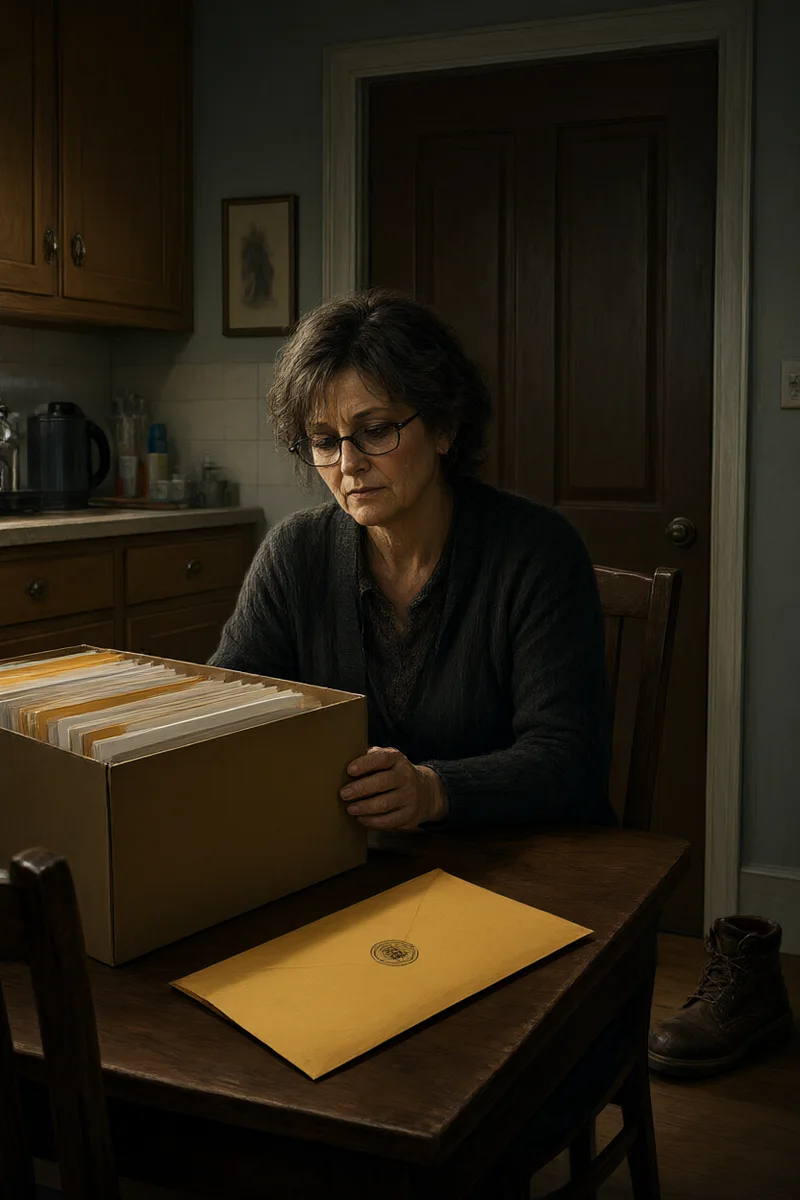
Two hundred and eleven letters. I had numbered them. My mother had paid for the stamps until she died in my third year; after that, I paid for them out of fourteen cents an hour.
Anselm Pardo found me in the back at four, matching socks from the lost-and-found bin with a ferocity he noticed. "You can go home early," he said. I said I'd rather fold. "Then fold. But fold my sheets, not my socks. The socks don't owe you anything."
What I could not get from Fitzroy, I could get from the county. That was the first thing the accounting program had taught me, under all the debits and credits: money always leaves a footprint, and most footprints are public.
On my Tuesday off I signed out of Abernath House at eight, took the bus to the Haskett County courthouse, and spent five hours at a terminal in the recorder's office with a legal pad.
The lake house on the point had been bought thirty-one months ago by Cardew Shore Holdings LLC. The deed listed a mailing address: 1180 Quarry Road, Suite B. The state business registry, free on the library computer across the street, listed the same address for Cardew Shore's registered agent. And for Haldane Brook Supply LLC, the supplier that never supplied, dissolved eight months after my sentencing.
Suite B was a mailbox store between a vape shop and a tax preparer. I went inside and asked the clerk how much a box rented for, and he told me, and I thanked him and left. Nothing illegal about asking a price.
"You're making a map," Lunetta said that night, looking over my shoulder at the boxes and arrows: loan, operating account, Haldane, Cardew Shore, lake house.
"I'm making a ledger."
"Same thing in here." She lay back on her bed. "My cousin Odell does process serving. If you need somebody to hand somebody something, he's good."
"I don't need to hand anybody anything yet."
On Thursday the envelope from Vellacourt Memorial came to the front desk. Forty-two pages. I read them standing up in the hallway.
Patient: Moira A. Sutton. Procedure: laparoscopic appendectomy. Anesthesia start: 10:18 a.m. Incision: 10:31. Closure: 11:22. Transferred to recovery: 11:40. Patient unresponsive to verbal stimuli until 12:05.
I laid the photocopy beside the anesthesia record on the windowsill. Somebody had typed a six-digit code from my token while I was unconscious on an operating table nine miles away, and the only other person with a key to my desk drawer had driven me to the hospital that morning and kissed my forehead in pre-op.
Hollins had had this page. He had told me it didn't matter.
I made three copies at the library for ten cents each. One went in the Bible. One went in a sealed envelope mailed to myself, so the postmark would date it. The third I kept in my coat.
Saturday morning, at the bus stop across from Kinder Hours, a man in a brown Silverado was parked where he had no reason to park. He had a camera with a long lens resting on the steering wheel, and when I looked straight at him, he did not look away.
The End